
RUDOLF VON ALT
(Austrian 1812-1905)
AVAILABLE WORKS
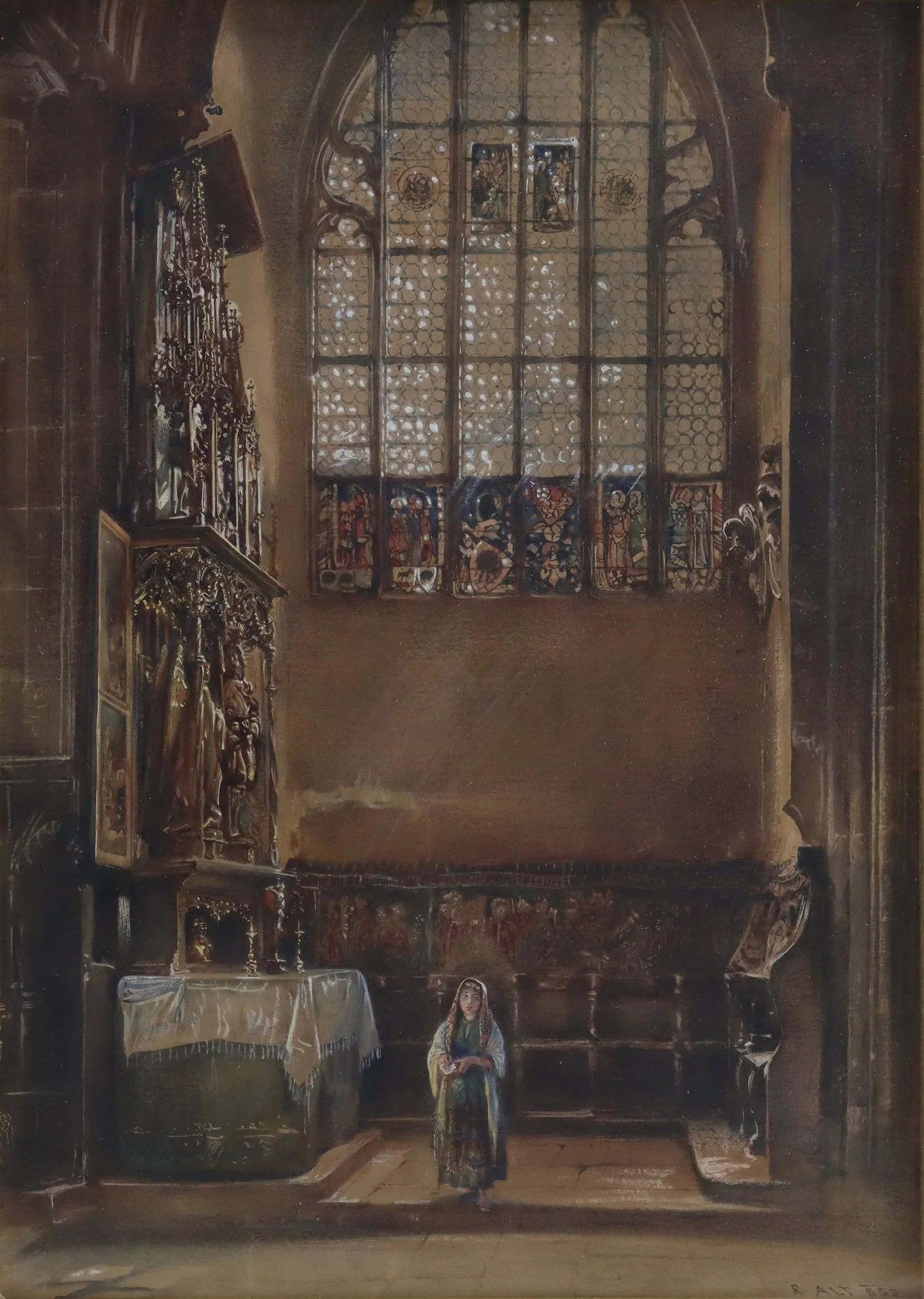
Rudolf Ritter von Alt was born Rudolf Alt in Vienna in 1812, the son of lithographer Jakob Alt (1789-1871) and brother of painter Franz Alt (1821-1914). Rudolf studied at the Academy of Fine Arts in Vienna under landscape artist Josef Mössmer. In 1828 he travelled with his father through Bavaria and Austria to Venice in 1828, followed by annual study trips through Austria and the Crimean Peninsula which continued through most of his life.
Inspired by a trip to Italy including Venice in 1833, Rudolf von Alt painted architectural subjects including everyday objects and interior views which became one of his strong points. He visited and worked in Rome and Naples, then travelled to the lakes of Lombardy, Galicia, Bohemia and Dalmatia, Bavaria, later returning often to Italy many times. While painting on hiking trips through the Austrian Alps and Northern Italy he developed a detailed, realistic style which became very popular.
Portrayals of stately rooms was a fashionable genre in Viennese society, and Rudolf von Alt’s glamorous interiors documented the splendour of the aristocratic palaces of early 19th century Viennese society. His stately interiors were often depicted from a vantage point in the corner of the room, with sunlight falling through tall windows to create subtle reflections on the chandeliers, furniture and flooring. He received many official commissions including Prince Alois II (1796–1858) and his wife, Princess Franziska (1813–1881), who over several decades commissioned von Alt to document their residential palaces, many of which are now housed in the Constantina Museum in Vienna. Additionally, he was chosen by the Austrian government to document their most impressive buildings.
One of the founding members of the Vienna Künstlerhaus, von Alt served as President from 1874. In 1882 he became a nobleman which led to further success amid among nobility and collectors, which added “Ritter” (Knight) to his name. In 1897 he was chosen by his younger peers as honourary president of the newly founded Vienna Secession. Later in life he turned toward a more luminous and impressionistic style. He died in Vienna in 1905. The Albertina Museum in Vienna has held several exhibitions of his work including a major retrospective in 2019.
Rudolf von Alt is considered one of Austria’s greatest watercolour artists and a master in depicting space and light, able to capture the topographical landscapes and architecture of Austria in a detailed, realistic manner. During his eight-decade career, not only did he depict both exterior and interior views of popular castles and noble palaces, but also veduta, buildings and public spaces including the rapid changes in the Viennese cityscape.