
RECENT ACQUISITIONS
PAINTINGS | OBJETS D’ART | ANTIQUE FURNITURE | ANTIQUE SILVER | ETHNOGRAPHIC
PAINTINGS

The Young Mother
oil on canvas, signed lower left "W.P. Frith"
Provenance:
Johnson Art Galleries, Montreal #2746
Uno Langmann Limited, Vancovuer #13352
Private Collection, West Vancouver
One of the most popular artists of the Victorian era, William Frith specialized in precise historical and genre scenes depicting contemporary Victorian life. He was educated in London at Sass’s Academy in preparation for the Royal Academy where he was elected Associate at the age of twenty-five and full member in 1853. He would continue to exhibit at the Royal Academy until 1902. Frith’s large compositions depicting everyday English life gained him wide popularity, and Queen Victoria became an enthusiastic supporter. His work was regularly reproduced in print which added to his success.
Frith was regarded as one of the finest traditionalist artists of his time. Beyond his popular panorama scenes, his realistic paintings include portraits, literary scenes, anecdotal works and genre scenes. He used ordinary people in contemporary settings as models, including his own family, working ‘en plein air’ not from memory like other artists of the day. He excelled at creating highly finished works capturing in fine detail not only his subjects but also the delicate patterns and textures of their clothing and décor.
This delightful work is a superb example of Frith’s precise style and perfectly epitomizes the artist’s talent and skill in depicting highly finished figures and settings. The painting is centered around the mother and infant baby and the intimacy of their playful interaction. The scene is frozen in time and the charming and intimate interior elegantly curated; the room is beautifully composed, enhanced by the intricacy of the furnishings. The painting gives us a realistic glimpse into Victorian life and an upper-class parlour of the era.
Size: 12 h x 9 w (with frame 15.75 h x 21 w in)
J21849
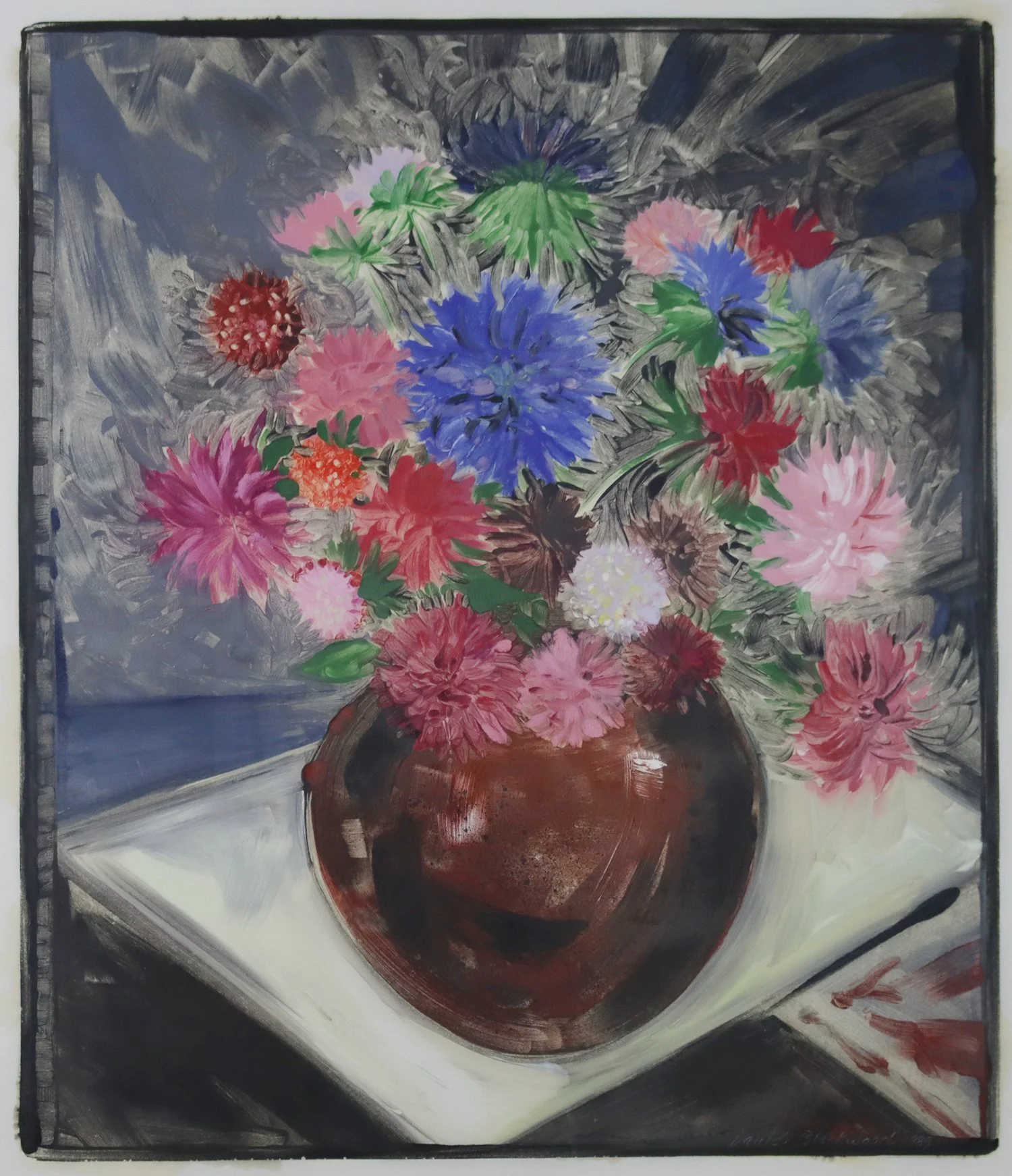
Still Life of Flowers
monotype on paper, signed and dated lower right "David Blackwood 1989",
David Blackwood’s monotypes began as an experimental practice when he did not have access to his print press while in the midst of building a new studio. With these monoprints the media is applied to the printing plate and transferred to paper, creating a unique printed image without the need for a press. The action of applying directly to the printing plate bridged the gap between his painting and print making practices.
Size: 24.5 h x 21 w (with frame 33 h x 29.5 w)
J21831
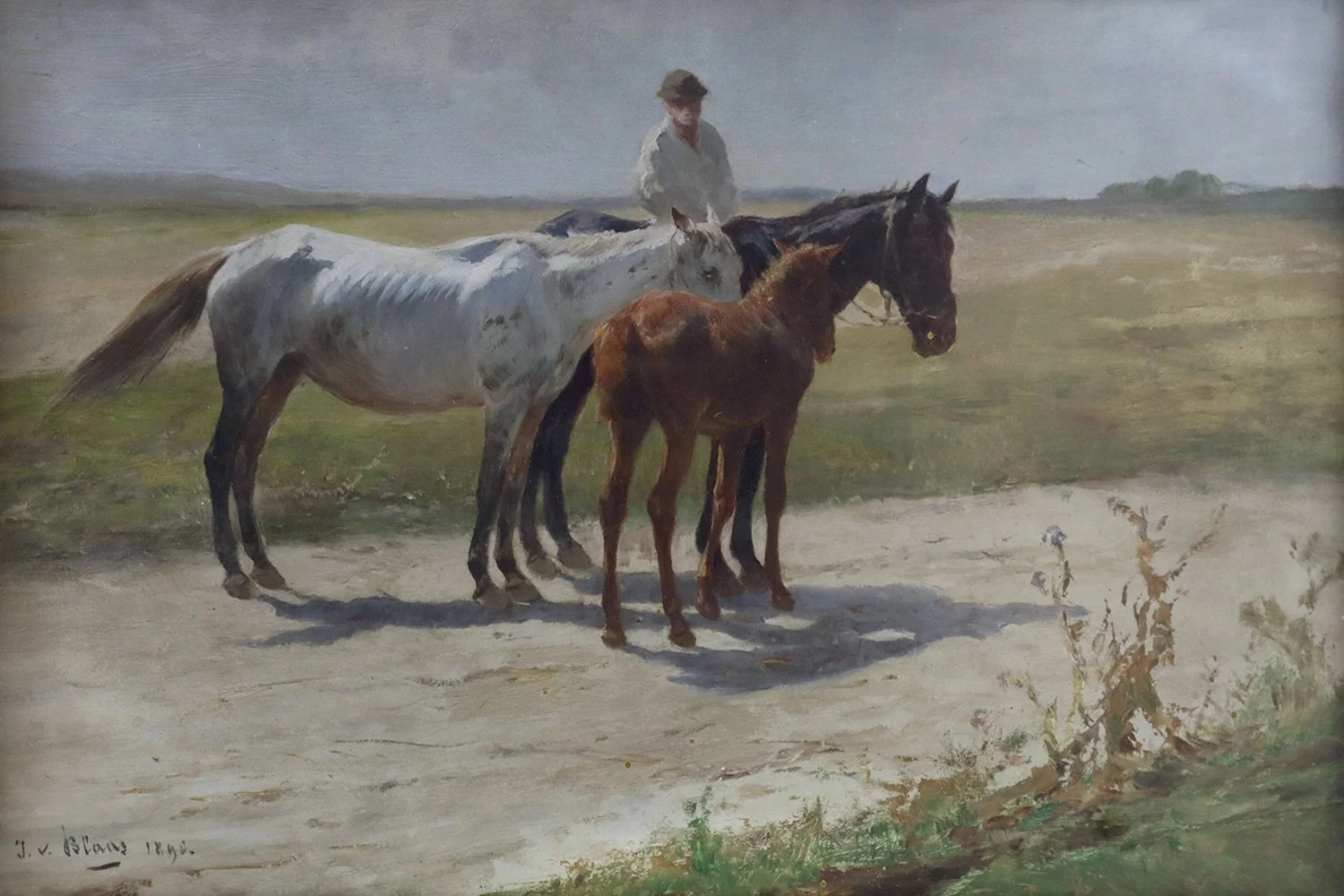
Julius Von Blaas (Italian 1845-1923)
Three Horses with Rider
oil on board, signed and dated lower left "J.V. Blaas 1896"
Provenance: Estate of Thea F.B. Bentley
Size: 10 h x 12 w (with frame 17.25 x 21.5 in)
J21798
Born in Italy, Julius von Blaas studied under his father Karl von Blaas in his Venice studio and was also influenced by his celebrated older brother Eugen von Blaas. Julius studied in Florence and Rome before attending the Academy of Fine Arts in Vienna where he later became a professor. He painted historical works, portraits and battle scenes, but devoted himself to equestrian subjects which were greatly admired. Employed by the Austrian court as a portrait painter he completed almost 50 portrait commissions, including equestrian portraits of the Emperor and his wife Empress Elisabeth. He was a member of the prestigious Vienna Künstlerhaus artists association, and received the Archduke Carl-Ludwig Medal.
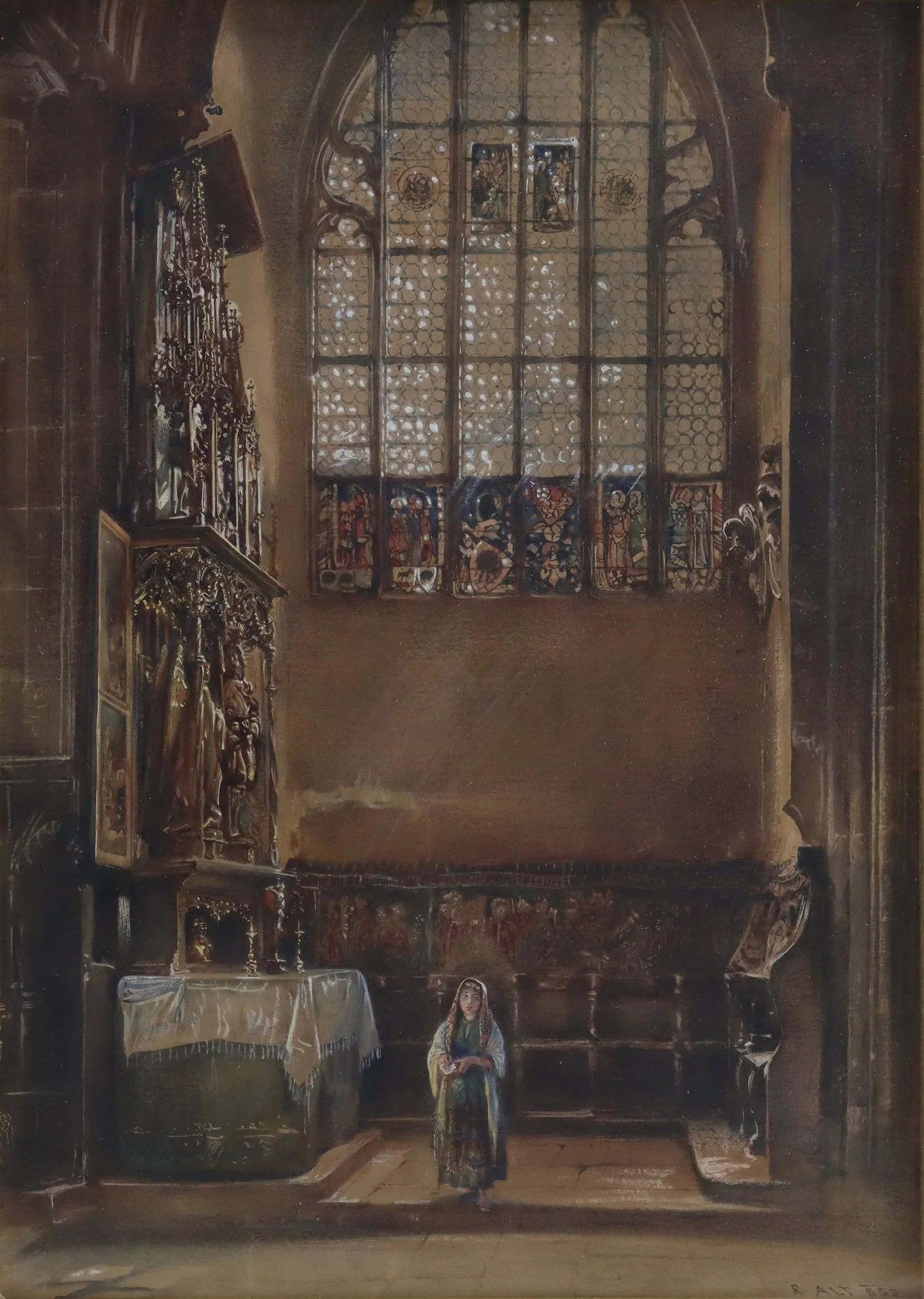
Rudolf Von Alt (Austrian 1812-1905)
Chapel Interior
watercolour on paper, signed and dated lower right "R. Alt 1853" Provenance: Estate of Thea F.B. Bentley
A member of Austrian nobility, Rudolf von Alt was educated at the Academy of Fine arts in Vienna, founding member of the Vienna Künstlerhaus and honourary President of the Vienna Secession. He is considered one of Austria’s greatest watercolour artists and a master in depicting space and light, able to capture the topographical landscapes and architecture of Austria in a detailed, realistic manner.
Inspired by a trip to Italy in 1833, von Alt painted architectural subjects including everyday objects and interior views which became one of his strong points. While painting on hiking trips through the Austrian Alps and Northern Italy he developed a detailed, realistic style which became very popular. He received many commissions for glamorous interiors documented the splendour of the aristocratic palaces of early 19th century Viennese society and was chosen by the Austrian government to document their most impressive buildings. During his eight-decade career, not only did he depict both exterior and interior views of popular castles and noble palaces, but also veduta, buildings and public spaces including the rapid changes in the Viennese cityscape.
Size:10.75 h x 15.5 w (with frame 22 x 26.5)
J21800
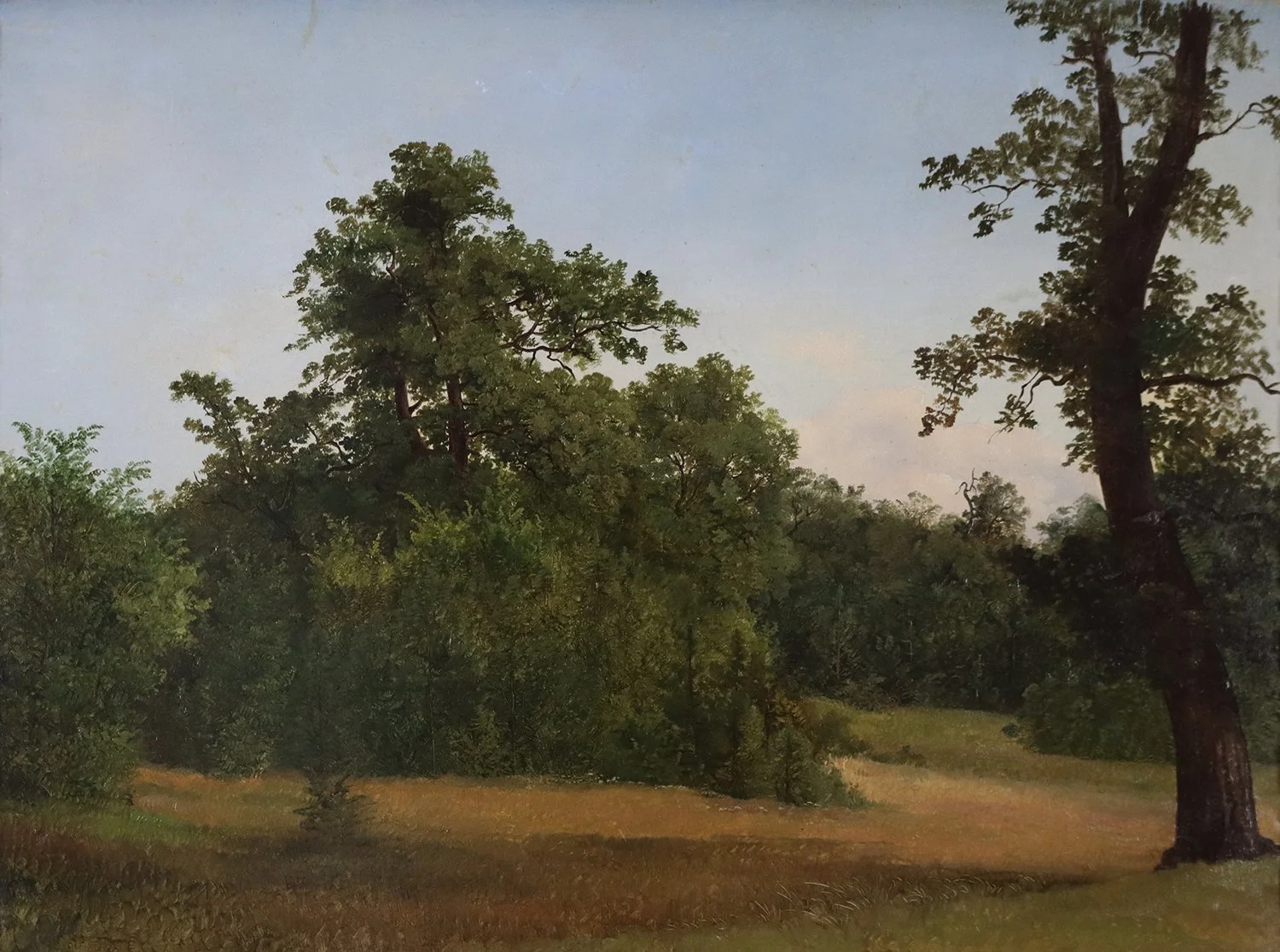
Josef Feid (Austrian 1806-1870)
Wooded Landscape
oil on board, with label on verso from C J Wawra
Provenance: Estate of Thea F.B. Bentley
Size: 14 h x 20 w in (with frame 21 x 26 in)
J21799
Josef Feid first studied architecture at the Fine Art Academy in Vienna before turning to painting. His favourite subject matter was forest landscapes and he was very talented at depicting foliage and forest life. He painted in the large Prater Park and surrounding area in Vienna, as well as the Austrian Alps in the Salzkammergut region near Salzburg. The art critic Ludwig Hevesi nicknamed Feid the “forest man from the Vienna Woods” in 1903.
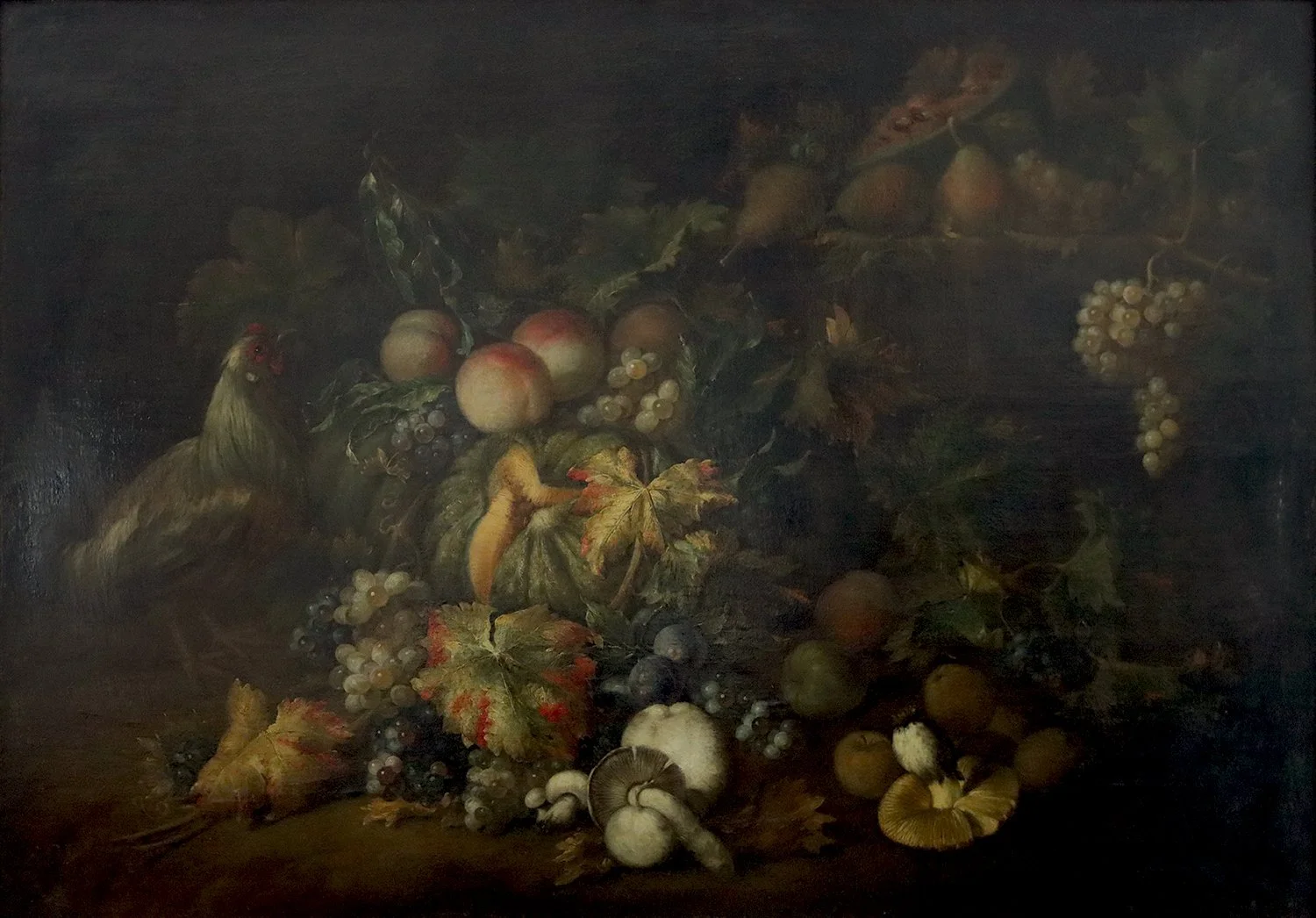
Maximilian Pfeiler (German 1656-1746)
Still Life of Fruit, Mushrooms and Chicken
oil on board, signed lower right "M. Pfeiler"
Provenance: Estate of Thea F.B. Bentley
Born in Germany in 1656, Maximilian Pfeiler became a member of the Prague Lesser Town Painting Guild in 1683. He lived in Rome from between 1694 and 1721 where he was influenced by the works of his teacher Christian Berentz, as well as Franz Werner. Pfeiler is also known to have collaborated with Francesco Trevisani and Michele Rocca.
Influenced by Northern European art and working in the fashion of the late Baroque, Pfeiler specialized in naturalistic still life paintings incorporating fruit and metal plates in elegant and balanced compositions. He rose to be one of the best-known still life painters of the first half of the 18th century.
Size: 36 h x 52 w in (with frame 40 3/4 x 56 1/4 in)
J21797
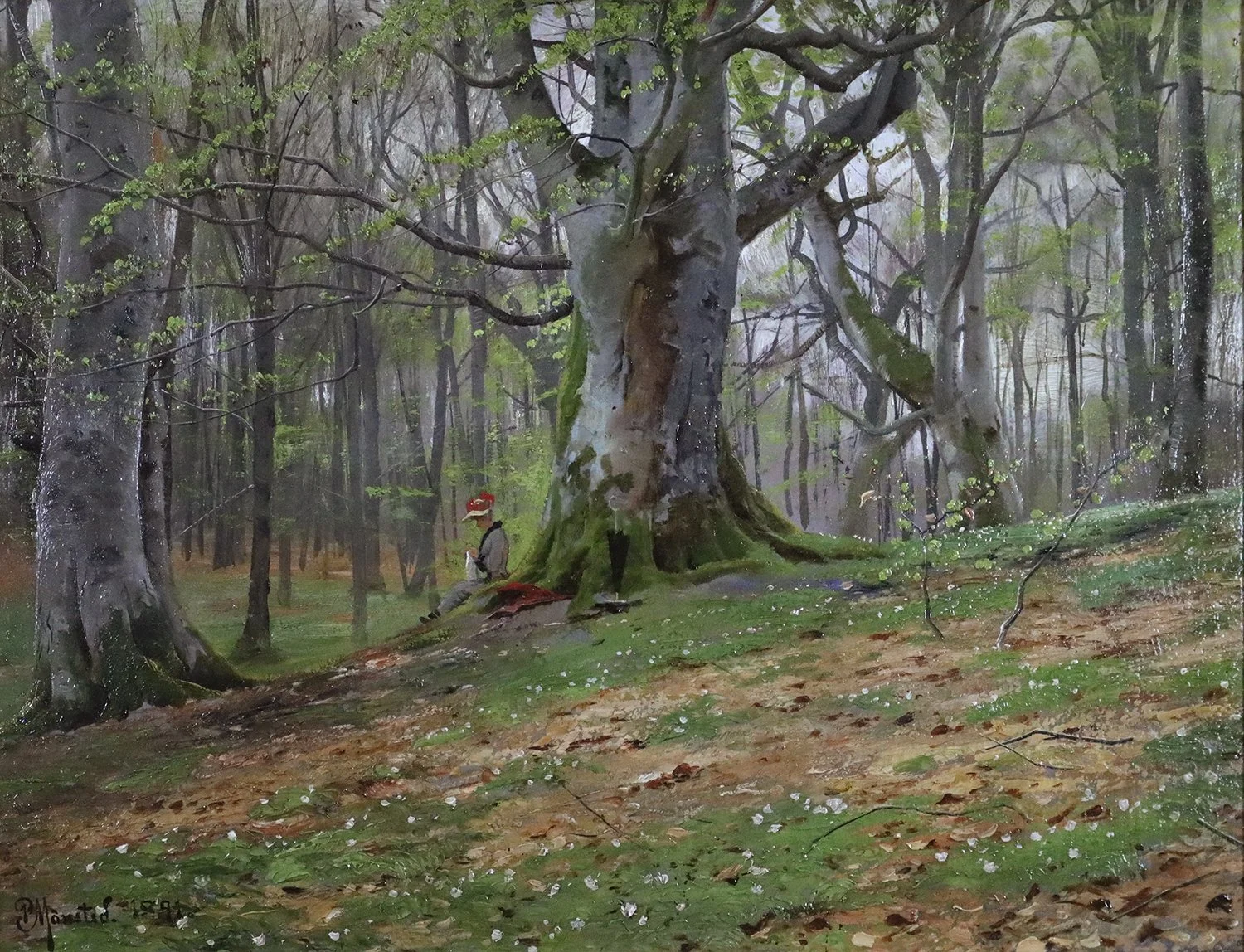
Peder M. Monsted (Danish 1859-1941)
Idyll Amongst The Blooming Anemones
oil on cardboard, signed and dated lower left "P Monsted 1891"
Size: 12.5 h x 16.5 w in (with frame 24 3/4 x 28 1/2 in)
J21825
SOLD
This item is no longer available. Please contact us to inquire about similar pieces.
uno@langmann.com
604 736 8825 or 1 800 730 8825
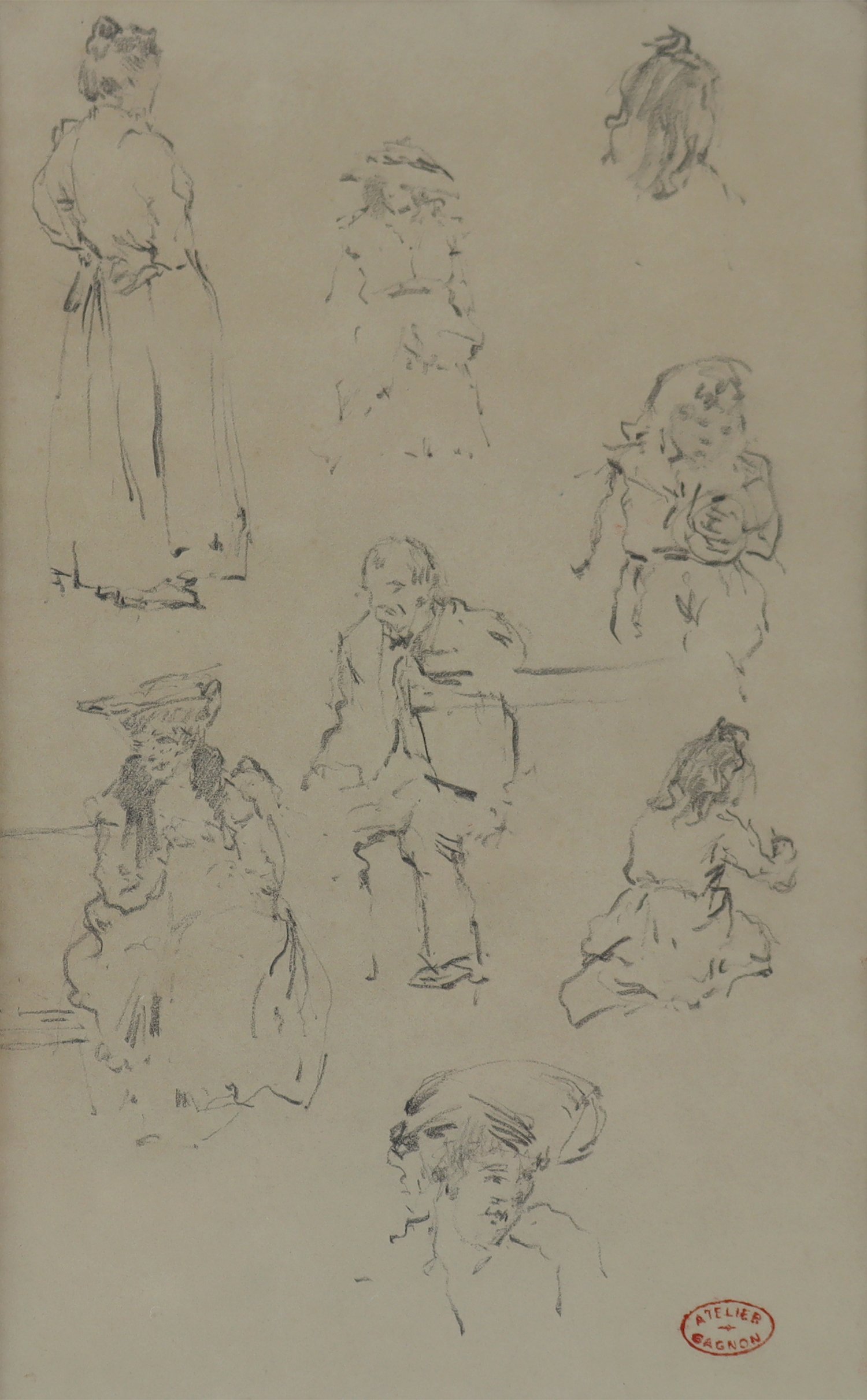
Clarence A. Gagnon (Canadian 1881-1942)
Figure Studies
pencil on paper, signed lower right with stamp, with label on back Walter Klinkhoff Gallery
Provenance: Estate of Niels Knudsen, Victoria
Size: 7.25 h x 4.5 w in (with frame 10 1/2 x 8 1/2 in)
J21717
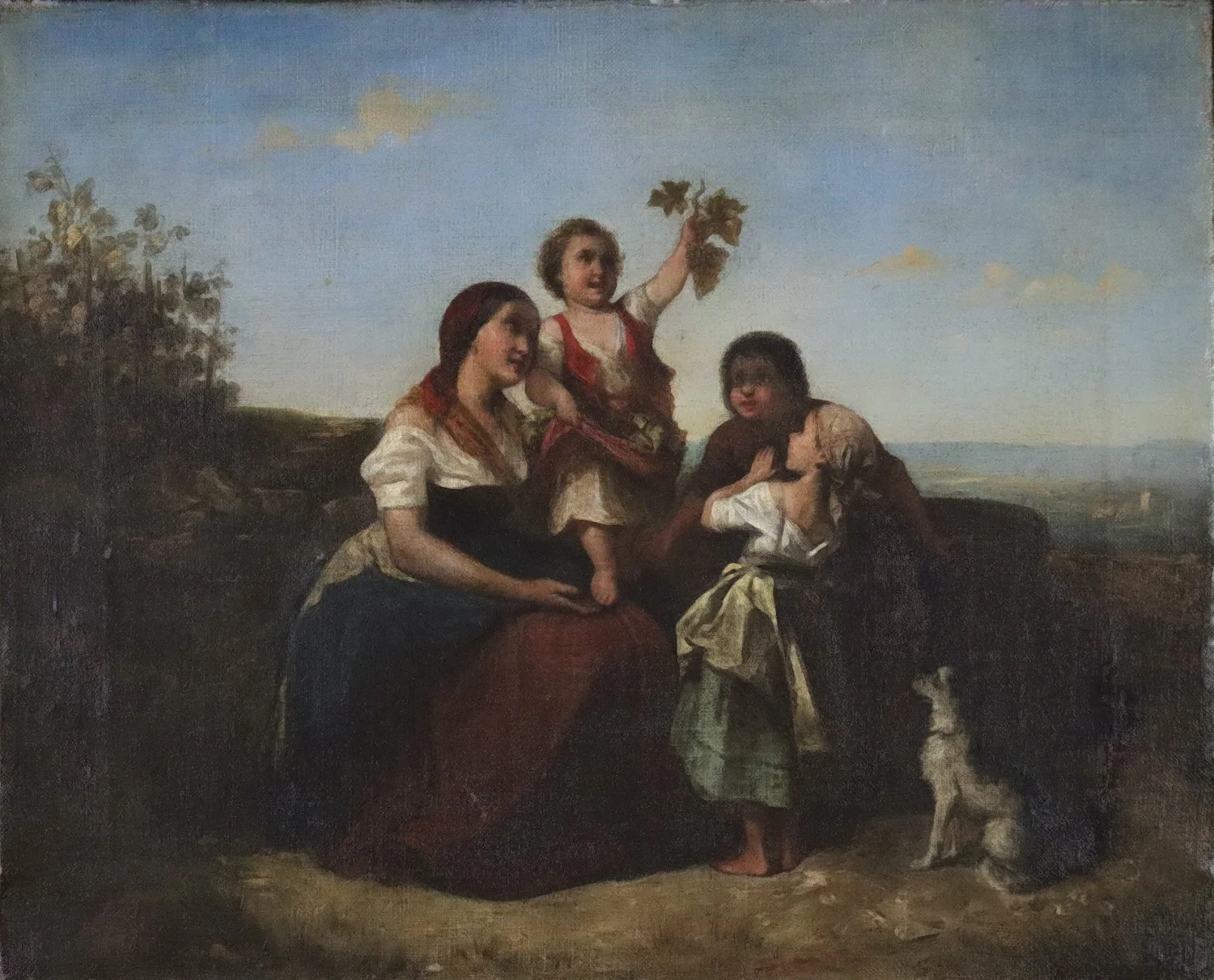
Friedrich Friedlander (Austrian 1825-1901)
Four Figures with Dog in Landscape
oil on canvas, signed lower right "F. Friedlander"
Provenance: Estate of Niels Knudsen, Victoria
Size: 12.25 h x 15.5 w in (with frame 21 x 24.25 in)
J21729
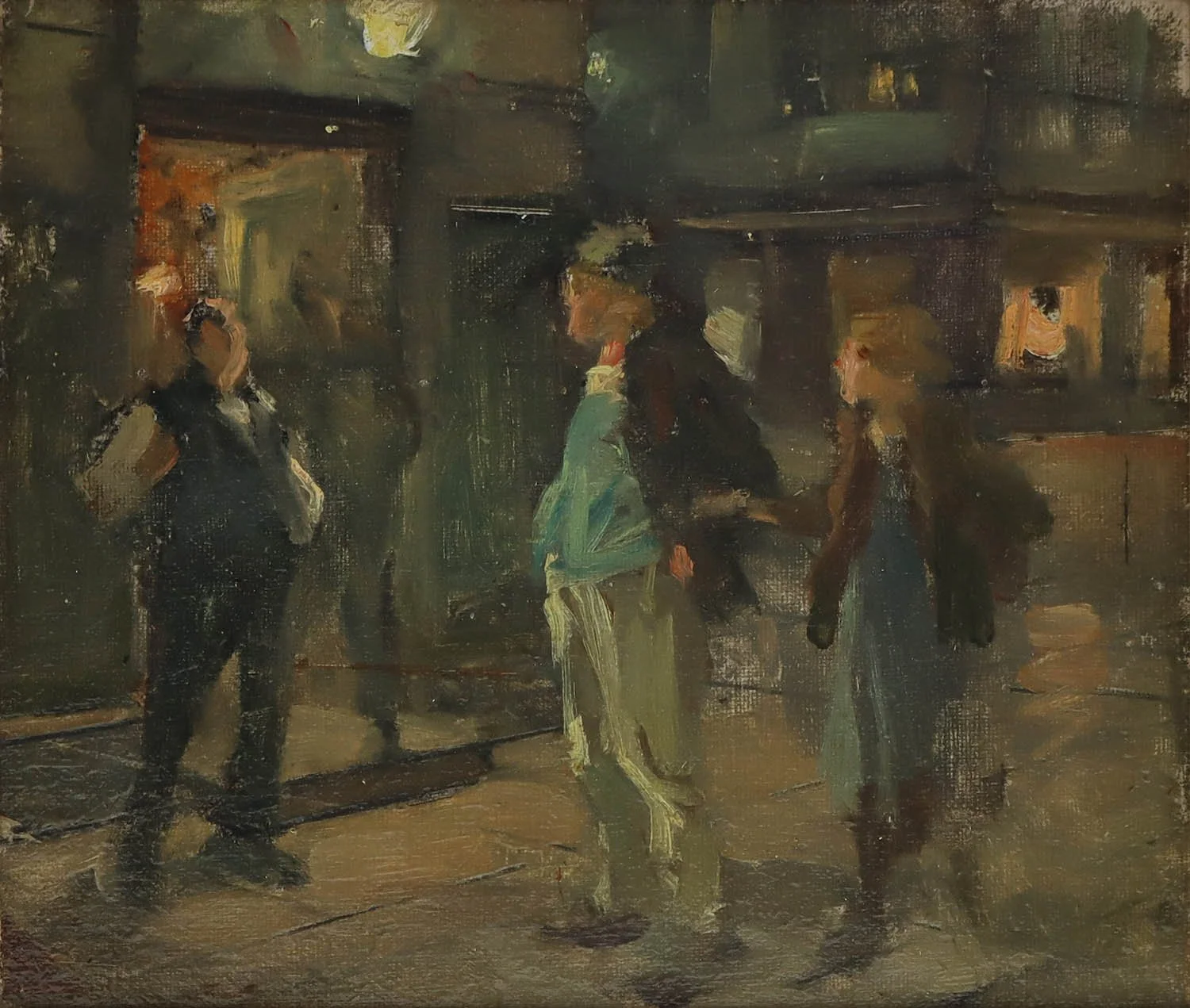
Erik Ludwig Henningsen (Danish 1855-1930)
Quitting Time
oil on panel, inscribed on reverse "M-15818 Fyraften" and estate stamp No. 224
The title of this work, "Fyraften" is a term used for ending the work day, knocking off, quitting work. However in this case it is used as a play on words for the end of the evening, time to go home. The scene depicts figures outside the local tavern at the end of the evening.
Erik Ludvig Henningsen was a Danish painter and illustrator known for his genre and social realist works depicting children and the working class. He was born in Copenhagen in 1885 and was the younger brother of Frants Henningsen, also an accomplished painter. In his adolescence Erik displayed great artistic talent and was accepted into the Royal Danish Academy in 1873 at the age of 18, graduating in 1877. He traveled widely throughout Europe and won numerous awards, exhibiting in Copenhagen, Vienna and Paris. Henningsen became focused on city life in Copenhagen, and during the first two decades of the 20th century his work concentrated on genre scenes and historical work. He was also an illustrator for books and magazines, perhaps his most iconic work being is his poster “The Thirsty Man” (1900) for Tuborg Brewery. He is represented in institutions including the Hirschsprung Collection, Copenhagen Museum and Stockholm Museum.
Size: 6 h x 6.5 w (with frame 10.25 h x 11.5 w in)
J21785
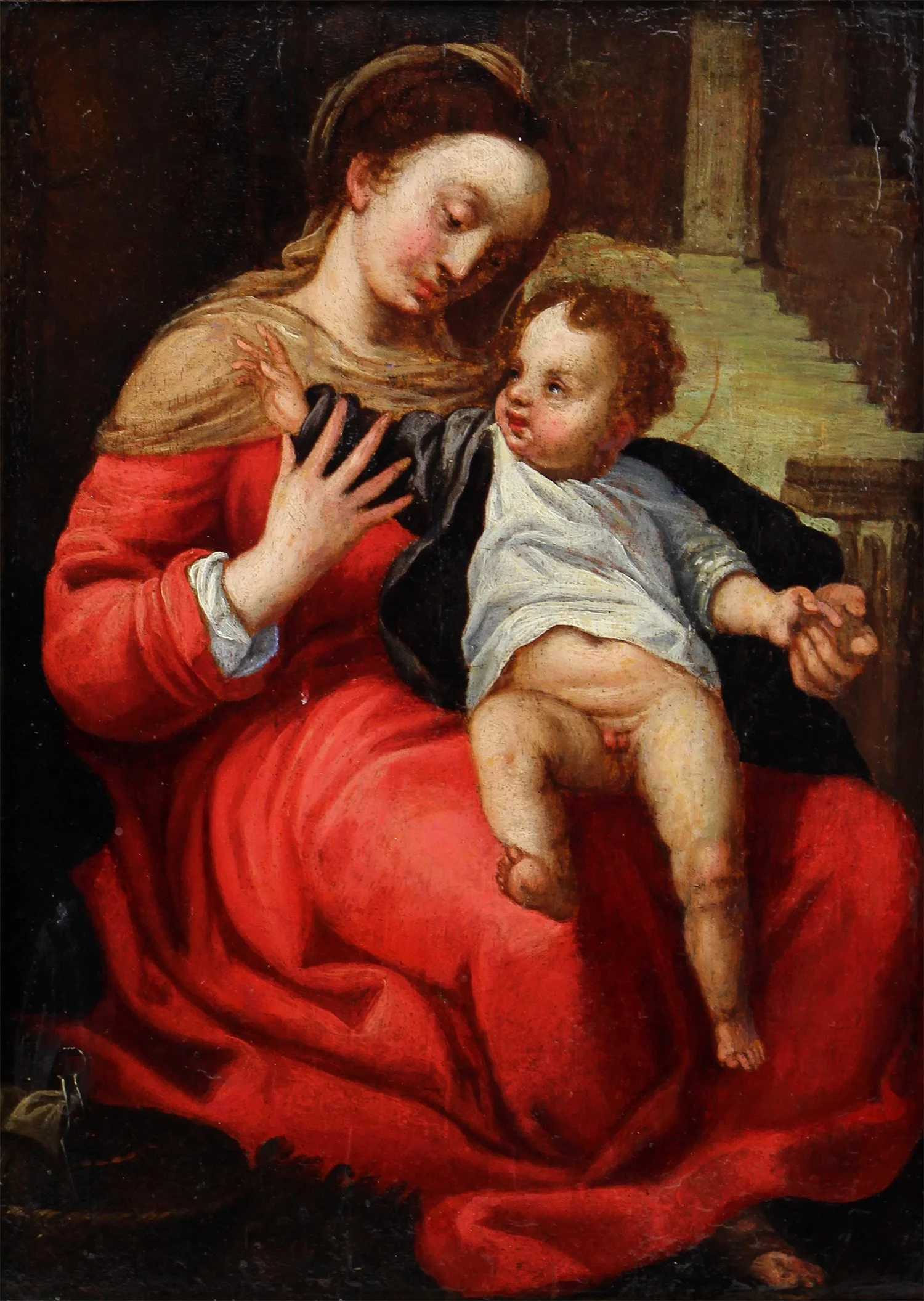
The Madonna of the Basket
Italian School, 17th century, oil on panel, with wax seal on reverse "DIEU ET MON PAYS/IM" ("God and My Country"), copy of Correggio's "The Madonna of the Basket" in the National Gallery London
Size: 4 3/4 h x 6 1/4 w in (with frame 8 1/2 x 9 3/4 in)
J16744
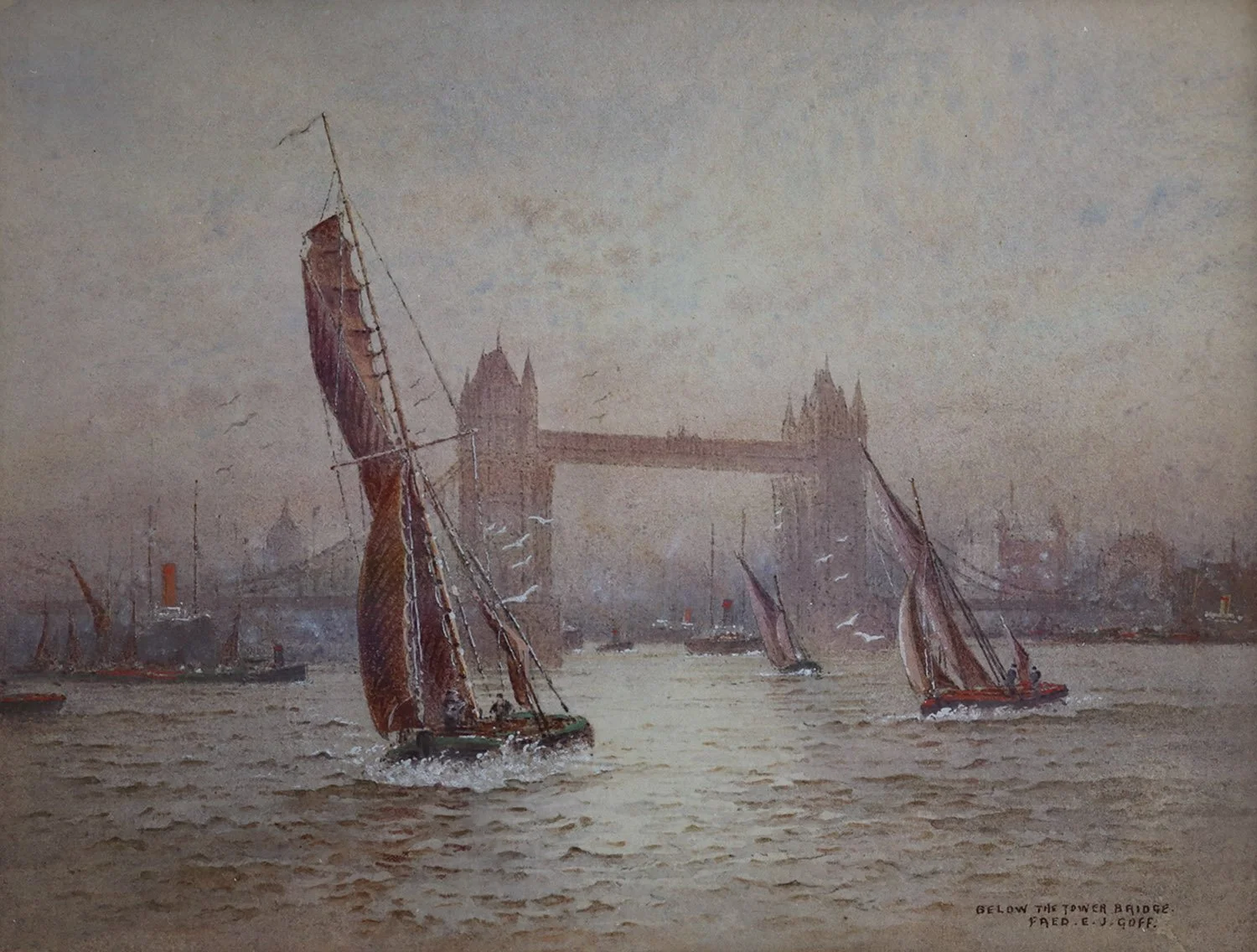
Frederick Edward Joseph Goff (British 1866-1933)
Below the Tower Bridge
watercolour, signed and inscribed lower right "Below the Tower Bridge, Fred. E.J. Goff.", with label on reverse for Samuel Coombes Dealer in Works of Art London, 175 East of Strand, London
Size: 4 3/4 h x 6 1/4 w in (with frame 8 1/2 x 9 3/4 in)
J21806
OBJETS D'ART
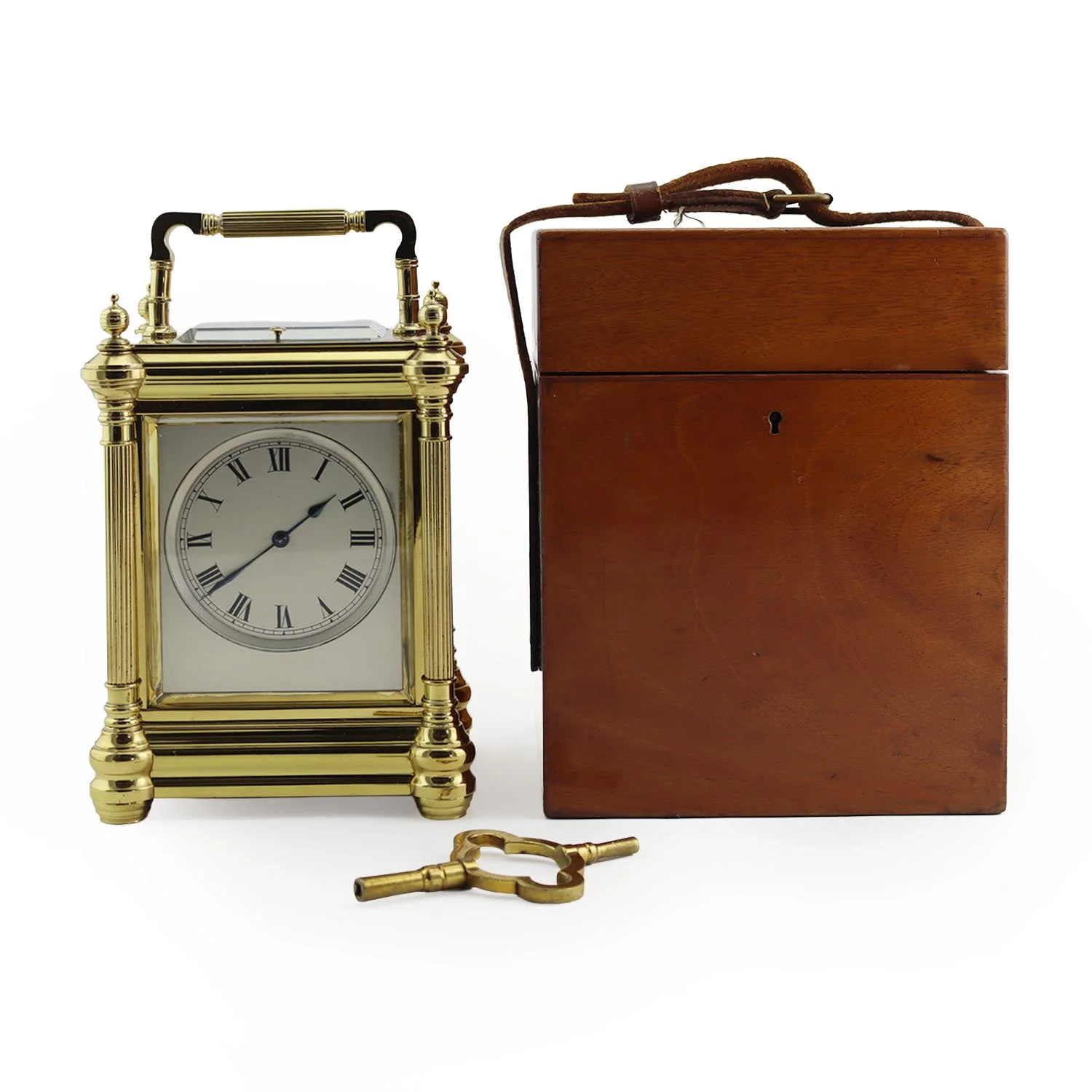
Rare French gilt brass carriage or mantle clock of large proportions by Alfred Drocourt, Paris, circa 1875, with Grande Sonnerie striking movement with repeater, silvered face with Roman numerals and spade hands, the back with AD oval stamp and numbered 16654, complete with original wooden fitted case with leather strap and numbered double-ended winding/setting gilt brass key.
Size: clock 9 3/4" to top of handle x 6" x 5" (size of box 10" x 7 1/4" x 6 1/8")
This exceptional and rare repeating Grande Sonnerie carriage clock by Drocourt has an eight-day spring-driven movement. The silvered dial has a circular Roman chapter ring with an outer minute track with Arabic five-minute markers, the time indicated by a fine pair of spade hands. The substantial brass gorge case is in original gilt condition and is surmounted by a carrying handle, with fluted round pillars, rounded corners with ringed capitals standing on further blocks and placed on a nicely moulded plinth. There are faceted glass panels to all sides including the top to reveal the moving escapement. The Grand Sonnerie movement stikes the hours and quarters on two gongs, with each being sounded at each quarter strike. The movement can be set to Silent, Striking or Full Striking on the undercase. The top has a repeat button, with which the last hour and quarters can be repeated at will. At the back there is a glazed door giving access to the winding and setting arbors. The backplate is stamped with the oval embossed and clock Drocourt hallmark, Drocourt serial number 16646, and with the word HANDS and an arrow to indicate the function of the arbor and the direction in which to turn. The speed can be adjusted regulator pin which can be seen through the window in the top and is accessible thorugh the back door. The clock comes complete with original wooden fitted case with leather strap and numbered double-ended winding/setting gilt brass key.
In the 19th century, Paris France, was the site of much of horological innovation. Pierre and Alfred Drocourt were the most celebrated makers of the second half of the century, with factories in Paris and St. Nicholas-d'Aliermont. Their highly decorative and innovative clocks won a series of medals at the Paris Exhibition, cementing their status. Born in 1819, Pierre Drocourt founded the company as early as 1846, although his first recorded clock was five years later. The firm went through a series of name changes throughout the century from Drocourt, to Drocourt et Fils in 1870 as Alfred became a partner, reverting to Drocourt by 1873 confirming the hand-over from Pierre to his son Alfred. Alfred was very active in Paris horological circles and was one of the first 21 members included in the newly formed Chamber Syndicale de l’Horlogerie de Paris. By 1889 The firm had received multiple awards at the Paris Exhibition including a gold medal. Alfred continued to run the business with great success until it sold in 1904.
Carriage clocks can be traced back to a clock first created for Napoleon in the late 18th century by Abraham Louis Breguet. Originally called an Officer’s Clock these had a balance rather than a pendulum so they could be transported without having to be reset. Originally made in the Empire style, by the 19th century rail and road travel was becoming increasingly common and by the 1860’s these portable time pieces were being produced on a grand scale. Many of the most valuable styles of carriage clocks were produced toward the second half of the 19th century, exquisite examples with intricate gilt cases. Most carriage clocks will strike on the hour and half past the hour. The Petite Sonnerie system strikes the number of hours on the hour, and strikes each quarter hour, while the Grande Sonnerie, the movement of this exceptional clock, strikes the number of hours on the hour, and the number of hours and quarters on each quarter-hour strike. The finest examples include a repeat button, with which the last hour and quarters can be repeated at will.
Serial No.: 16646
Movement: No blanc number
Case: Giant fluted rounded pillars with original gilding
Movement: Grande Sonnerie on 2 gongs with repeater
Platform: Angled, two part bridge
Dial: Silvered, dots to the 5 minutes with black Roman numerals, unsigned
Rear of dial: Unknown
Hands: Spade
Backplate: Stemped with Drocourt serial no. 16646, oval embossed and clock Drocourt stamp
Regulation script to top of backplate: S/F
Holding screws: Double
Gong block: FD
Size: 9.75 h x 6 w (size of box 10 h x 7.25 w x 6.125d)
D21867
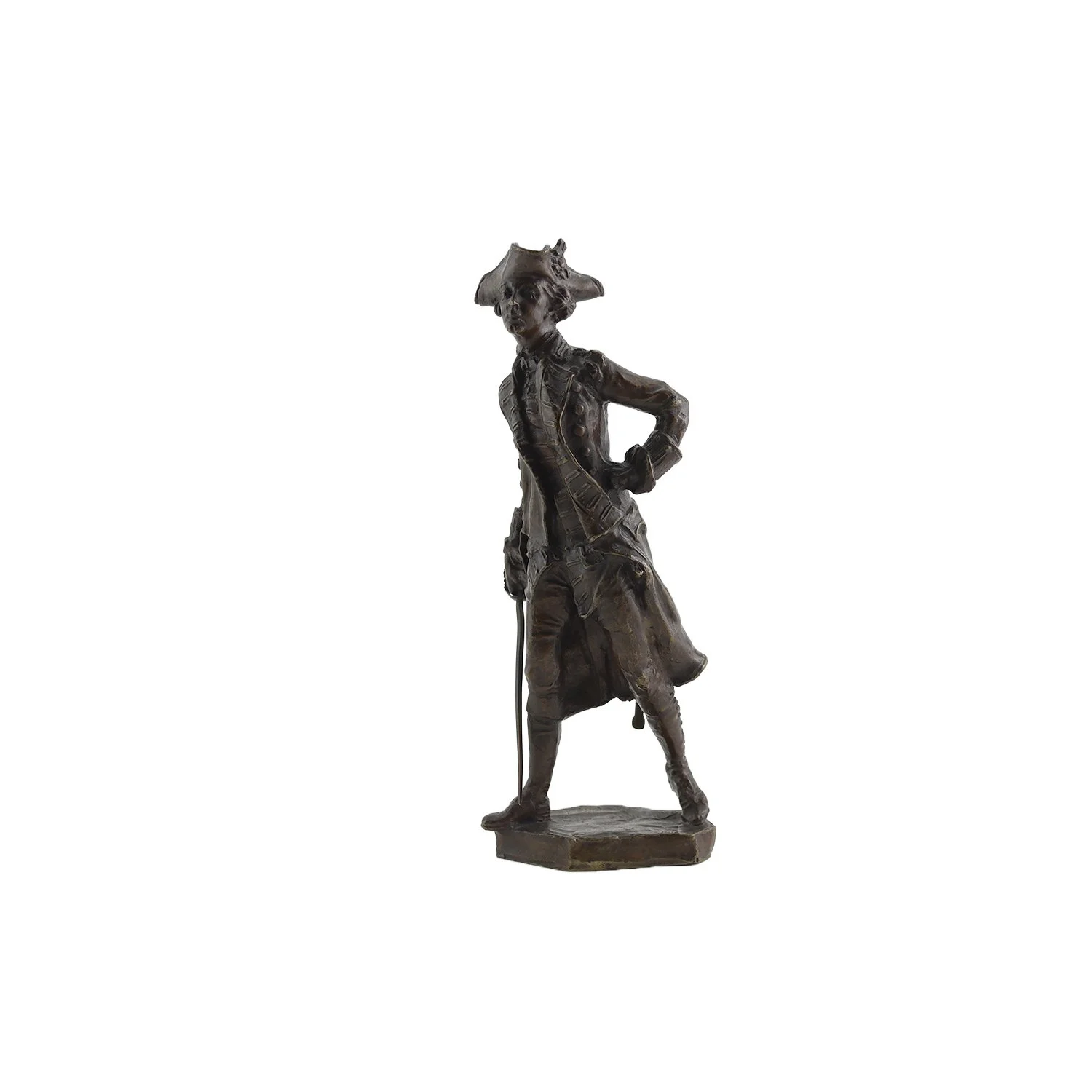
bronze with mid-brown patina, signed and dated on base "Vernon March.1910", cast circa 1910.
Size: 1.25 h x 8 w x 8 d
G21808
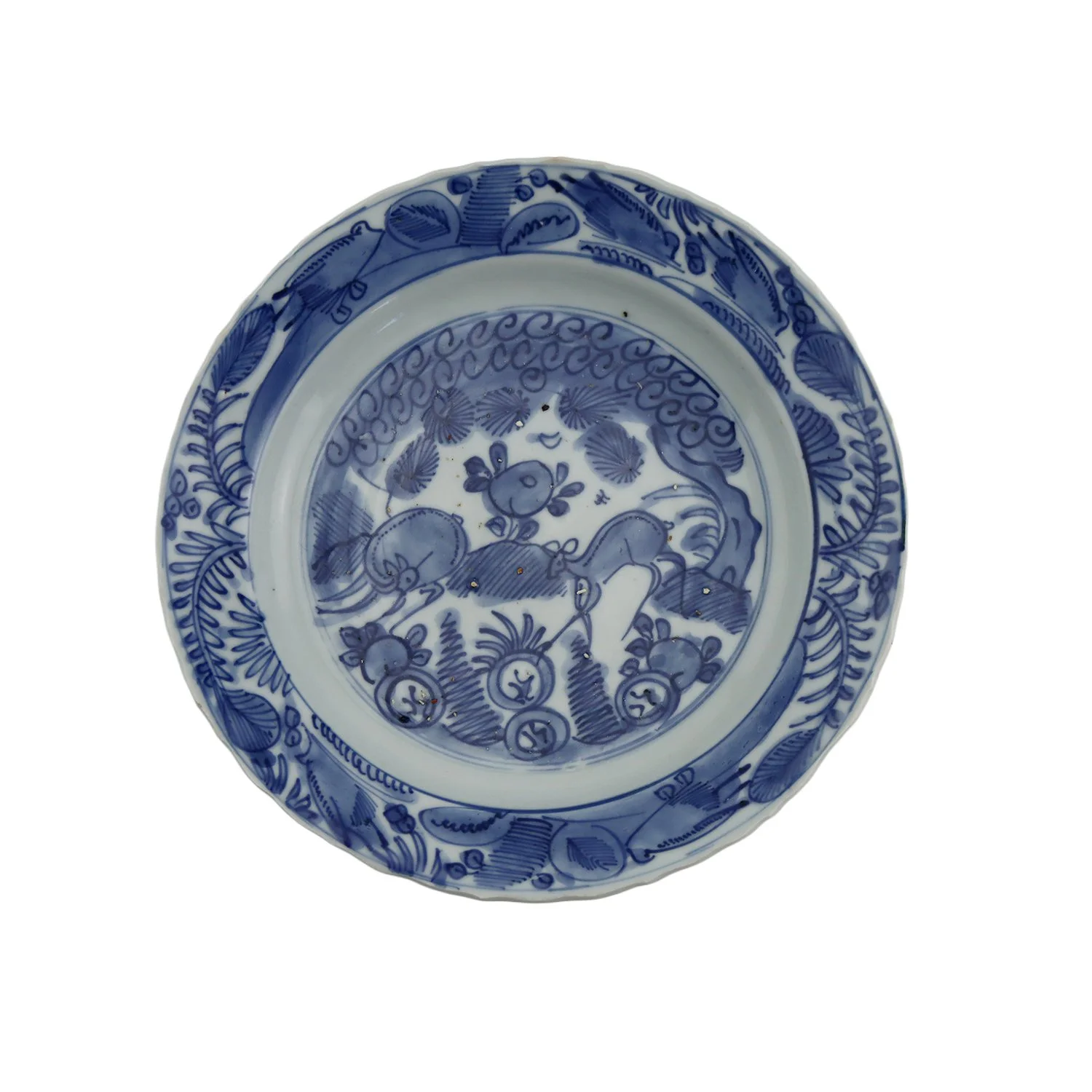
Chinese blue and white Deer Dish, Tianqi Period (1621–1627), Ming Dynasty.
Size: 1.25 h x 8 w x 8 d
D21864
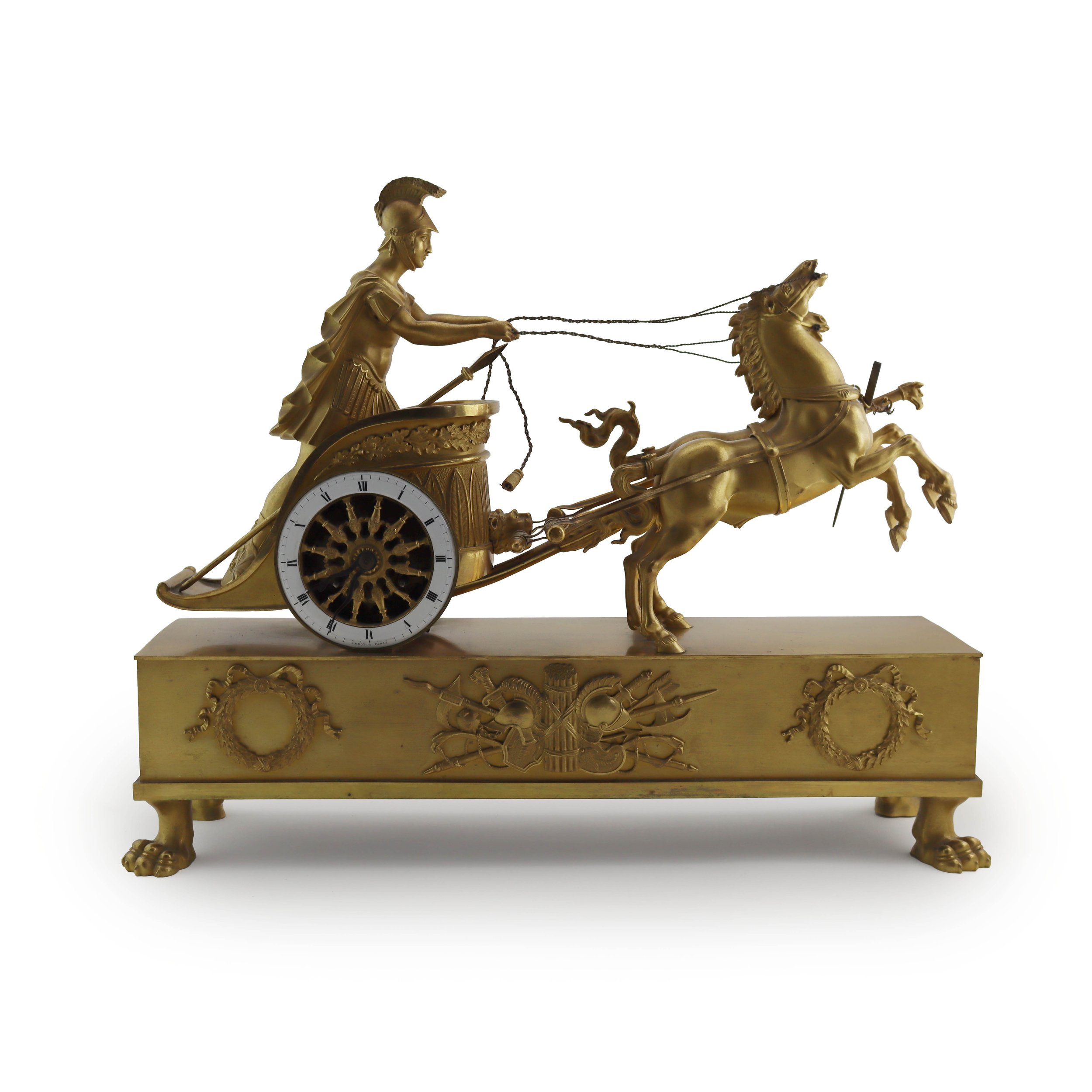
French gilt clock with a Roman Charioteer, face with enamelled dial, signed "Leroy a Paris", 19th century.
Provenance: Estate of Thea F.B. Bentley
Size: 15.5 h x 19 w x 6 d
H21804
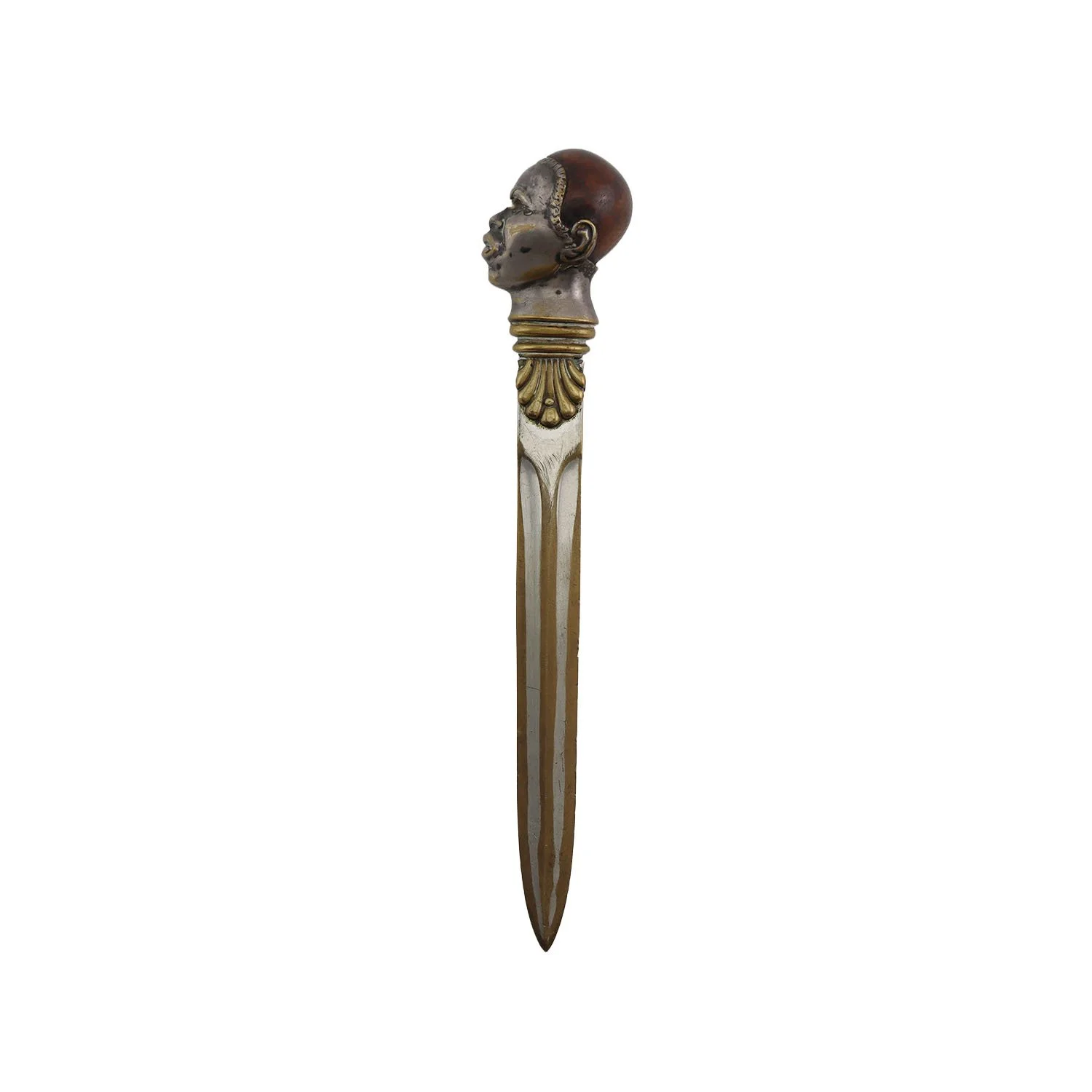
Silvered brass letter opener, the handle with cast head of African man with inset eyes and wooden hair, 19th century.
Provenance: Estate of Niels Knudsen, Victoria
Size: 9 h x 1.75 w x 1.25 d
D21780
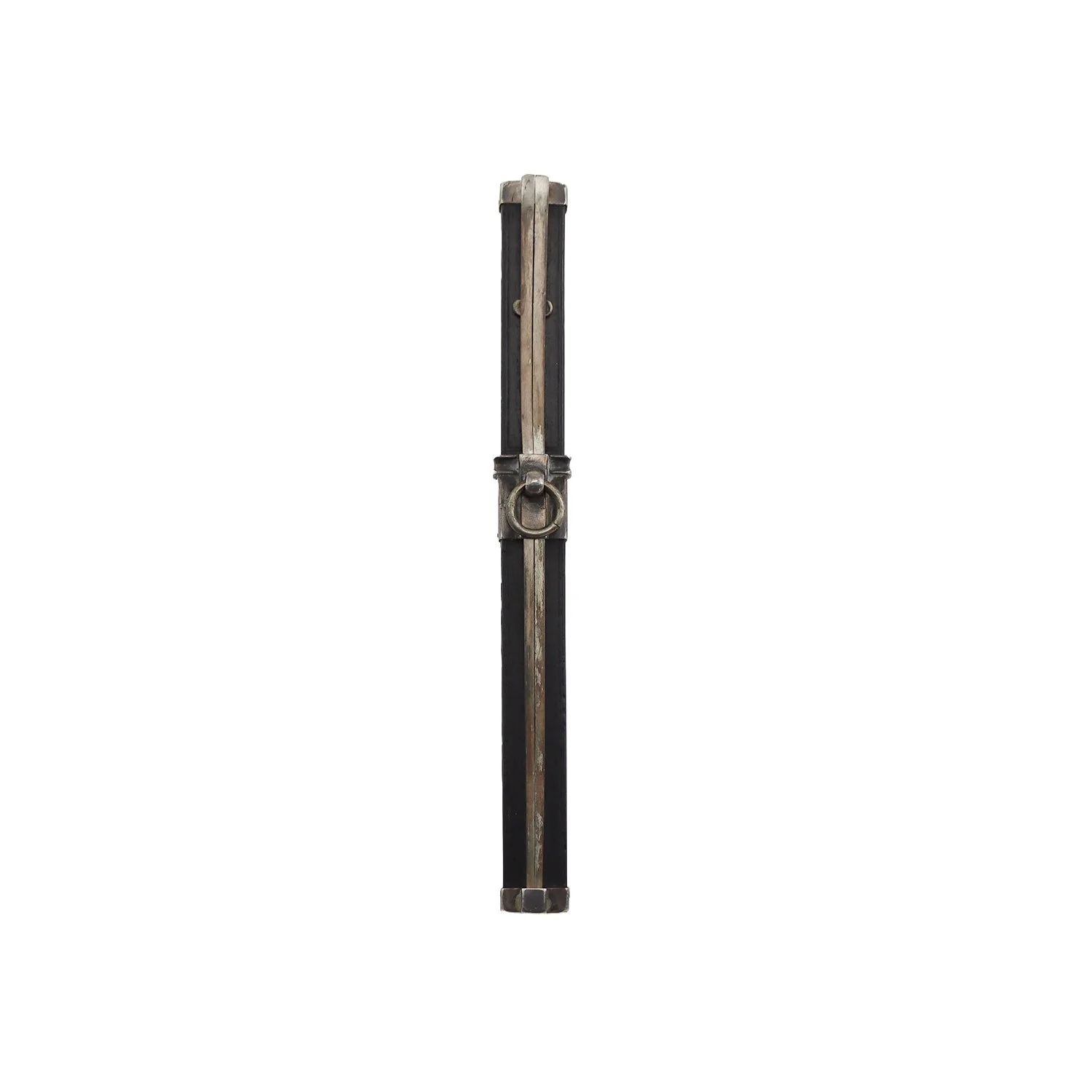
Japanese antique traveling set incorporating steel knife and chopsticks with carved wooden scabbard decorated with carved pagodas and flowers, with metal ring, 19th century.
Provenance: Estate of Niels Knudsen
Size: 6.5 h x 0.75 w x 0.75 d
D21501
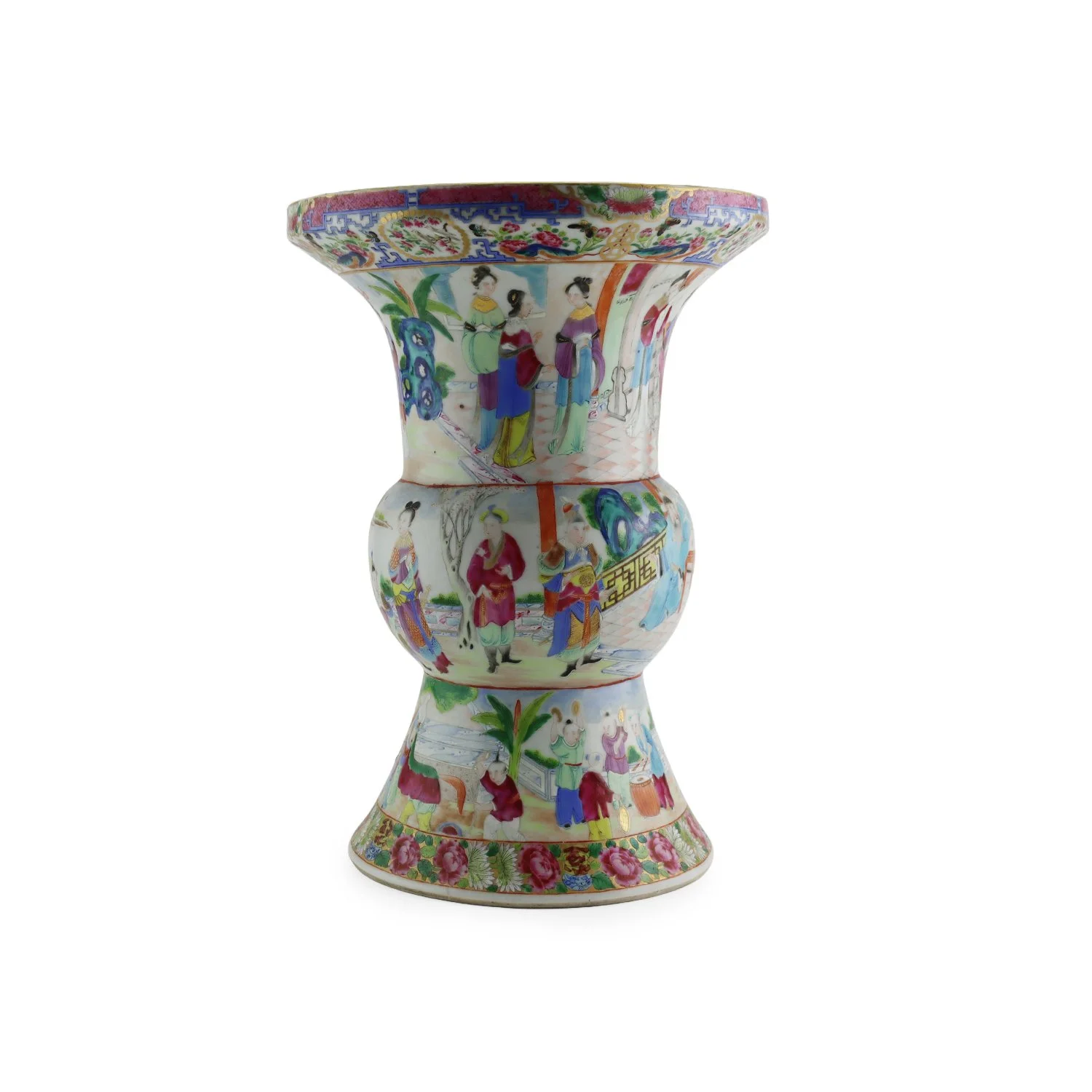
Chinese round vase with fluted rim, decorated with famille rose figures and flowers, the inside of the top rim decorated, mid to late 19th century.
Provenance: Estate of Niels Knudsen, Victoria
Size: 12.5 h x 9 d x 9 d in
D21755
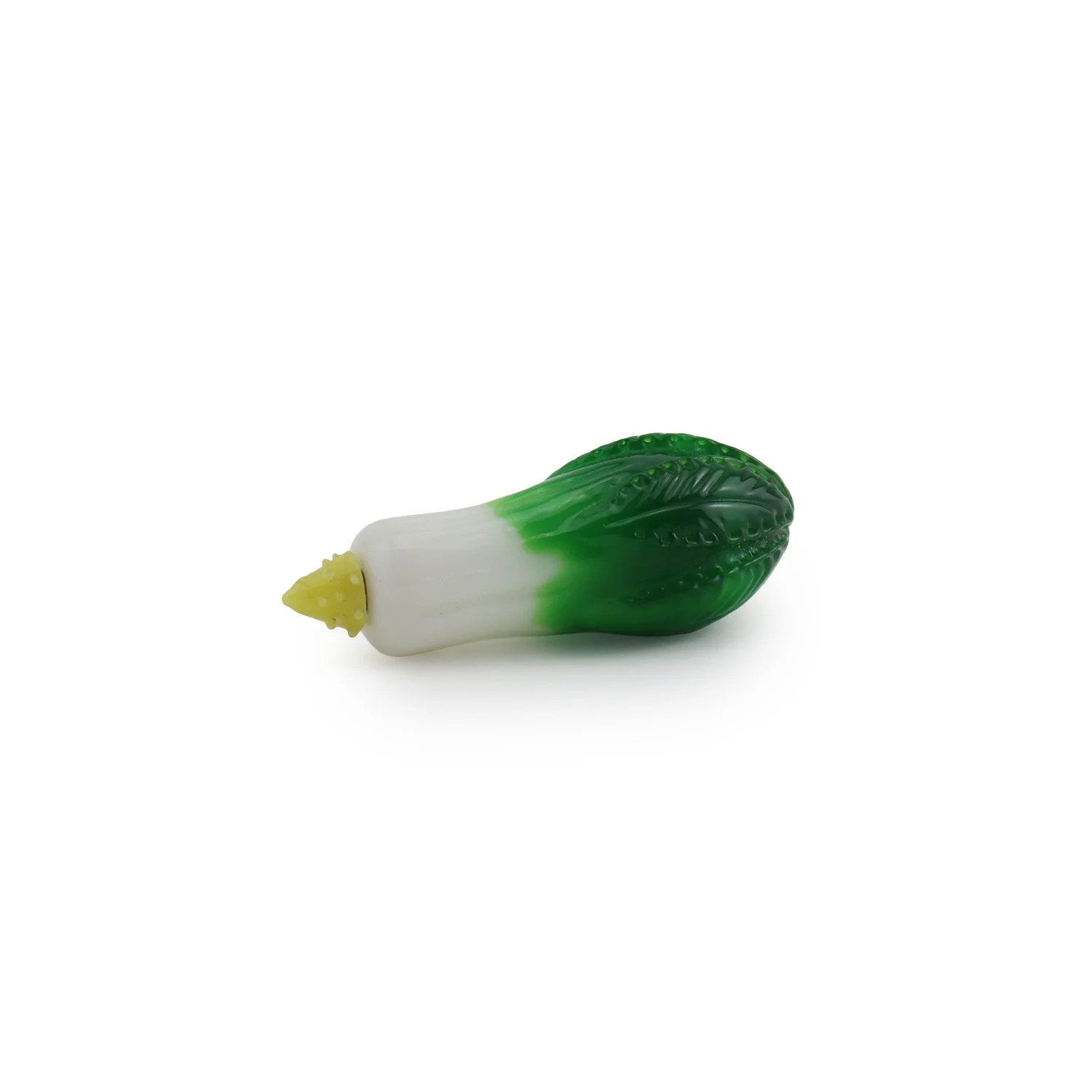
Chinese glass snuff depicting Bok Choy, with yellow stopper, 20th century.
Provenance: Estate of Niels Knudsen, Victoria
Size: 1.25 h x 11.5 w x 8.5 d
D21579
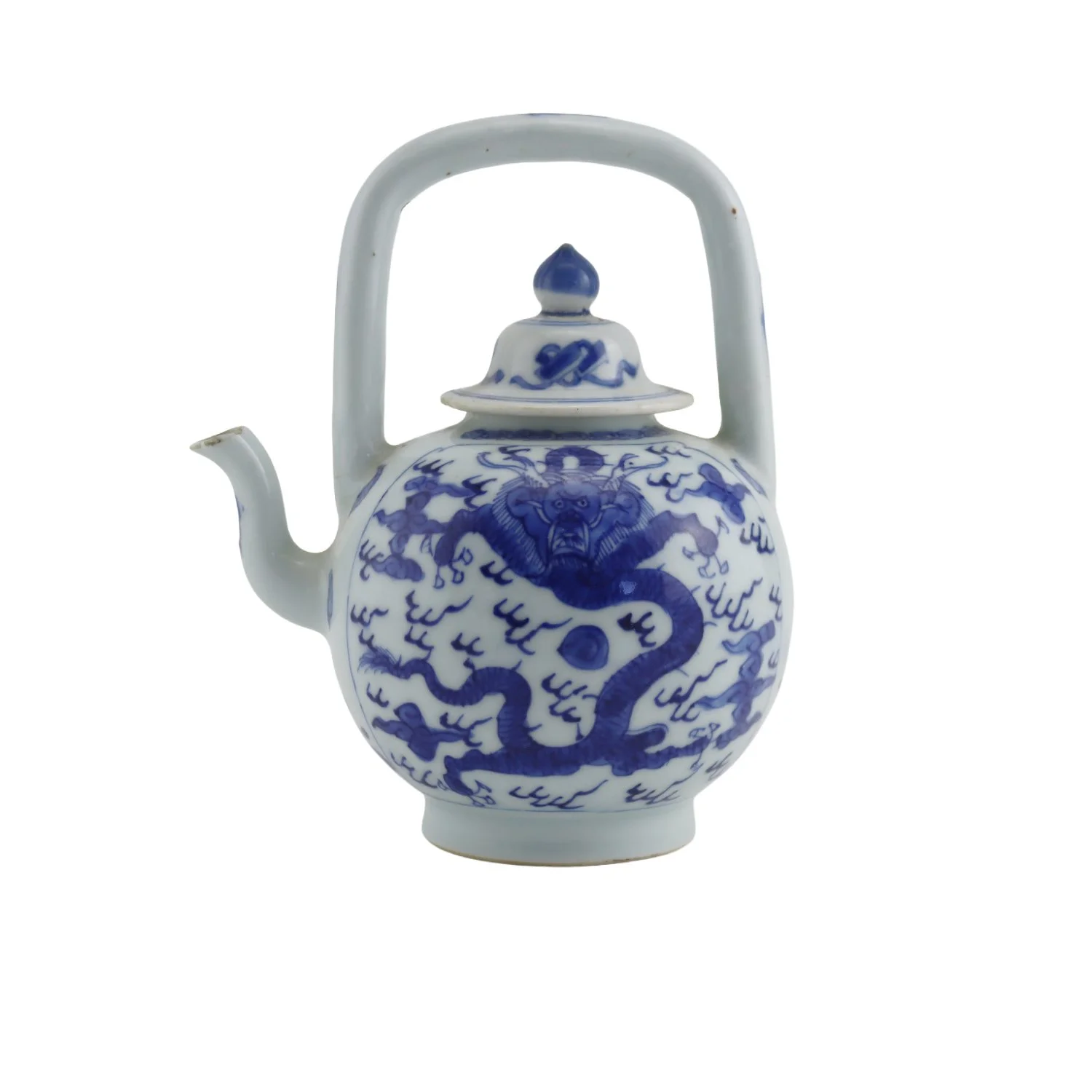
Chinese Export tea pot with handle and lid, early 18th century, crack in handle and repair to lid, decorated with dragon.
Provenance: Estate of Niels Knudsen, Victoria
Size: 6.25 h x 5.25 w x 4 in
D21745
ANTIQUE FURNITURE
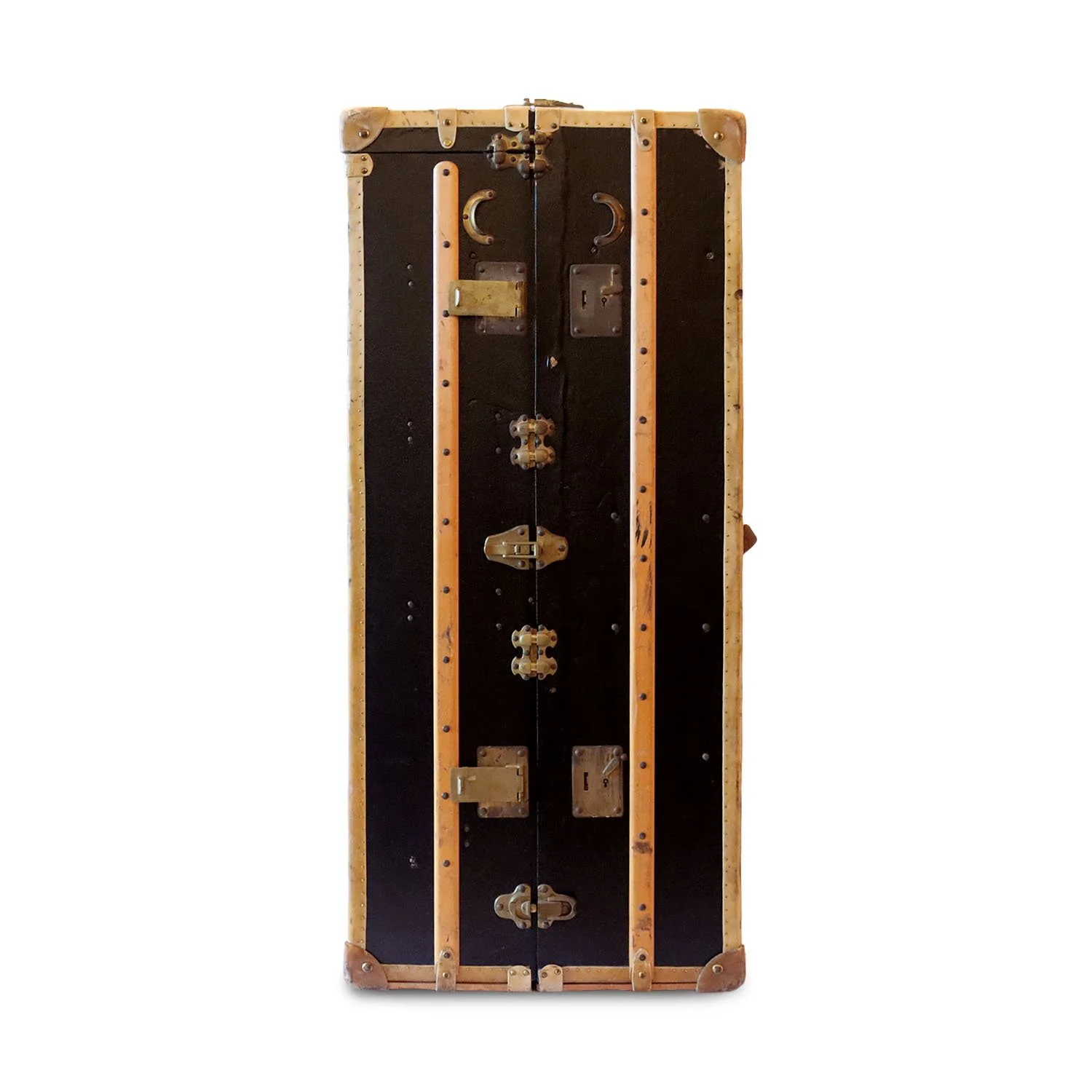
Austrian leather covered travelling wardrobe suitcase/trunk, by Vienna based luggage workshop Paul Stark, circa 1920. Fitted interior, the right side bearing the manufacturer's plate "Schrank Koffer Werkstatte P. Stark Wien, IV. Prinz Eugenstr. 56 Tel. U49-4-70", with hinged drop-front opening onto interior compartment, above three drawers and storage area, the left side containing clothes hangers on rods, covered by a canvas curtain. The trunk with a rounded top and brass rollers, heavy leather handles, yellow brass clusures, locks and rivets, leather-reinforced corners and angles with wooden protective slats, metal rivets, locks, catches and re-enforced wood, leather and metal edging and corners. Inside with label , with personalized monogram RBB, with original key
Provenance: Estate of Thea Bentley, Vancouver
Size in inches: 53 h x 22.5 w x 21.5 d
M21796
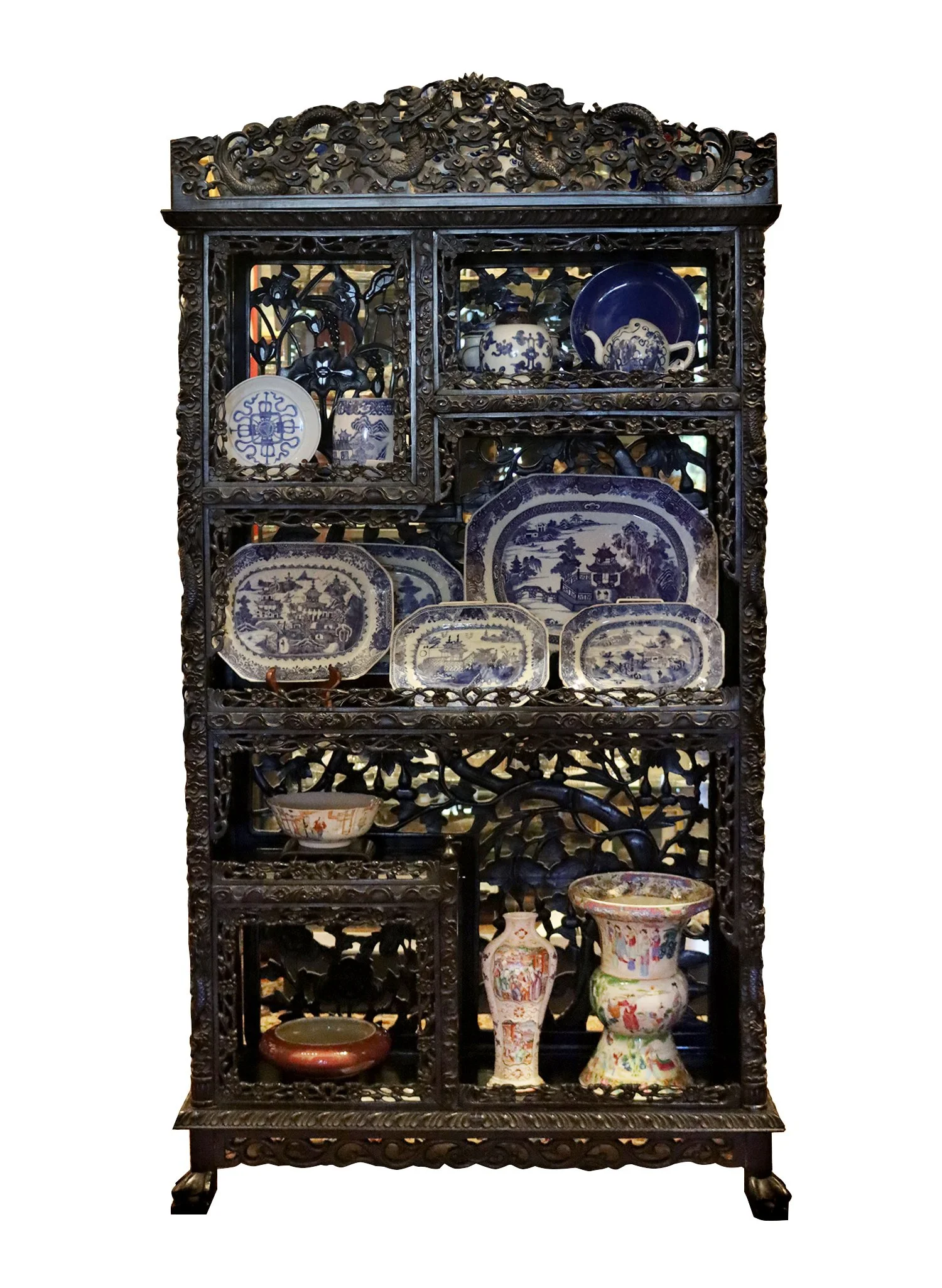
Chinese pierced and carved hardwood display cabinet, late 19th century
Late 19th century Chinese pierced and carved hardwood display cabinet or etagere, the shaped pediment to the top leading down to stepped, asymmetrical shelves bordered with carved fretwork, raised on cabriole legs with ball and claw feet, the whole carved with Chinese symbols including dragons and exotic fruits and flowers, circa 1880
Size in inches: 68 h x 34.5 d x 12.75 d
D21812
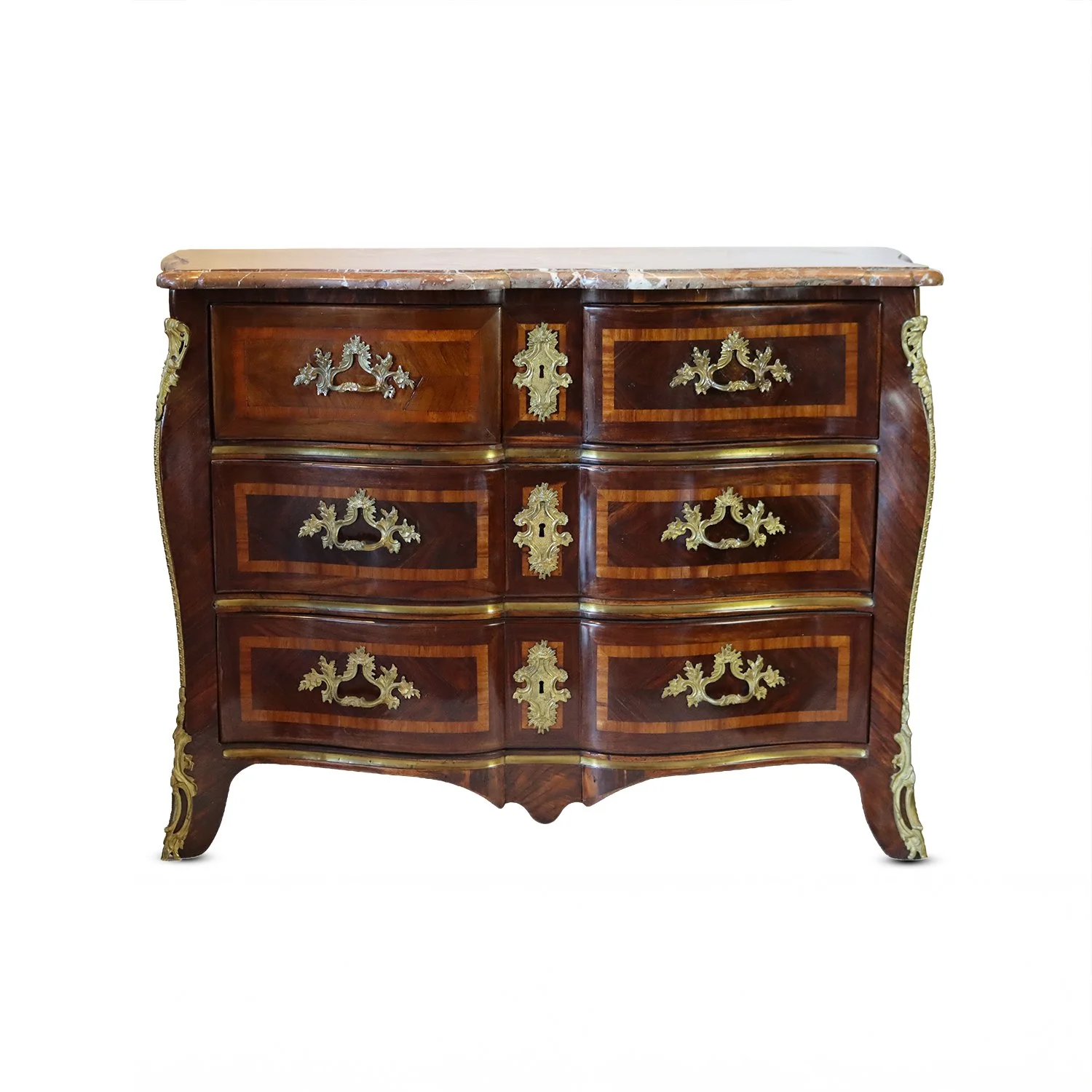
French kingwood commode, with two short drawers above and two long drawers below with veneered, quartered marquetry on drawer fronts and sides, the drawer fronts additionally crossbanded; with marble top, ormolu escutcheons, drawers handles and mounts; 18th century
Size in inches: 33 h x 46 d x 23 d
A21461
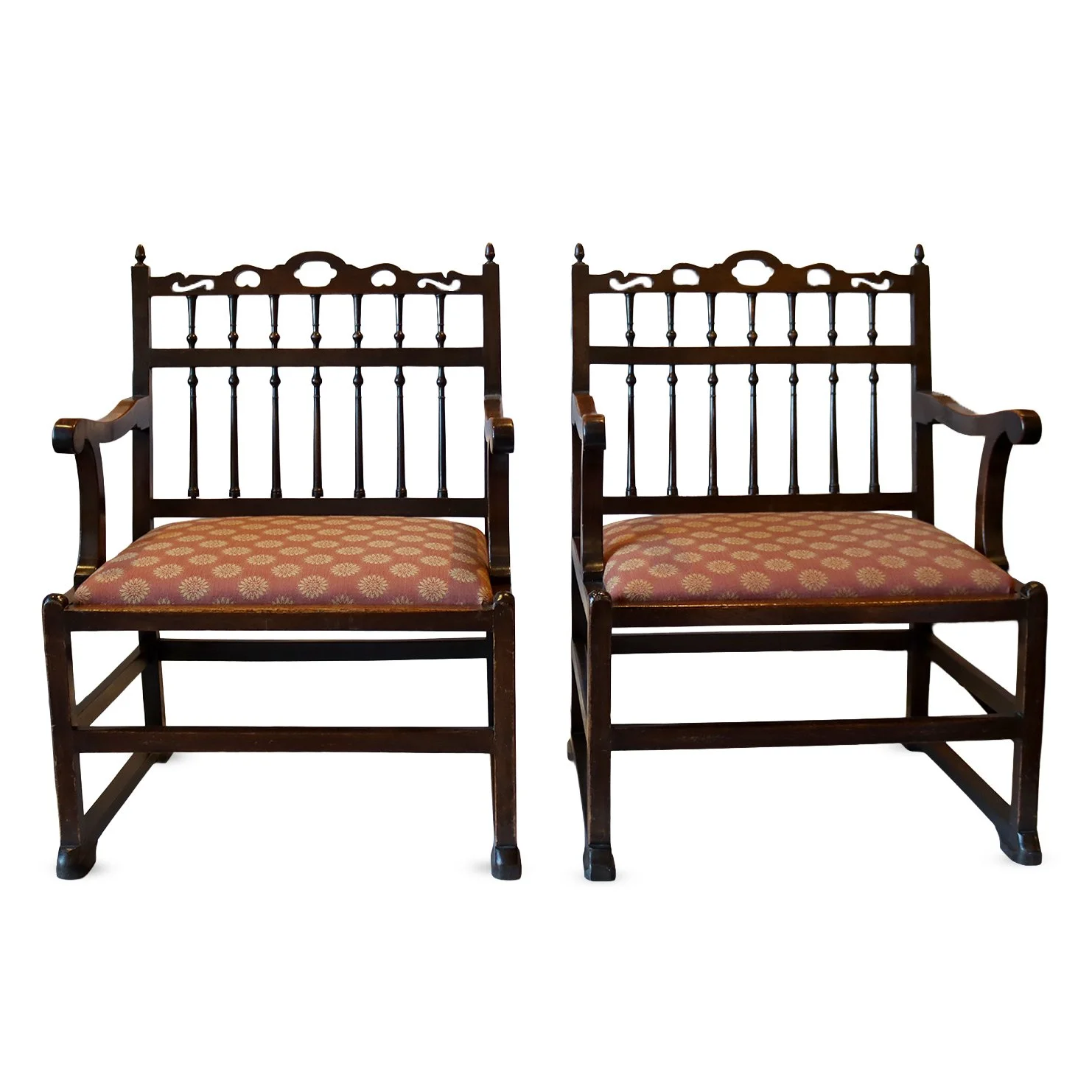
Pair of rare hardwood open arm or "garden" chairs with pierced and spindle inset backs with ball finials, scroll arms and drop-in seats, the square legs joined by straight stretchers and resting on two runners; English circa 1780-1800. Also often referred to as 'Yorkshire' chairs.
The term "garden" chair refers to the stability of the low stretcher design which prevents the legs from sinking into turf. These chairs were a staple in country houses in the second half of the 18th century, utilized as hall chairs which could be transferred outside for use in the garden. The top rail fret-work in the Gothic pattern corresponds to Mayhew and Ince's Universal System of Household Furniture patterns published in 1762. Mayhew and Ince may have provided an example for Henry, first Earl of Digby for the library at Sherborne Castle, Dorset, and a set with similar pierced crestings is found in the Lower Hall at Houghton Hall, Norfolk.
Size: 34 h x 24 ¼ w x 21 ¾ d in
A21134
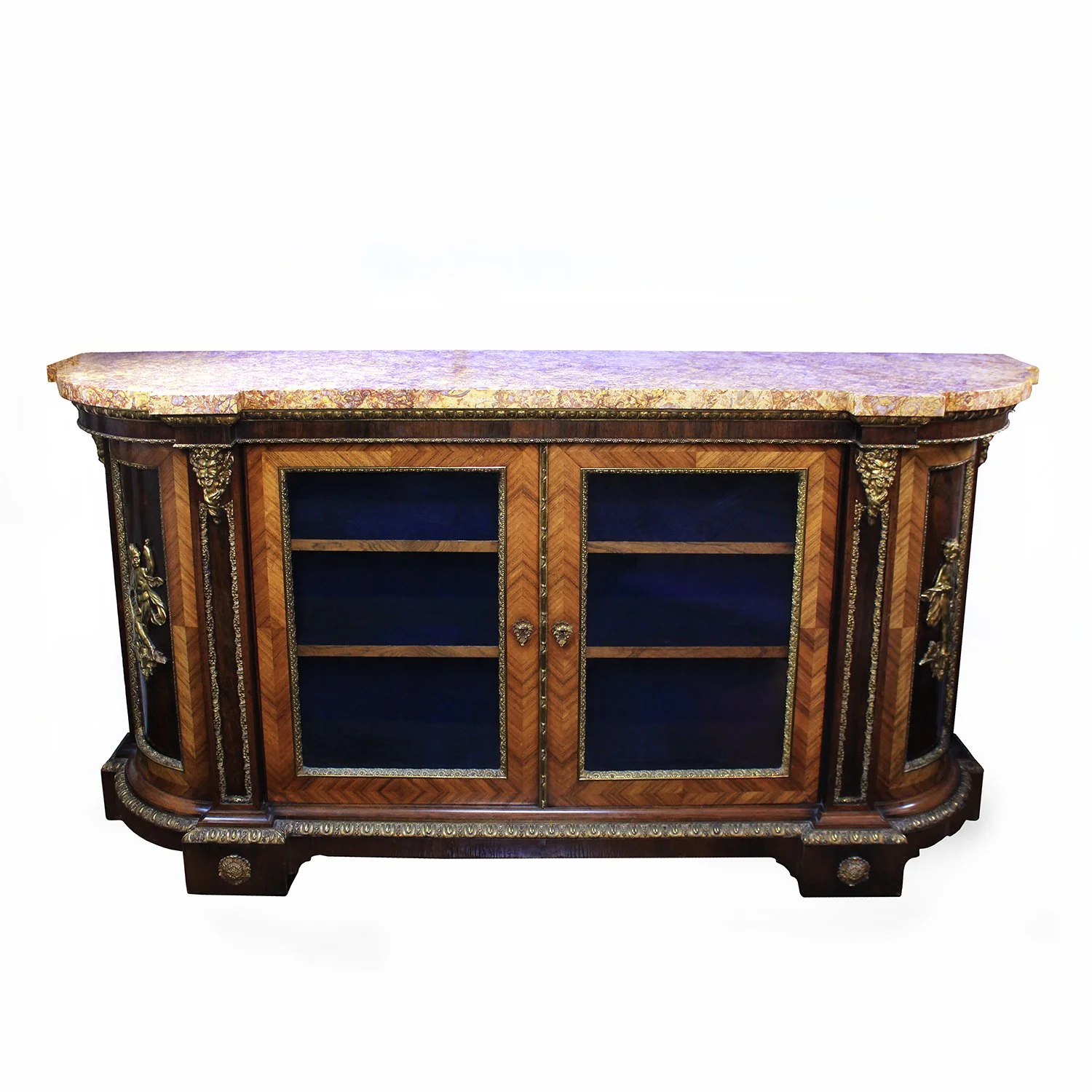
Victorian credenza with marble top and two glass front doors, decorated with gilt mounts depicting cherubs, English circa 1860, with key
Size: 34 ¾ h x 67 ½ w in x 17 d
A19108
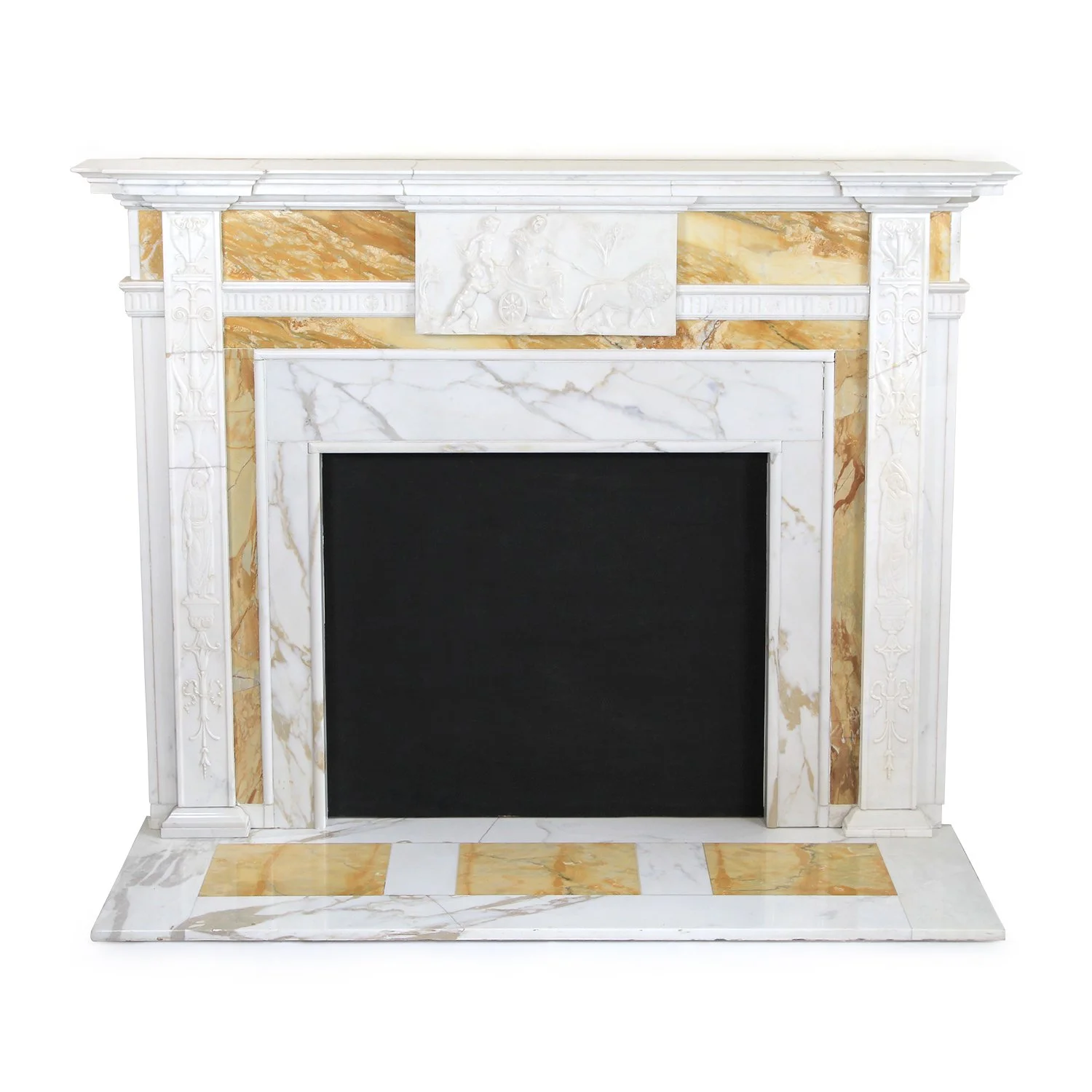
English Neo-Classical white variegated and Sienna marble fireplace mantle and surround, early 20th century
Provenance: Beaverbrook Art Gallery, Fredericton, New Brunswick
Estate of Marguerite Vaughan, Montreal, thence by descent through the family.
Size in inches: 52 ½ h x 72 ¾ w x 7 ½ d
M19815

Late George II carved mahogany birdcage-action tripod tea or supper tilt-top table, the plain figured top tilting over a swirl urn pedestal, cabriole legs with acanthus and bellflower capped knees and ball and claw feet, English circa 1760, possibly American
Size in inches: 28 ½ h x 31 ¼ d
A21209

Unique Georgian 19th century English oak jockey scale in the form of a chair, the back complete with a cast iron scale mechanism designed to weigh up to 14 stone 30 lb.
Size: 48 ½ h x 29 ¼ w x 26 ½ d
A21251

19th century French Walnut glazed front credenza with cast metal mounts, the two side and central doors each glazed
Size: 49.5 h x 52.5 w x 16.75 d in
A21171
ANTIQUE SILVER
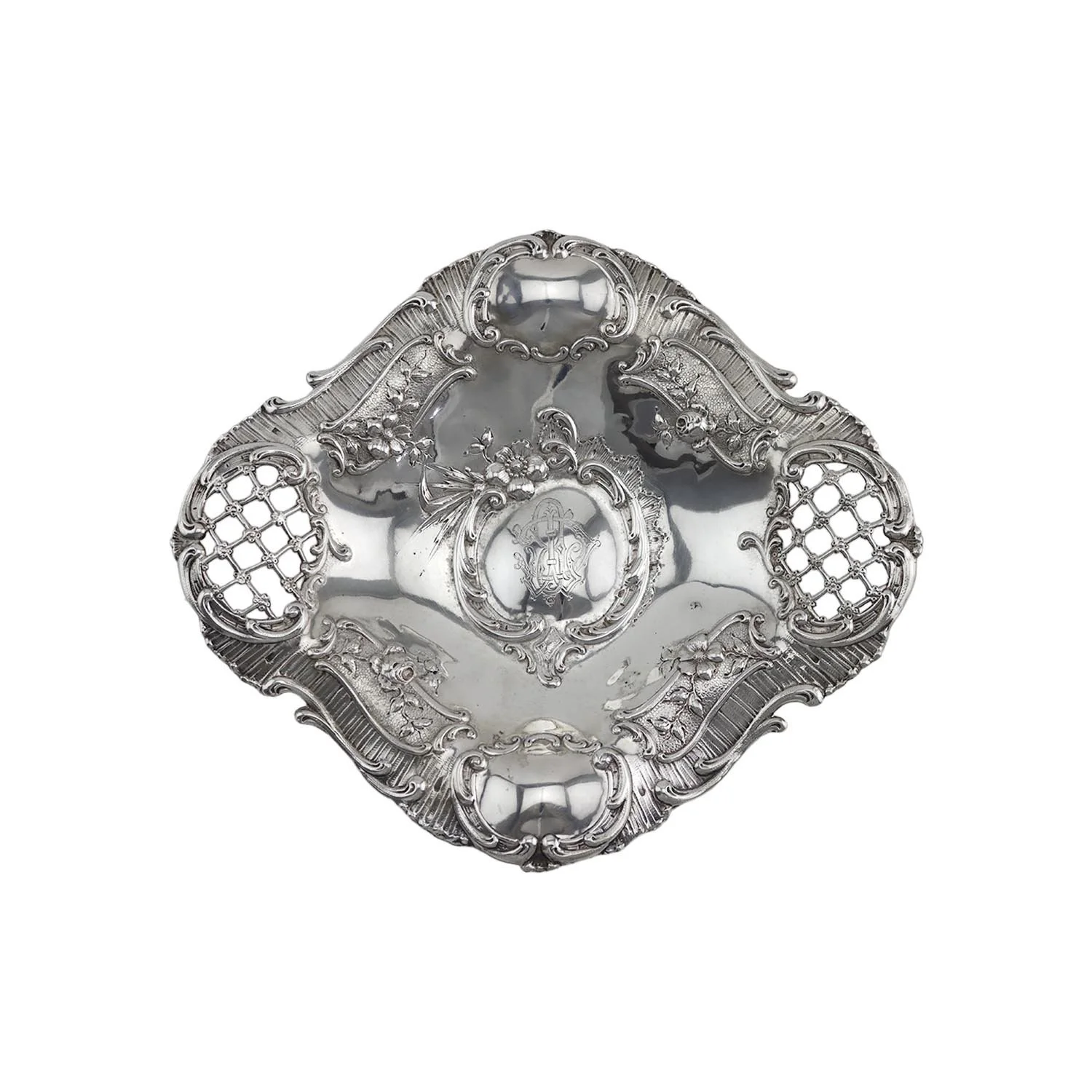
Silver bowl sitting on four feet, decorated with openwork, scrollwork and initials, hallmarked Austria 1872 800 silver, 160 grams
Size: 2 h x 11.75 w x 10 d
C21876
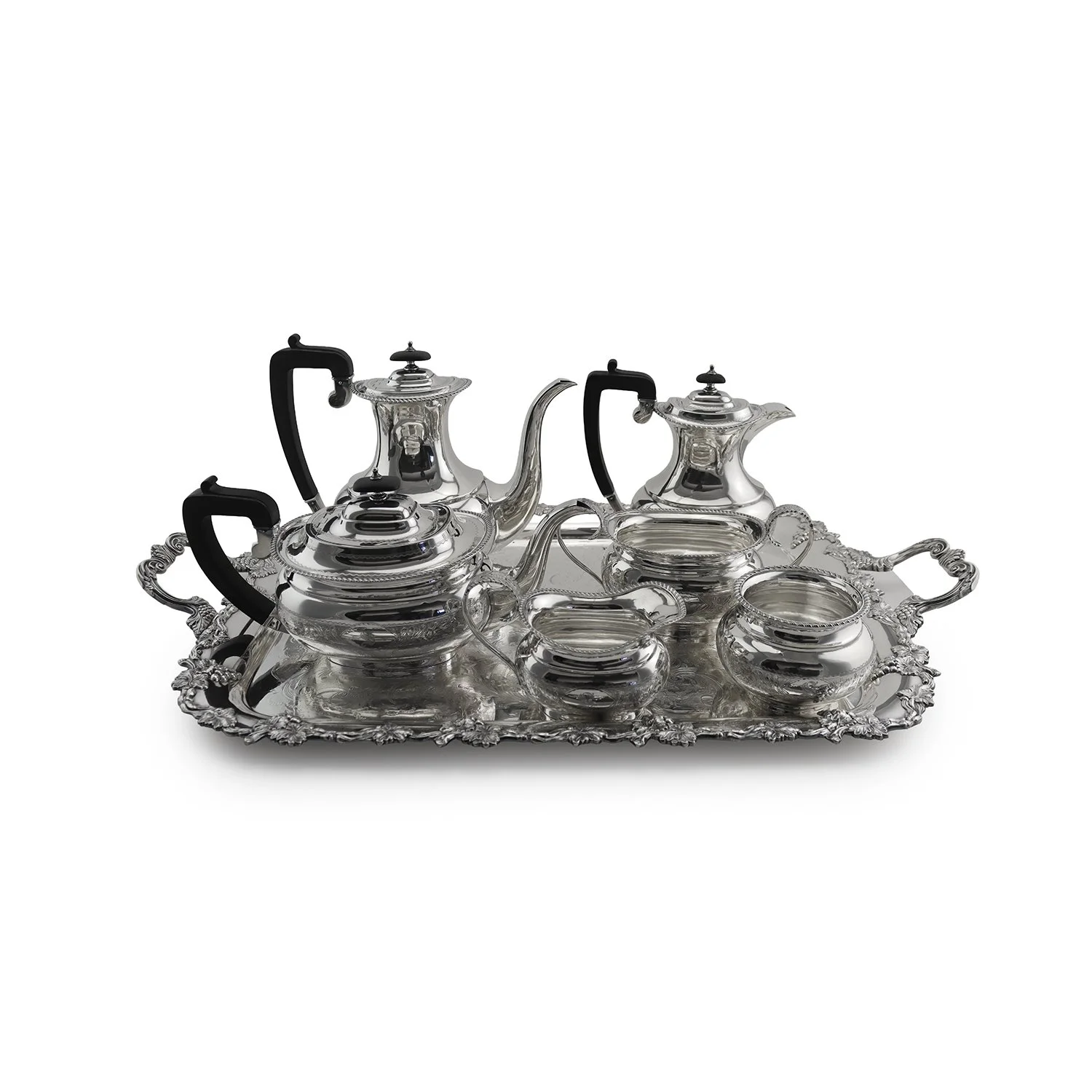
Rare six-piece sterling silver tea and coffee set, hallmarked "sterling" and with Carmichael monogram, of oblong shape with gadroon border, hand engraved decoration and shaped handles, inscribed with initials "S", sitting on silver plated tray, total 2017 grams including handles, including:
-coffee pot, with wooden handle & knop, 9" x 10 3/4" x 4 1/2" -tea pot, with wooden handle, 5 1/2" x 12 1/2" x 5"
-hot water pot, with wooden handle, 7 3/4" x 7 1/2" x 4"
-creamer with handle, 3 7/8" x 6" x 3 1/4"
-sugar with two handles, 4" x 8" x 4"
-slop bowl, 3" x 4 1/2" diameter
-silver plated tray,
Born in Victoria, British Columbia in 1894, William Morris Carmichael received most of his training in England. His father opened their first store in 1927 on Government Street in Victoria BC and two years later they moved to Fort Street where they remained. The firm became known for quality silver plate made in the Old Sheffield Plate style using a sheet of copper fused between two sheets of silver and then rolled and chased. Decoration often incorporating local flowers and indigenous designs, and rare pieces were made in sterling silver and are today highly collectible. Many works were commissioned including a Thunderbird bowl for King George V and Queen Mary in 1935. For years Carmichael was the only silversmith west of Toronto and is now sought after by collectors. Works can be found in museums in both Victoria and Vancouver.
Sizes: see above.
C21833
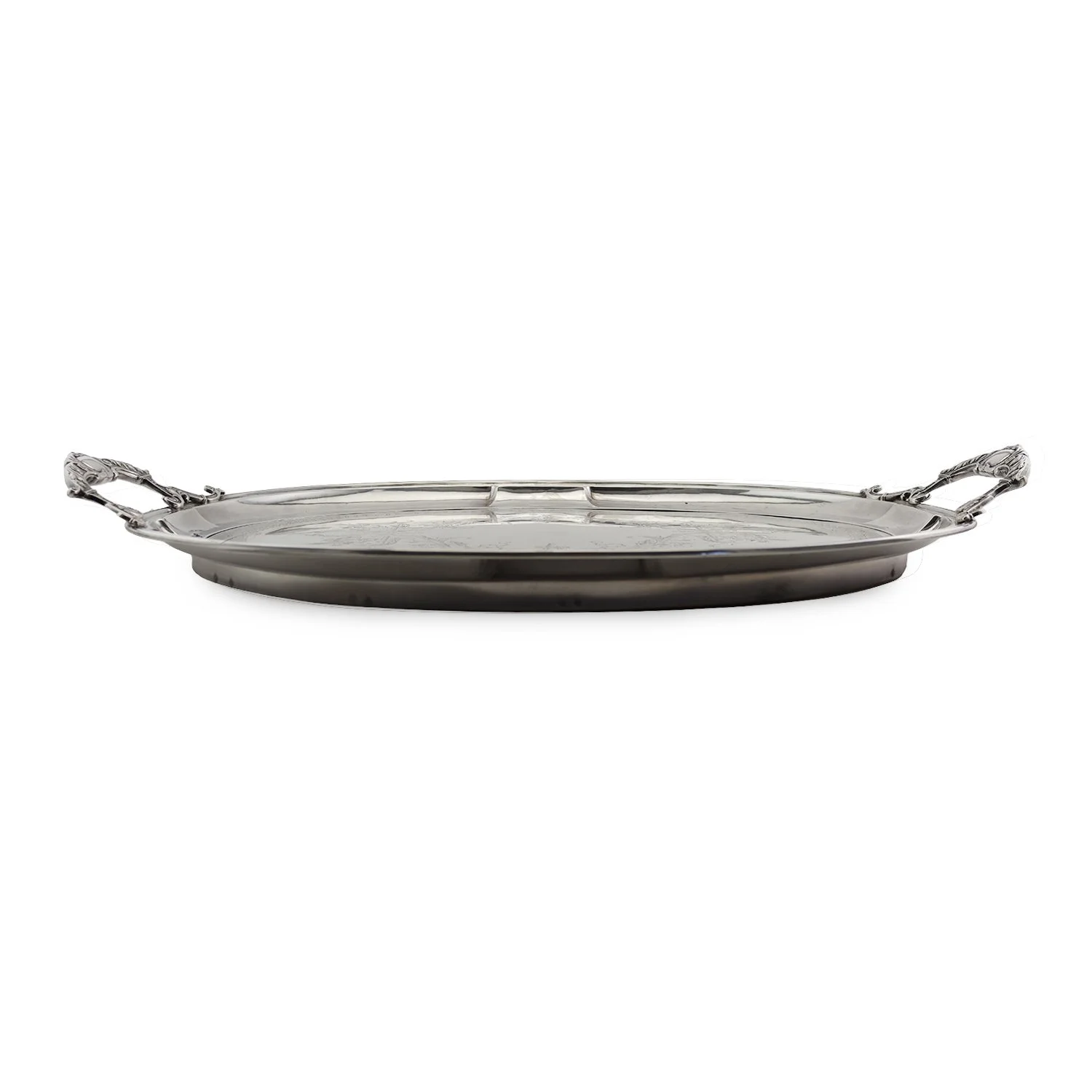
Austrian silver oval tray with handles, interior with scalloped edge, with floral decoration and looped surround, with wooden support base underneath, hallmarked Vienna .750, initials EG, other marks illegible.
Size: 3 h x 16.5 w x 25.25 d
C21842
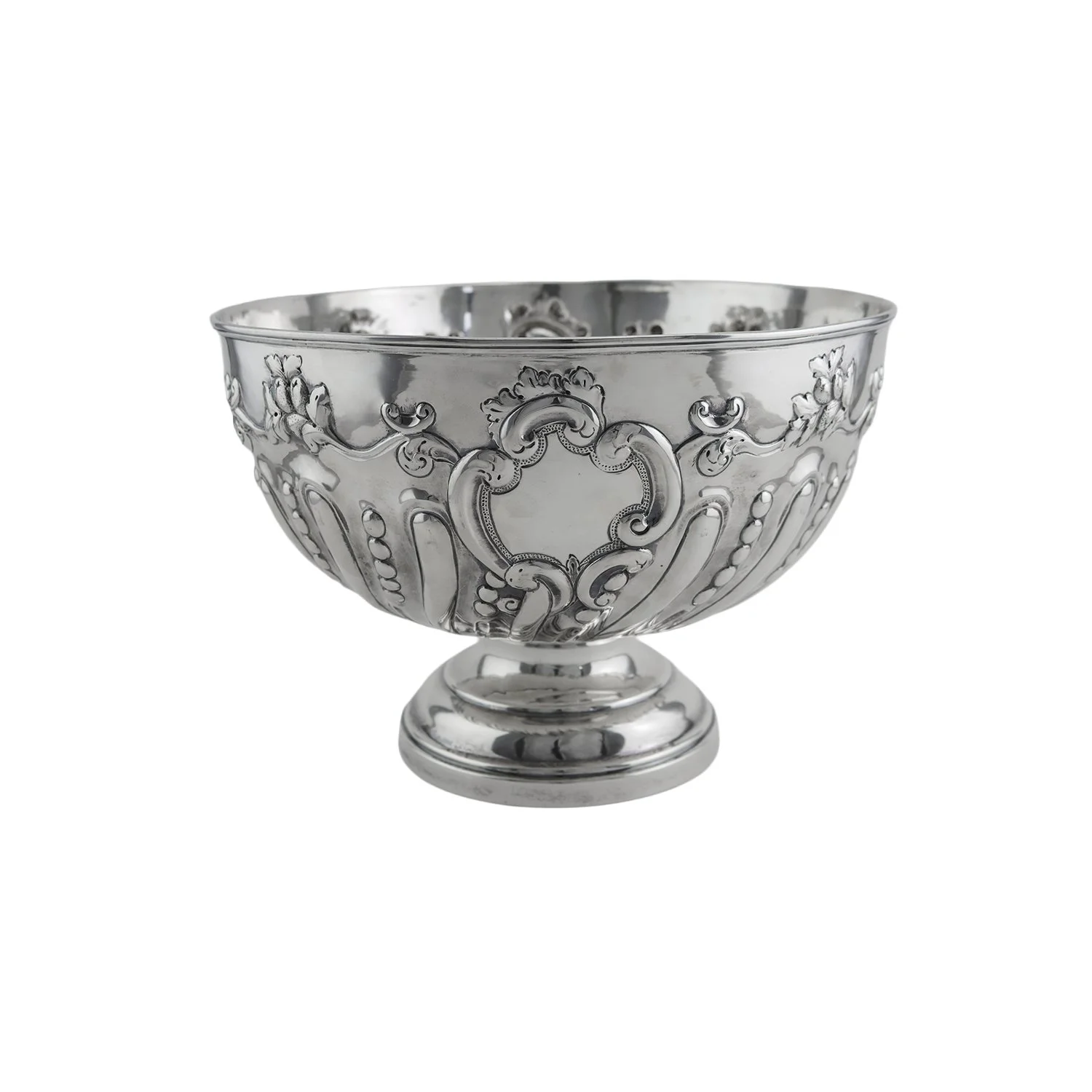
Sterling silver round rose or punch bowl, on footed base, decorated with flowers and gadroons, hallmarked for Birmingham 1898 and maker GNRH (George Nathan & Ridley Hayes), weight 811 grams
Size: 7.25 h x 10.25 w x 10.25 d
C21835
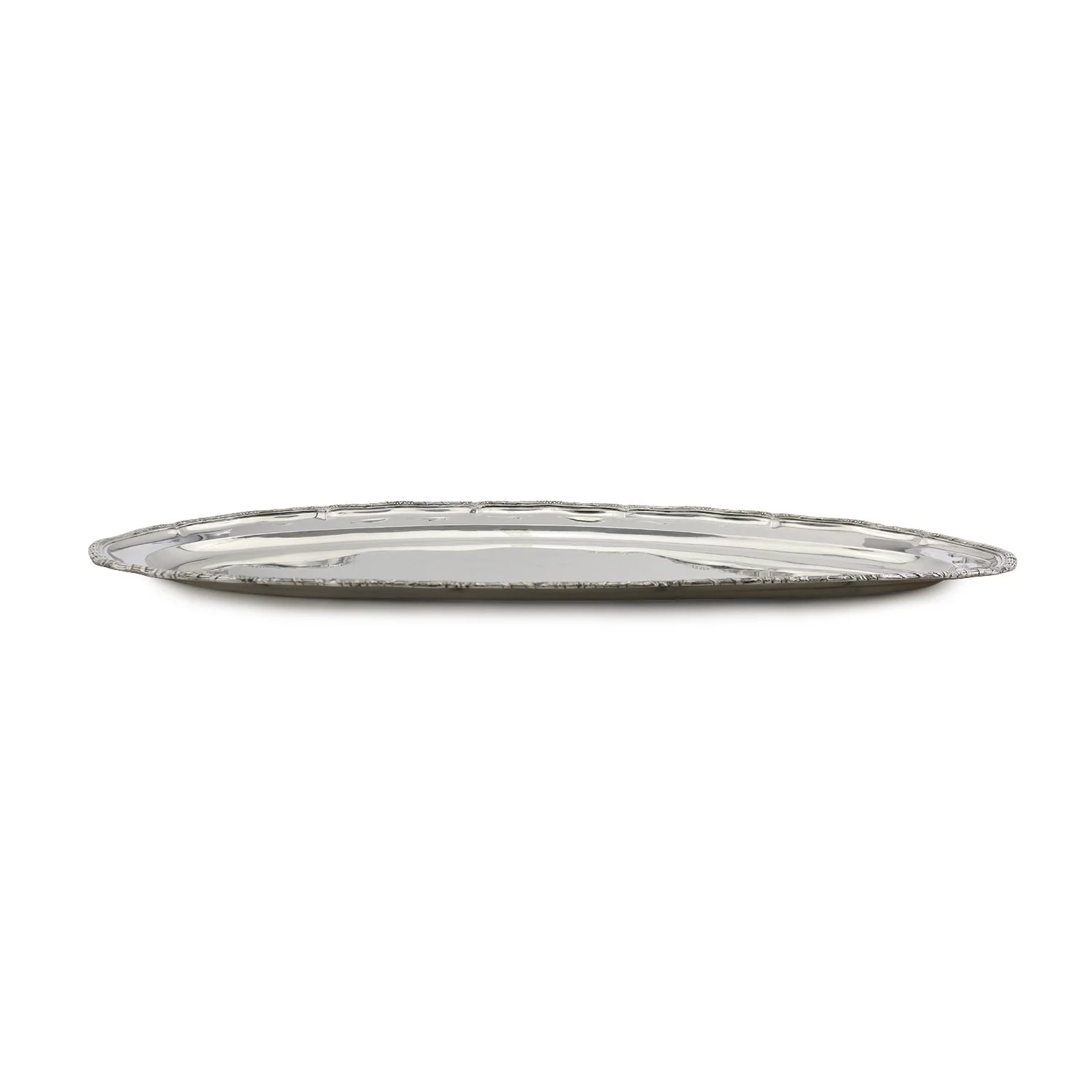
Oval silver tray with scalloped edge decorated with flowers, hallmarked Austria .800, additional hallmarks illegible, inscribed underneath with initials "BB", weight approximately 1822 grams.
Size: 1.25 h x 12.5 w x 28.25 d
C21838
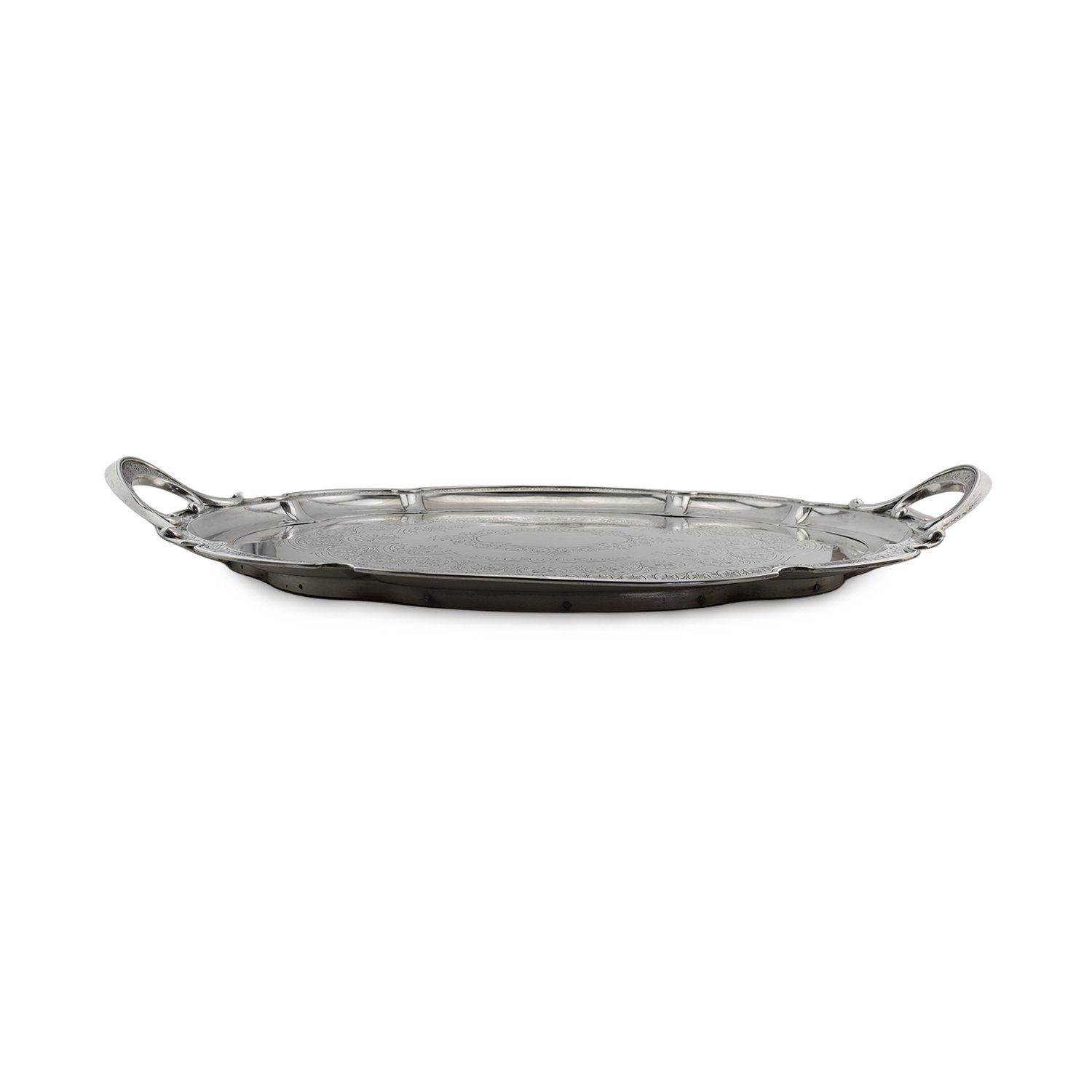
Austrian silver oval tray with scalloped border, the interior with floral decoration, with wooden support base underneath, hallmarked Vienna .750, initials BAC?, with further illegible mark.
Size: 3.5 h x 21 w x 30.25 d
C21843
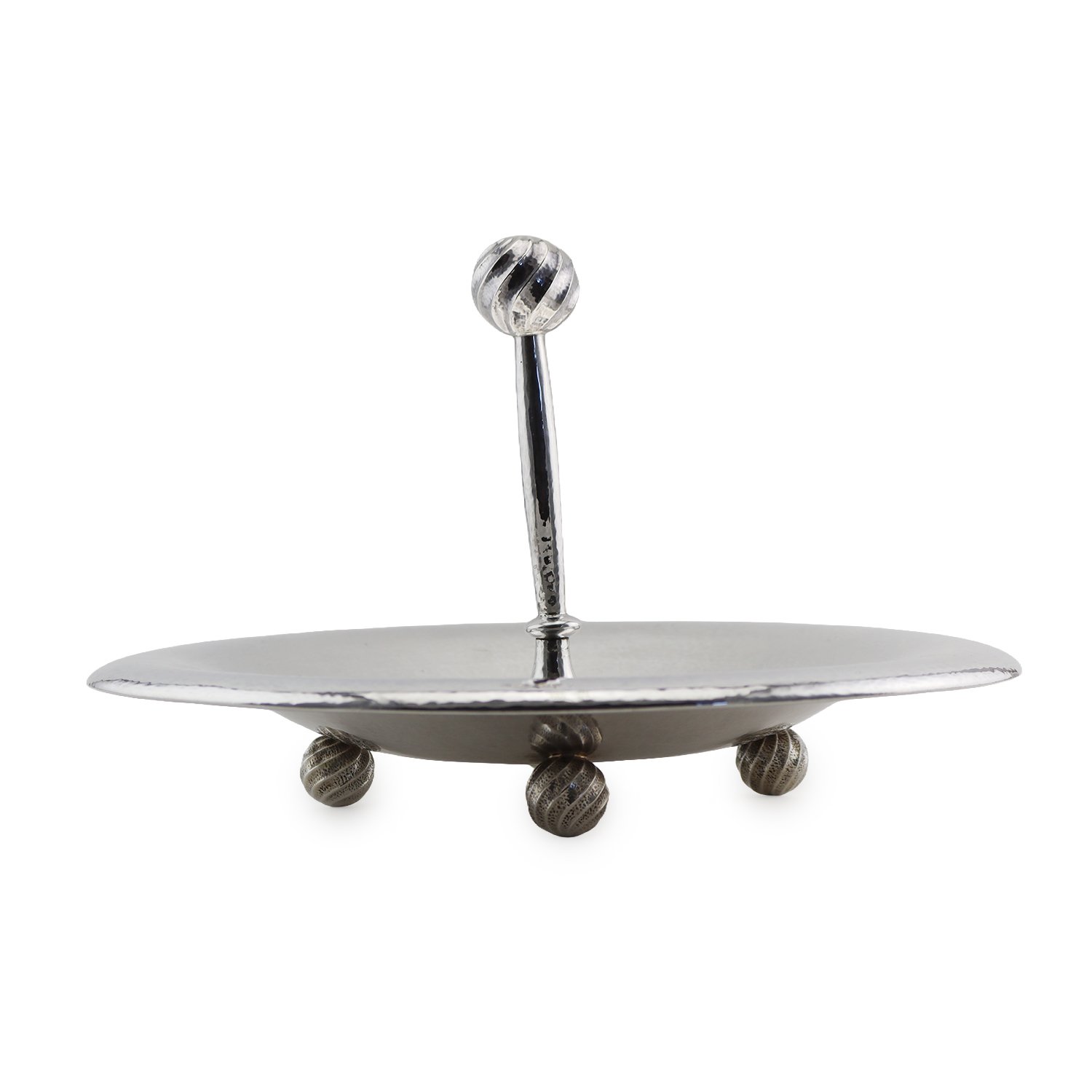
Fine Austrian hand hammered tray with center handle with ball, sitting on four ball feet, hallmarked 800 Schwarz & Steiner, Vienna .750 A*N, weight approximately 871 grams.
Size: 9.5 h x 13.75 w x 13.75 d
C21840
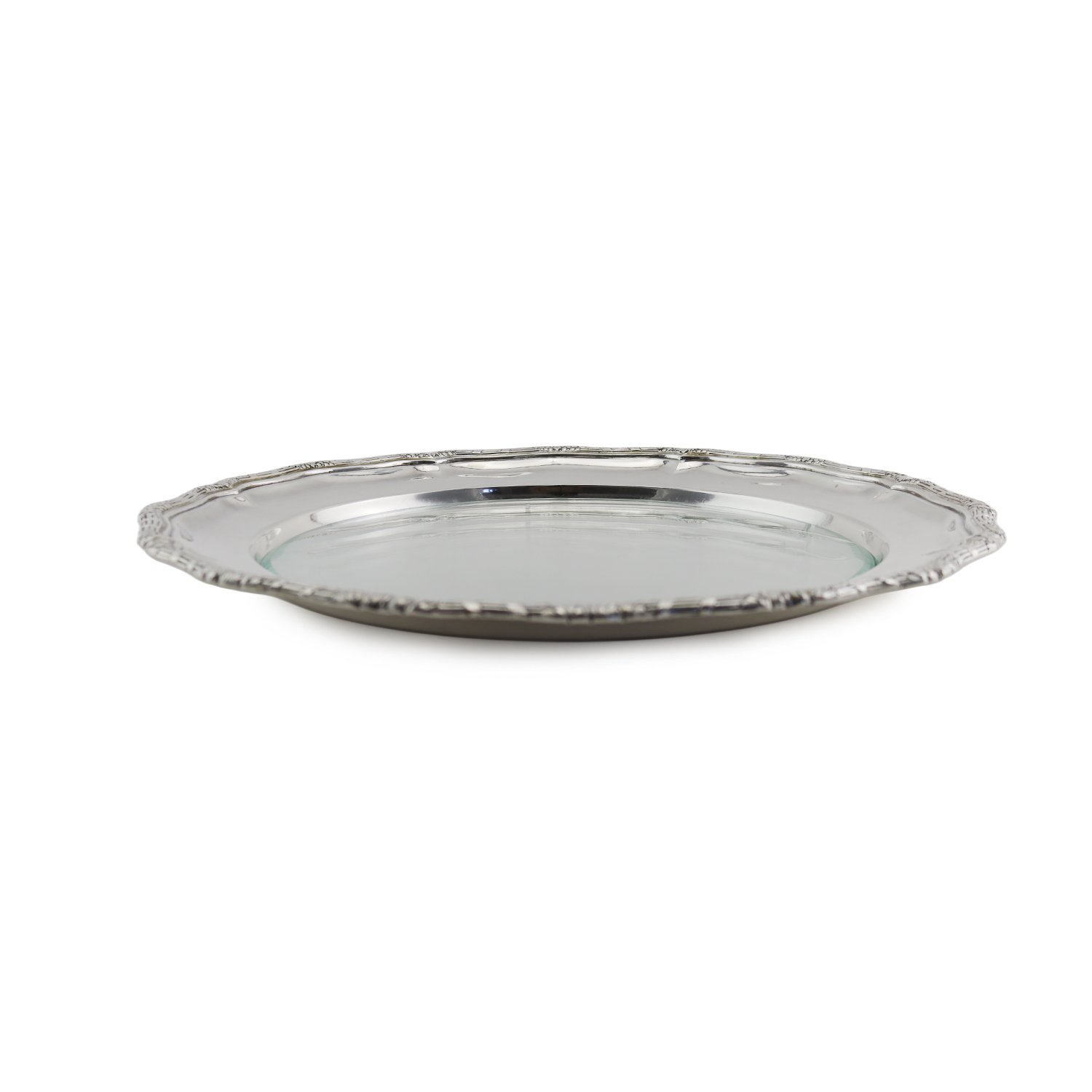
Austrian round tray with scalloped edge decorated with flowers, with glass insert (chip), hallmarked 800 Vienna, inscribed underneath with initials "BB", weight approximately 1092 grams.
Size: 1 h x 13.25 w x 13.25 d
C21845
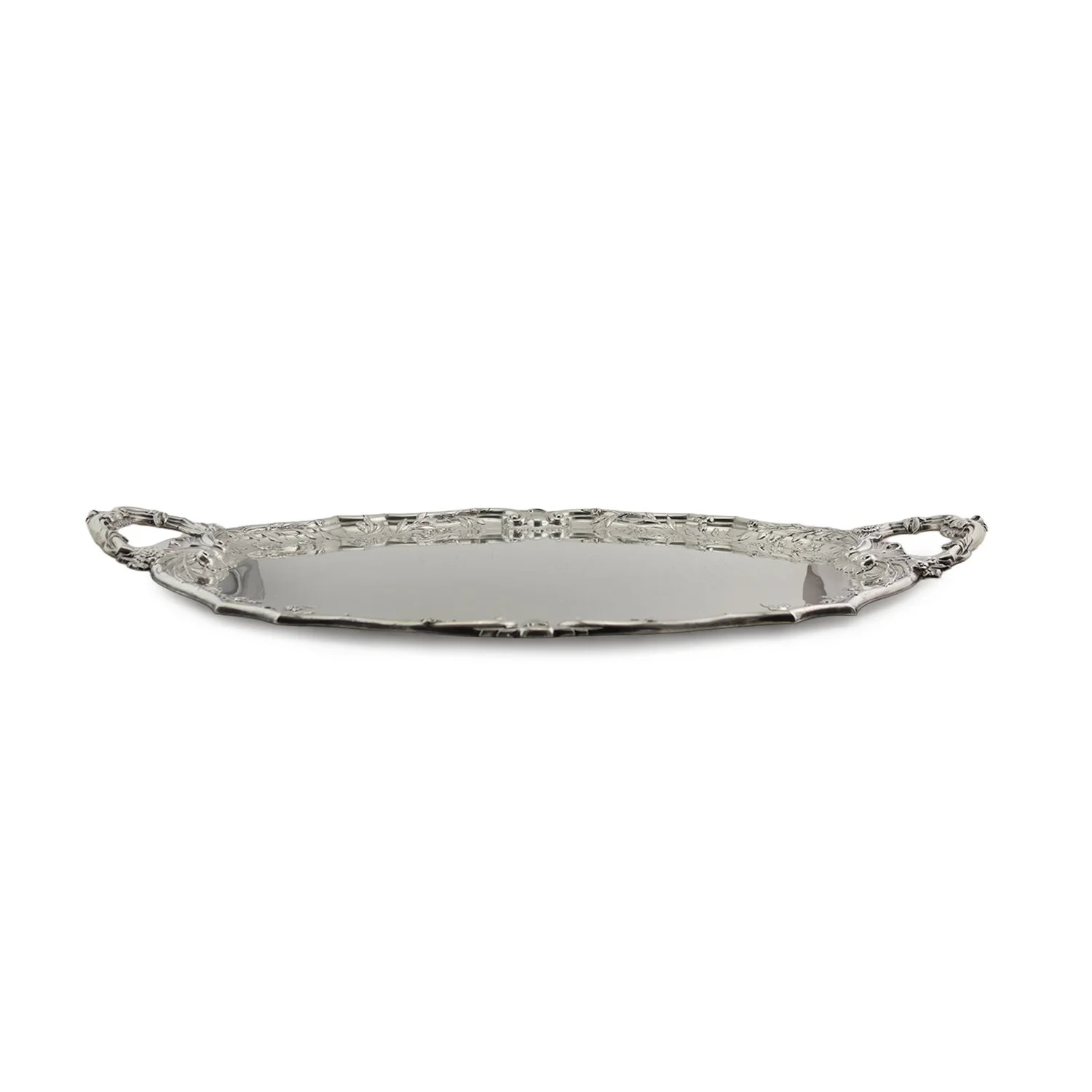
Fine double handed oval tray with Art Nouveau finely decorated with floral swags, hallmarked J.C. Klinkosch, Vienna 1872 .800, weight approximately 4009 grams.
Size: 1.75 h x 19.5 w x 31 d
C21839
ETHNOGRAPHIC
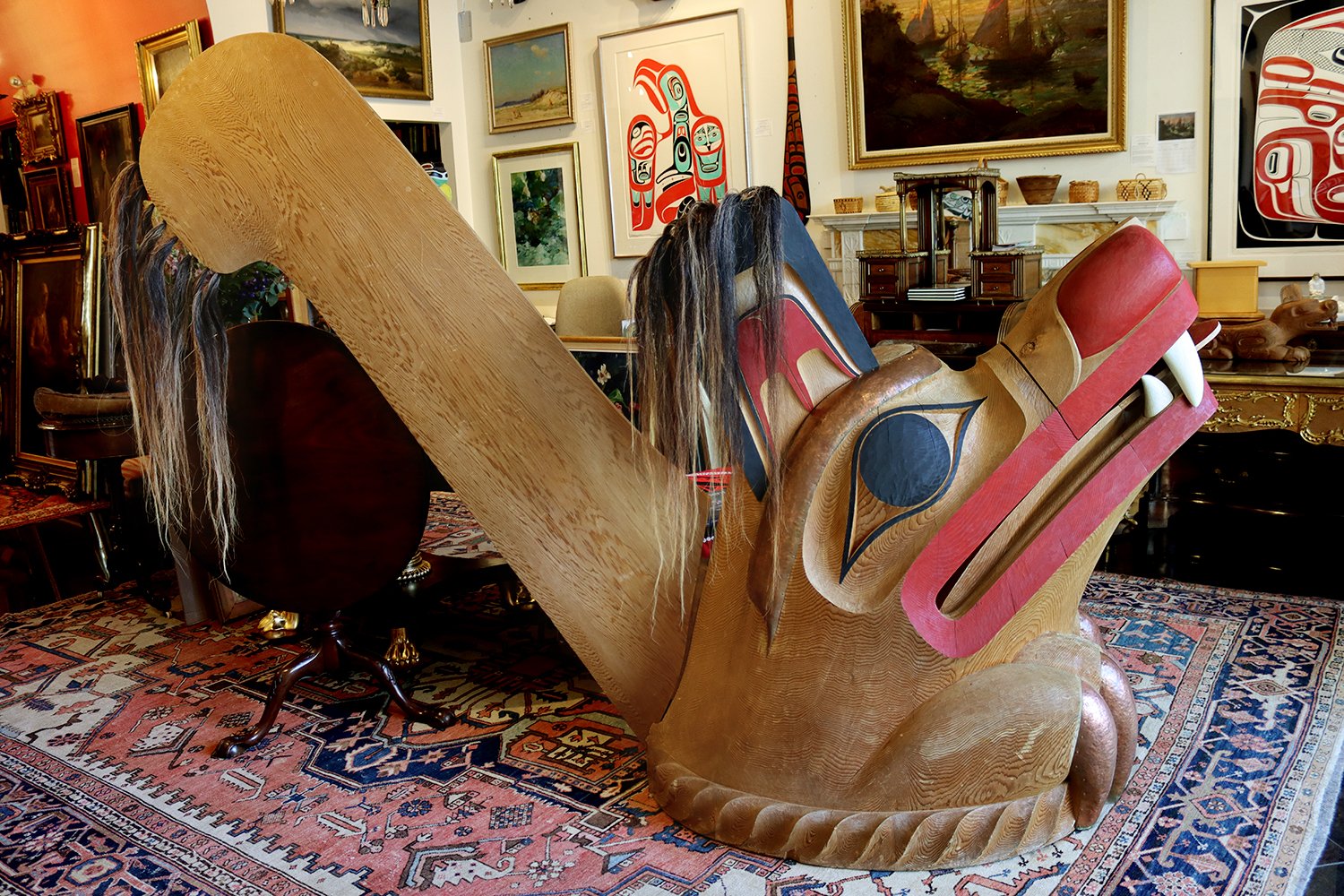
Wasco 1998
Red cedar, pigment, copper and horse hair.
Wasco is a legendary Haida creature that lives in the ocean, with hybrid features of a killer whale and a wolf that include copper claws and eyebrows.
Provenance: Private Collection, B.C.
Exhibition History:
Museum of Anthropology, UBC, central foyer
Eagle Lounge, Langara Island Lodge
Crystal Gallery, Audain Gallery, Whistler 2025-March 30, 2026
Size: 72 h x 99 w x 46 d
P21828
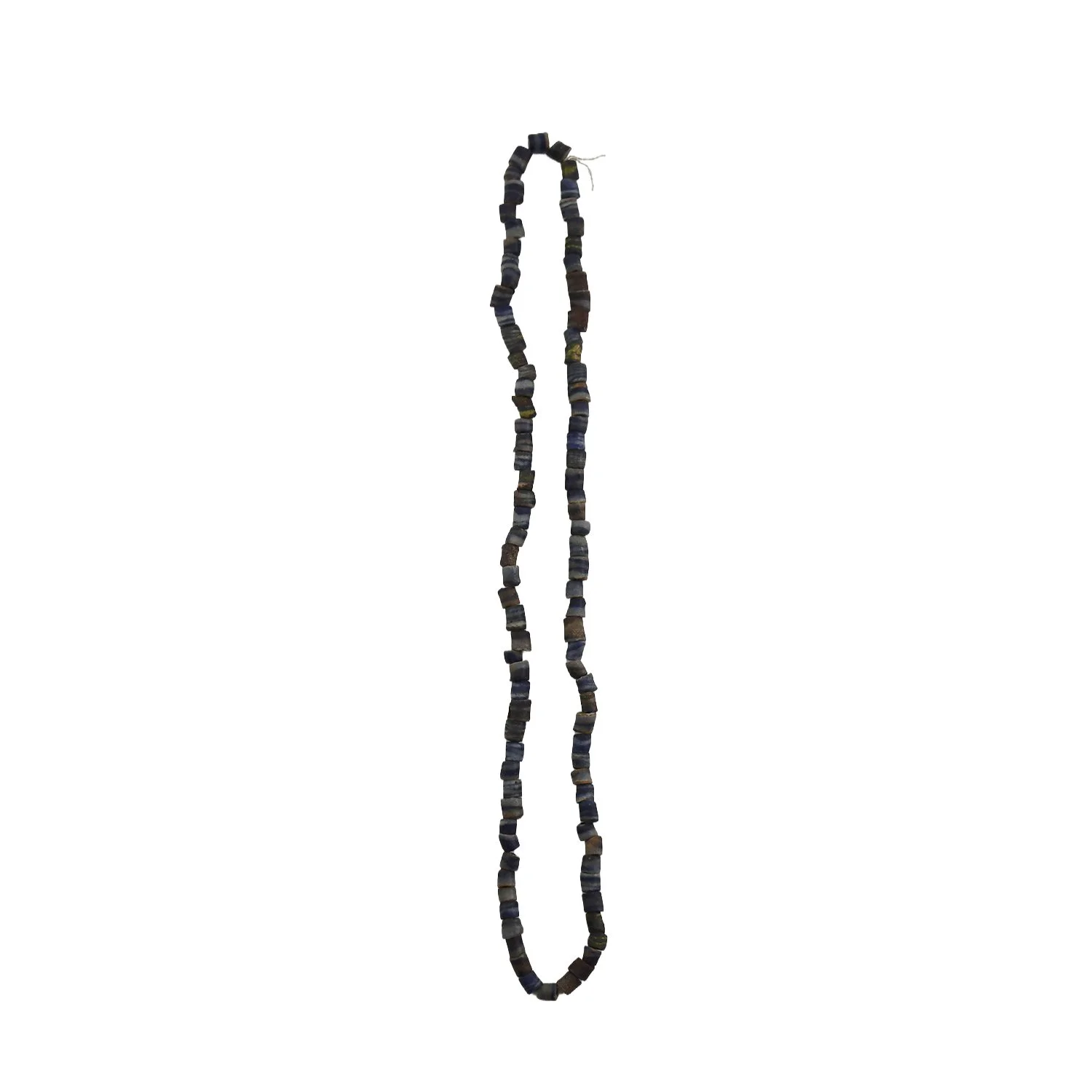
Strand of 95 ceramic trade beads, in and rare blue striation pattern (possibly African) found at the foot of Granville street by the Fraser river, circa 18-19th century, widest bead approximately 1/4", length of strand approximately 26"
As trade opened up throughout the Pacific Northwest, glass beads were introduced and became integral in trade between European fur traders and local Indigenous peoples. Being compact and easily transportable, beads became widely sought after for their colours and ease of use and soon replaced hand made local beads made from shell, pearl, bone, teeth and stone. They became a medium of exchange in favour of the European monetary system, were kept as ornaments and decorations, and often admired as status symbols or used to embellish personal items or jewellery. Many varieties of trade beads were used, the most popular being those known as “Russian Blue” after the Russian involvement in the fur trade in the area starting in the late 18th century. Designed for export, these beads were distributed to traders and found their way through various trade routes to both Africa and the Americas. It is said that one beaver skin could be traded for as much as a six-foot long strand of beads.
Size: 13 h
P21875
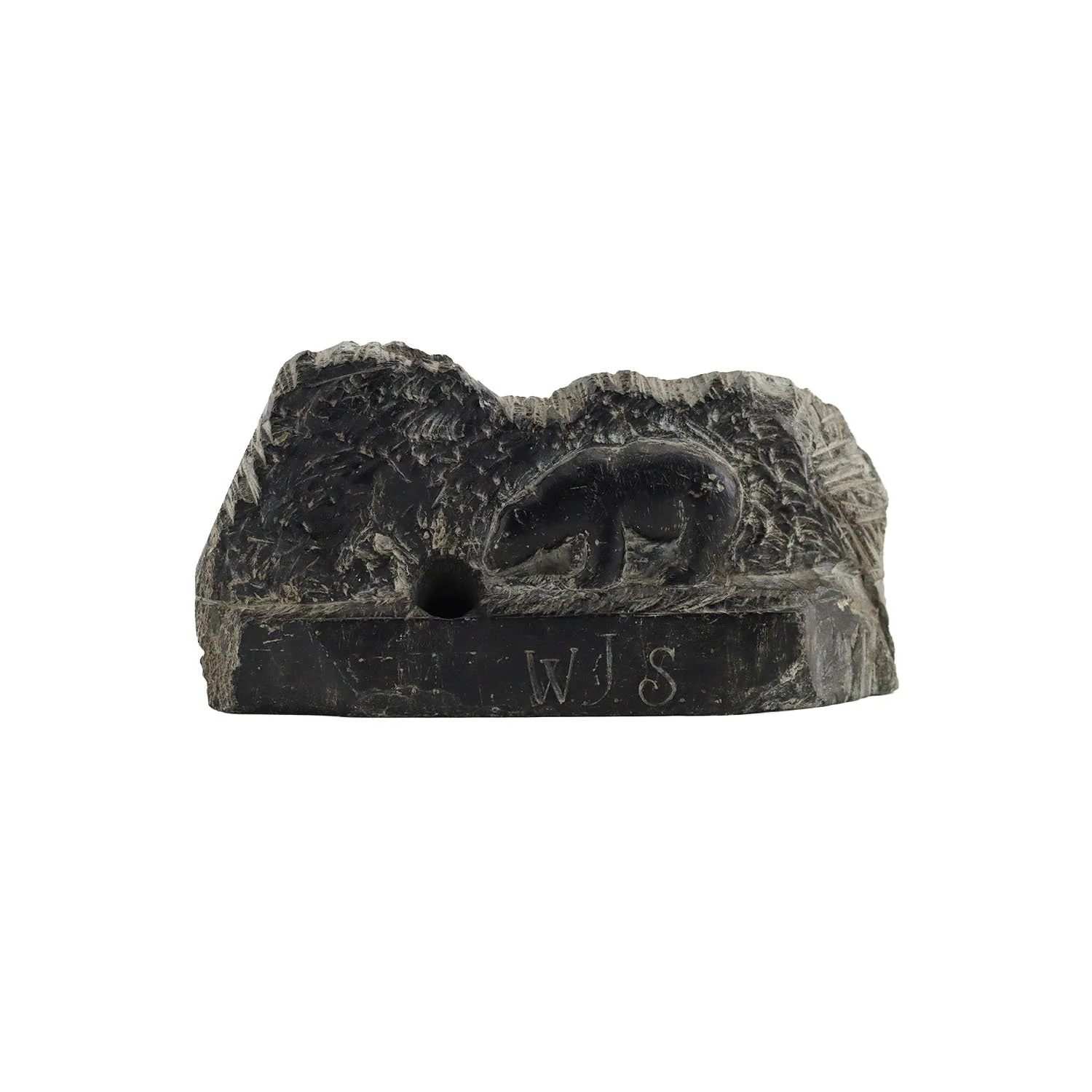
Inuit carved soapstone relief of polar bear by fishing hole, front inscribed "W.J.S." and reverse dated "Aug 1933"
Provenance: Estate of Niels Knudsen, Victoria
Size: 4.75 h x 9.25 w x 2.5 d in
P21683
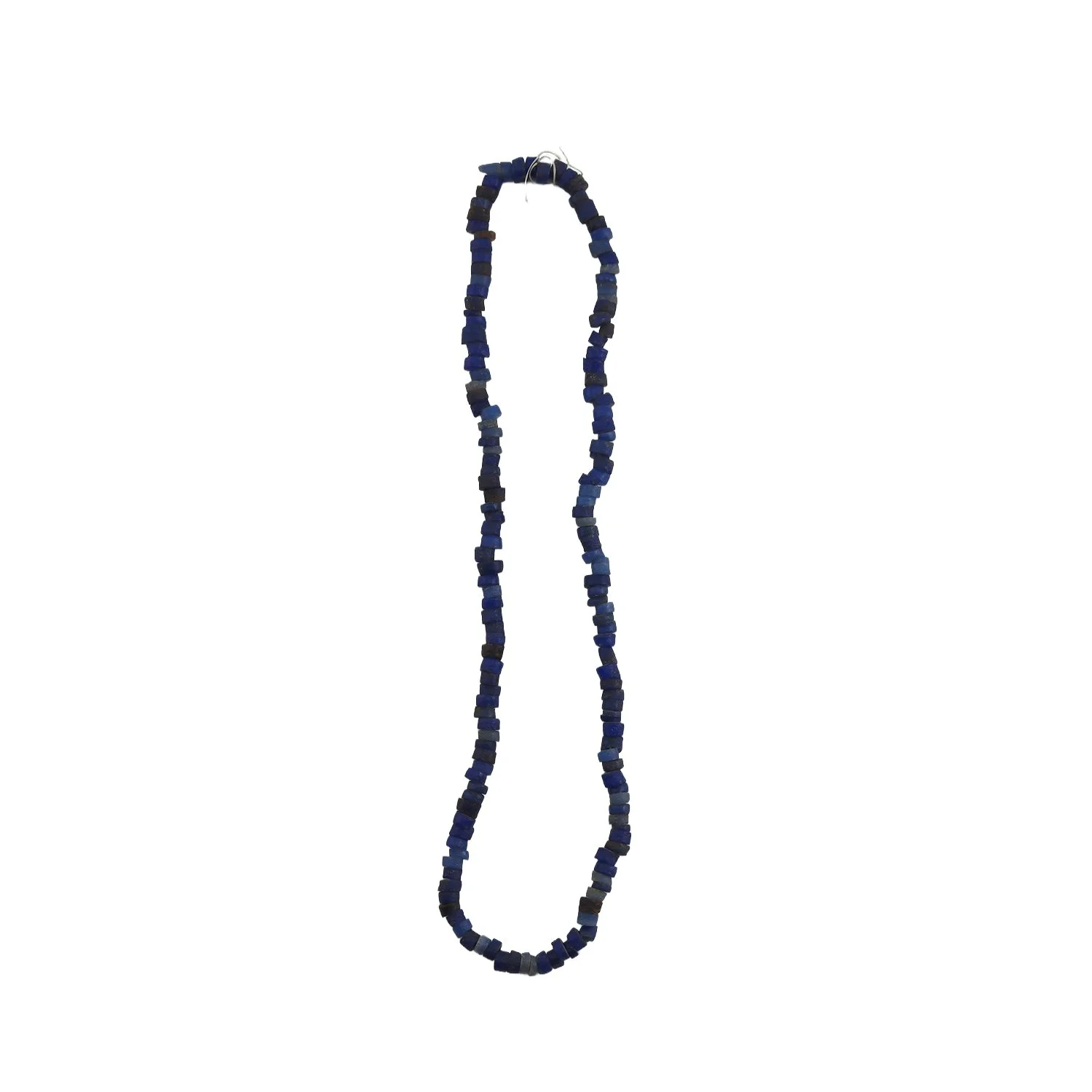
Strand of 158 glass trade beads, cylindrical shaped in a mix of lengths and shades of blue (possibly Chinese or Venetian) , found at the foot of Granville street by the Fraser river, circa 18-19th century, widest bead approximately 1/4", length of strand approximately 22"
As trade opened up throughout the Pacific Northwest, glass beads were introduced and became integral in trade between European fur traders and local Indigenous peoples. Being compact and easily transportable, beads became widely sought after for their colours and ease of use and soon replaced hand made local beads made from shell, pearl, bone, teeth and stone. They became a medium of exchange in favour of the European monetary system, were kept as ornaments and decorations, and often admired as status symbols or used to embellish personal items or jewellery. Many varieties of trade beads were used, the most popular being those known as “Russian Blue” after the Russian involvement in the fur trade in the area starting in the late 18th century. These are characterized by their solid cobalt blue colour and faceted disk shape with multiple sides and edges. Despite their name many of these beads were manufactured in Venice, Italy, although some were also made in Bohemia. Designed for export, these beads were distributed to traders and found their way through various trade routes to both Africa and the Americas. It is said that one beaver skin could be traded for as much as a six-foot long strand of beads.
Size: 1 1 h
P21874
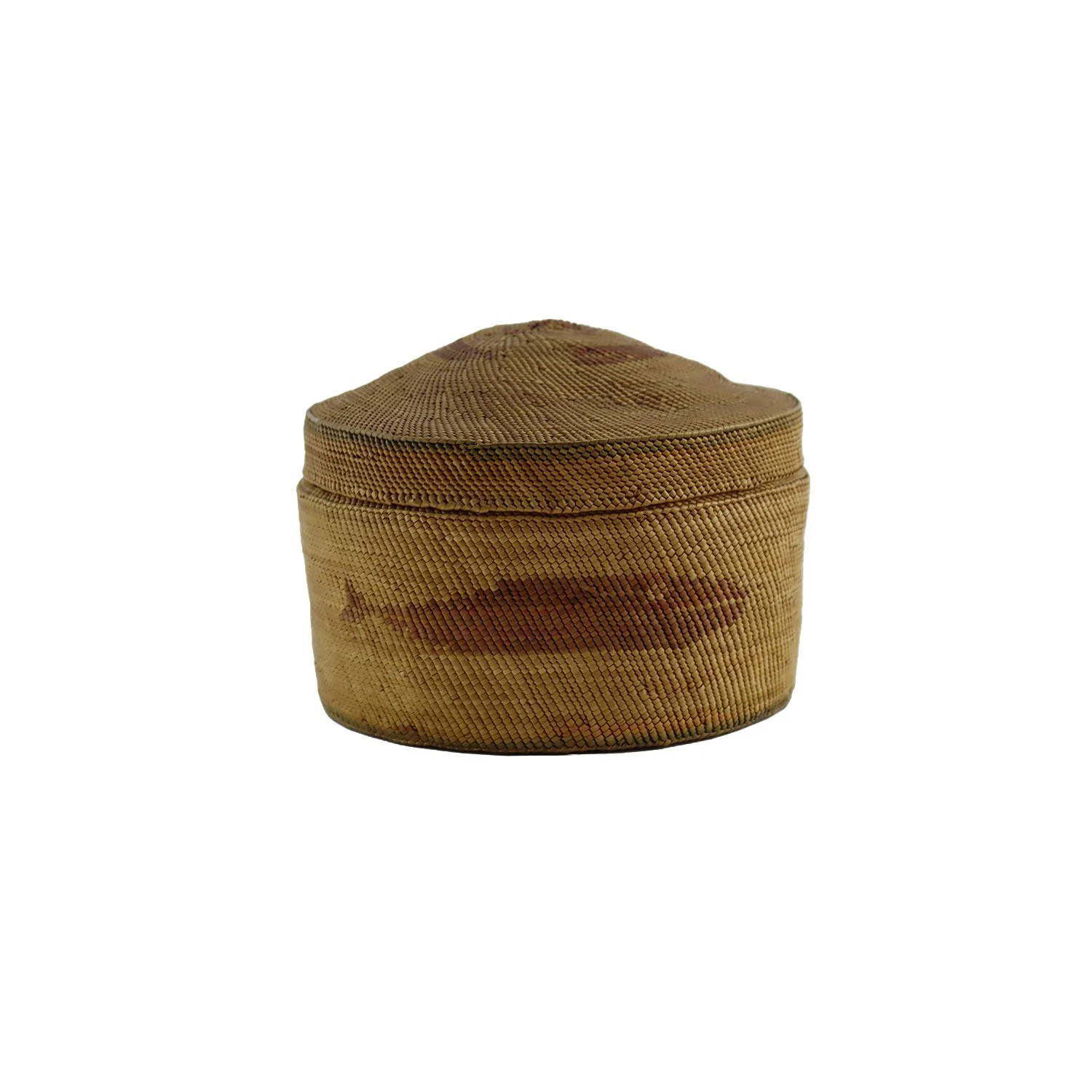
Nootka lidded round basket with domed lid, decorated with whales, circa 1900
Size: 4.25 h x 5.62 w x 5.62 d in
P21696
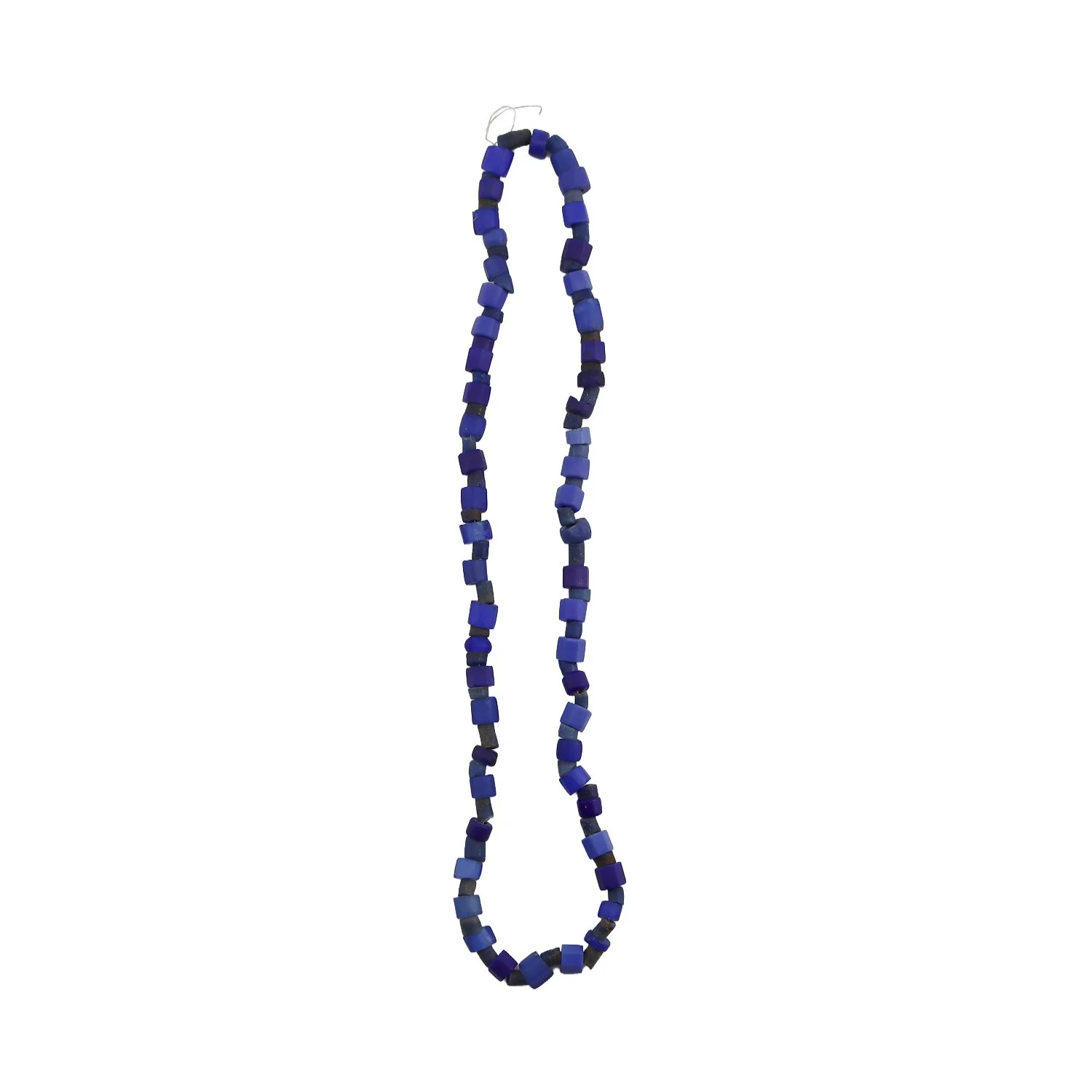
Strand of 104 glass trade beads, a mix of soft blue or "Russian blue" faceted beads likely Venetian made and blue cylindrical beads (possibly African), and blue rounded bead. Found at the foot of Granville street by the Fraser river, circa 18-19th century, widest bead approximately 3/8", length of strand approximately 25"
As trade opened up throughout the Pacific Northwest, glass beads were introduced and became integral in trade between European fur traders and local Indigenous peoples. Being compact and easily transportable, beads became widely sought after for their colours and ease of use and soon replaced hand made local beads made from shell, pearl, bone, teeth and stone. They became a medium of exchange in favour of the European monetary system, were kept as ornaments and decorations, and often admired as status symbols or used to embellish personal items or jewellery. Many varieties of trade beads were used, the most popular being those known as “Russian Blue” after the Russian involvement in the fur trade in the area starting in the late 18th century. These are characterized by their solid cobalt blue colour and faceted disk shape with multiple sides and edges. Despite their name many of these beads were manufactured in Venice, Italy, although some were also made in Bohemia. Designed for export, these beads were distributed to traders and found their way through various trade routes to both Africa and the Americas. It is said that one beaver skin could be traded for as much as a six-foot long strand of beads.
Size: 12.5 h
P21872