


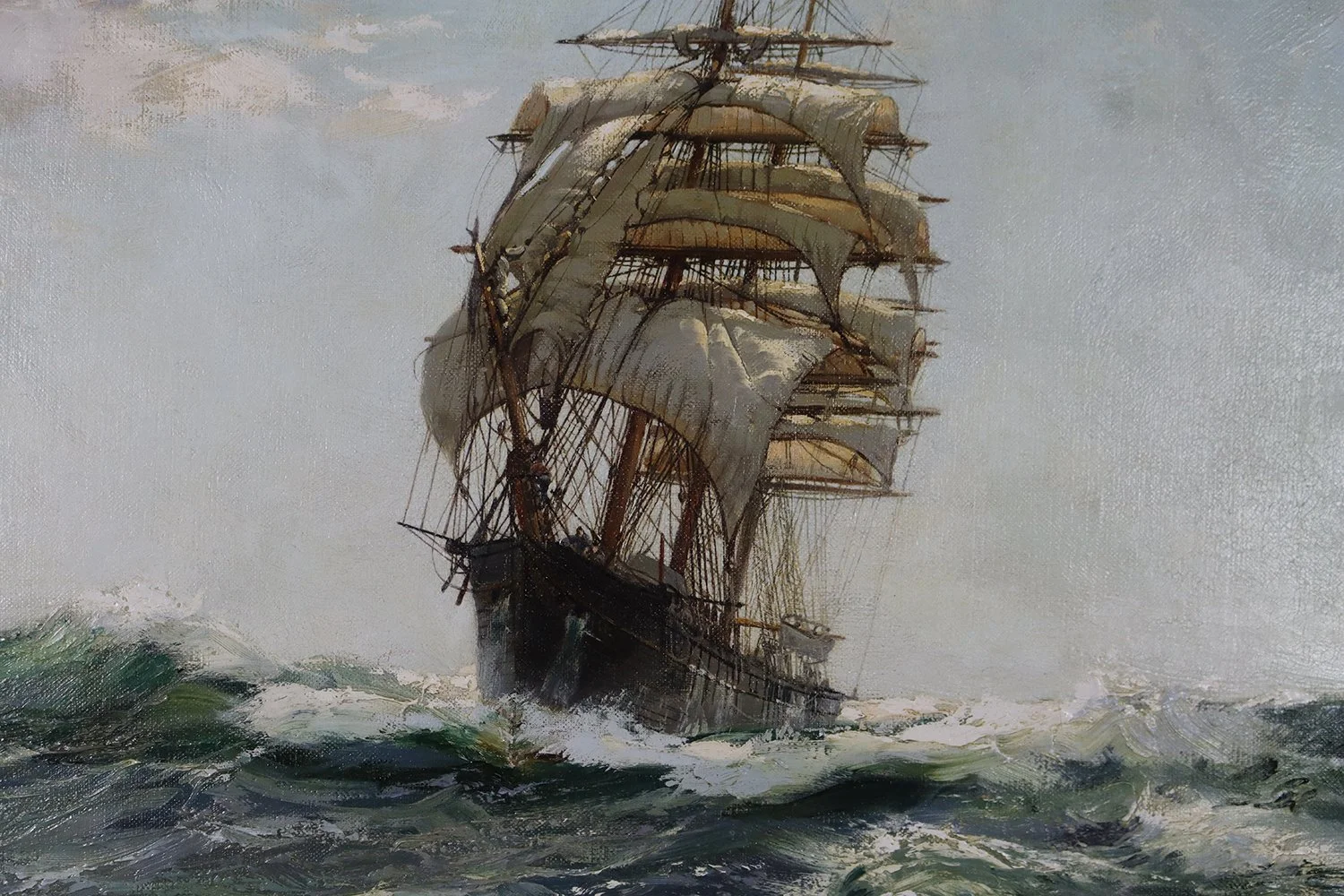
Montague Dawson (British 1890-1973)
High Winds - The Barquentine Titania
oil on canvas, signed lower left "Montague Dawson", inscribed on back in pencil "High Winds The Titania Built in 1866 of 879 tons", titled on gallery label
Provenance:
Frost and Reed Limited London UK
Cooling Galleries London UK
Private collection Toronto Canada
The SV Titania was a ship of extreme Canadian importance, as she was the first to transport canned salmon directly from the canneries in Steveston, British Columbia to Europe. She was considered the finest-lined composite-built clipper designed by Robert Steele and was launched in 1866 for Lowther, Maxton & Co. of London. Registered at 879 tonnes, she measured 200’ in length, with a 36’ beam and 21’ depth, with a mainmast of 146’. She originally sailed as a profitable China Tea Clipper making the run to and from asia loaded with tea for the British market, and was the second fastest clipper in the world. She beat the Cutty Sark and Taeping to Shanghai in 1870 and the Cutty Sark and Thermopylae from Foochow to London in 1871 in a record 93 days under Captain J. Dowdy. In 1885 she was bought by the Hudson’s Bay Company for £1400 and barque rigged circa 1886 for the voyage from British Columbia around Cape Horn and across the South Atlantic to London. In total she sailed from British Columbia to Europe and back five times for a total of ten crossings, each crossing taking between 106 and 136 days. She was sold in 1894 to Italian owners before being laid up in Marseilles in 1909 and scrapped in 1910.
In her HBC years, the Titania’s most commemorated crossing was in September of 1889 when she carried the first direct shipment of canned salmon from Steveston, British Columbia to London. Prior to this, canned salmon was shipped by paddlewheel steamer to Victoria before boarding ships to Europe. The Titania was the first European or British bound ship to dock at the Britannia Cannery wharf in Steveston, with large steam tugboats towing her up the Fraser River to the cannery to load her. The HBC ships would unload ballast in Steveston and fill with cases of Fraser River salmon, with the ballast rocks used to build roads and dykes. The HBC benefited from increased stock for the European market and from being in a freshwater port in which to rid the ship’s hull of barnacles.
Montague Dawson is considered the greatest marine painter of the 20th century in the realist tradition, known for the strict accuracy and nautical detail of his paintings. With little formal training, he was fascinated from an early age with ships and began drawing at the age of eight. After working as an illustrator in London he enlisted in the Royal Navy and earned the duty of keeping a visual record of the war at sea. Mentored by the marine painter Charles Napier Hemy, he submitted works to the Royal Academy and formed a partnership with Frost and Reed who represented him for the remainder of his career. After marrying he moved his family to Milford on Sea in Hampshire in 1934 where he painted until his death in a cottage he built behind his house. He exhibited regularly at both the Royal Society of Marine Artists and the Royal Academy and was known best for his clipper ships and multi masted sailing vessels of the mid 19th century whose graceful lines and romantic history enchanted him. His clients include the British Royal Family as well as two US Presidents, and he is represented in major private and public marine collections worldwide.
Size: 24 h x 36 w in (with frame 31 ½ h x 43 ½ w in)
J21193
uno@langmann.com
604 736 8825 or 1 800 730 8825