
Fourth Week of Advent 2025 - Holiday Gift Guide
Enjoy this week’s Advent - we have gathered elegant and useful tableware to help add character, beauty and history to your festivities. With sterling sliver hitting record prices this year and the expectation that this will continue into the new year, now is the time to add pieces to your collection which are both an asset and beautifully designed works which can be enjoyed for years to come.
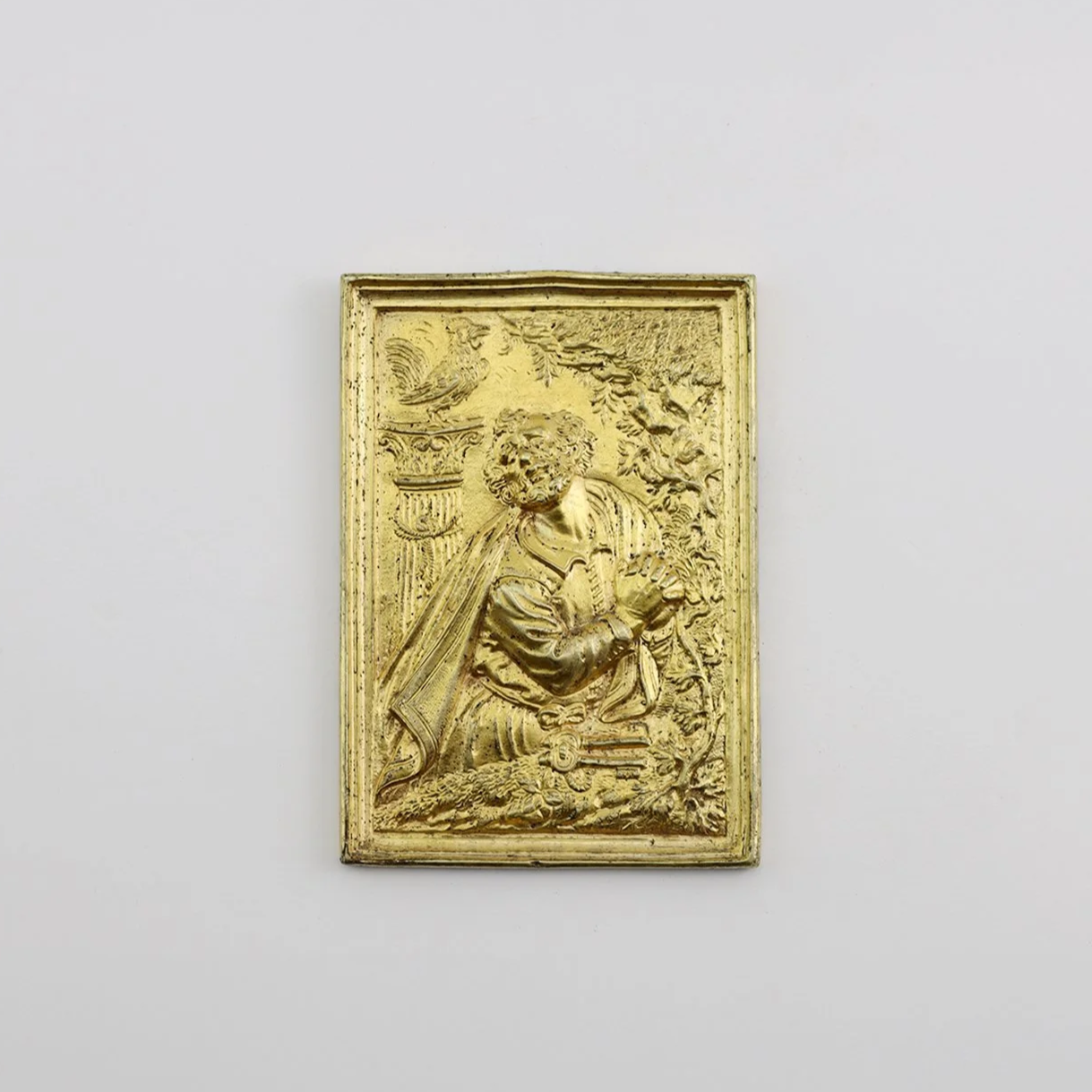
Finely detailed Spanish early 17th century Renaissance gilt wax-cast and chased bronze plaquette depicting Saint Peter as a Penitent. Size: 3 ¾” h x 2.75” w M21254
This plaque depicts Saint Peter in penitent attitude, with the rooster beside him and the keys to heaven in front. After the Last Supper, Jesus predicted that Peter would deny him three times that night before a rooster crowed. Despite his earlier declarations of loyalty, Peter did deny Jesus three times as predicted. The two large keys represent the ministry of authority that Jesus entrusted to Peter in the service of the church.
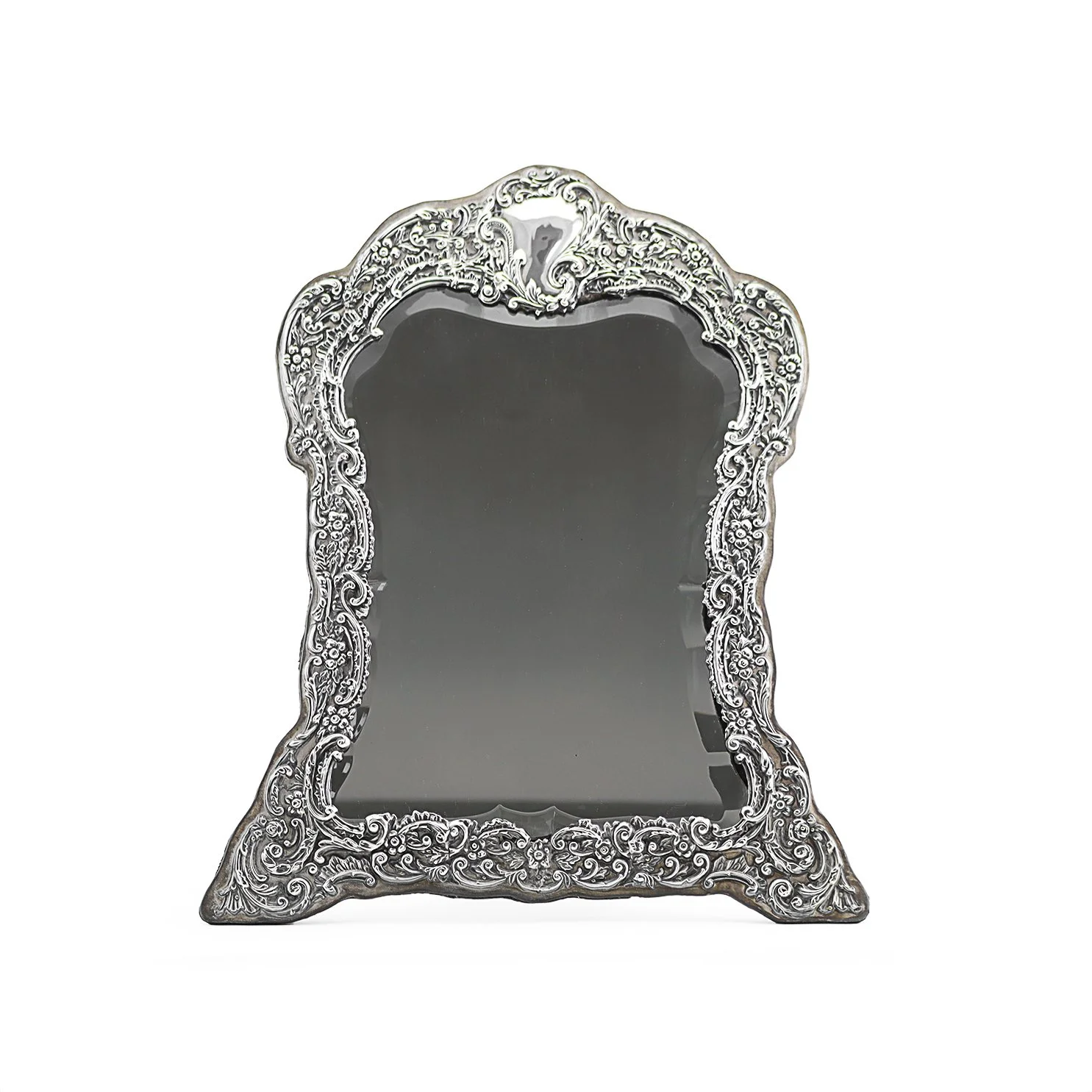
Ornate silver frame dressing mirror, with beveled mirror, circa 1900 possibly British. Size: 18 3/4 h x 15 w C21354
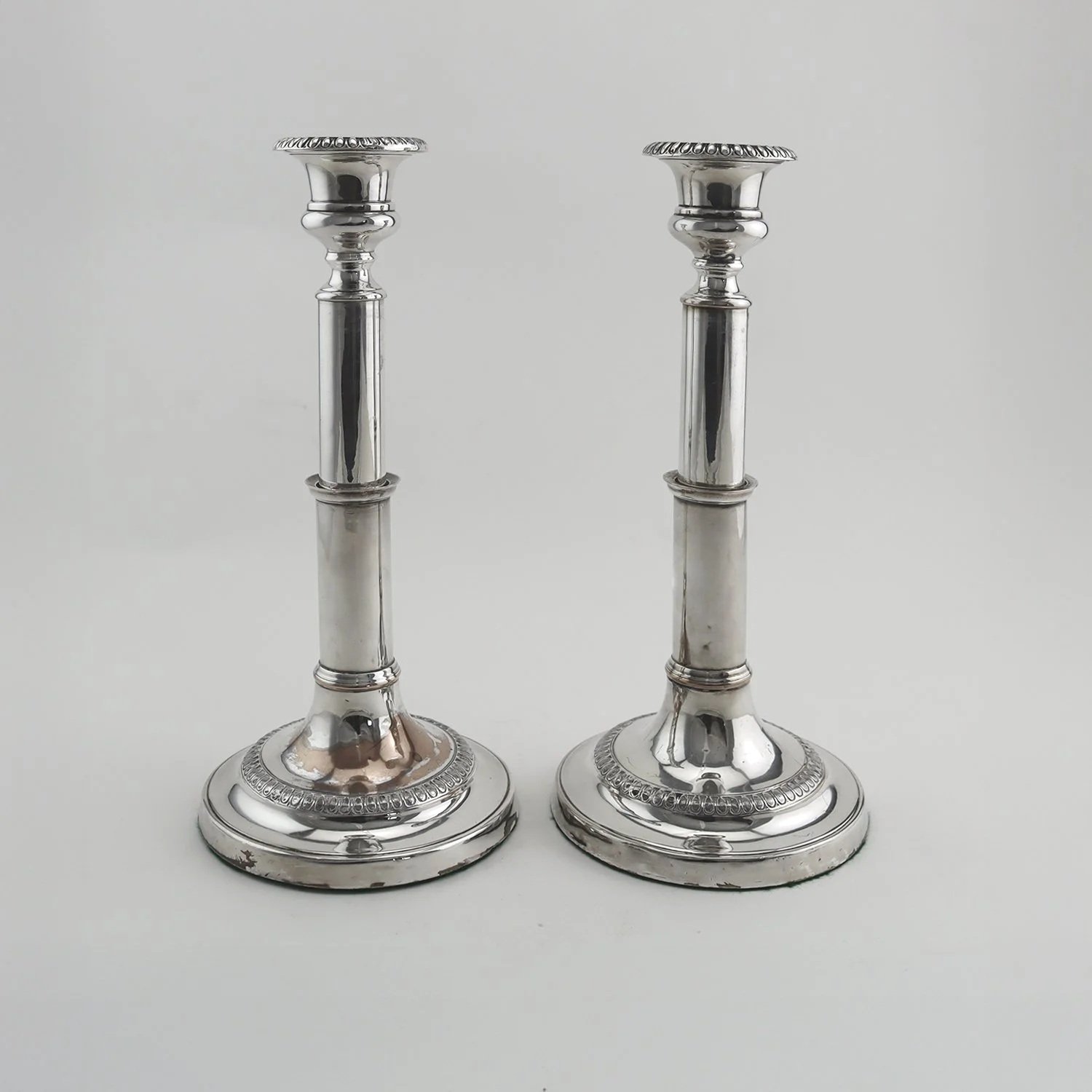
Pair of old silver plated telescoping candlesticks, English circa 1820. Size in inches: 7 ½ h x 4 ½ w (height fully telescoped 10") C21305
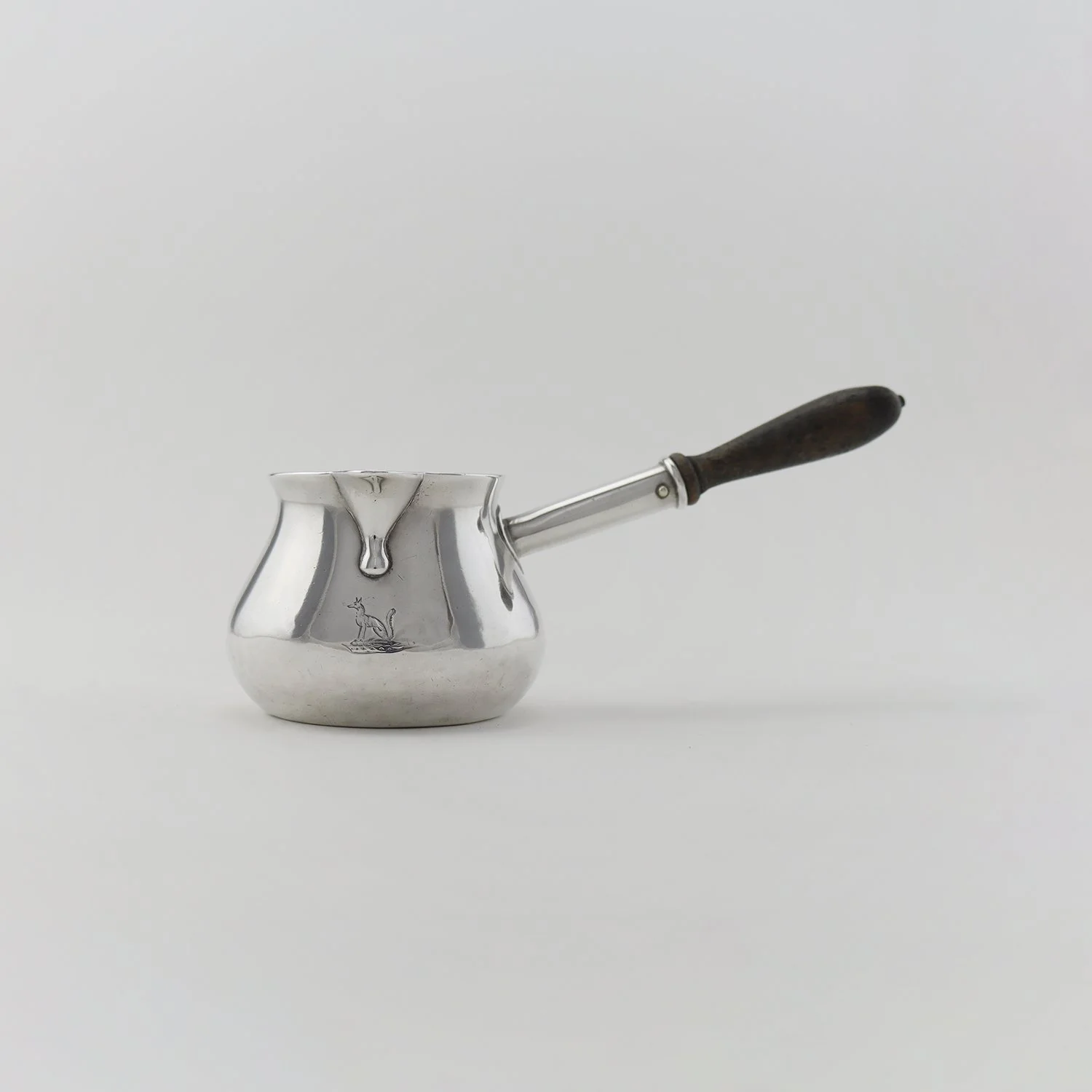
Diminutive George II sterling silver baluster shaped brandy warmer with wooden handle, hallmarked for London 1733. Size: 3 h x 6 w x 2 ¾ d C21005
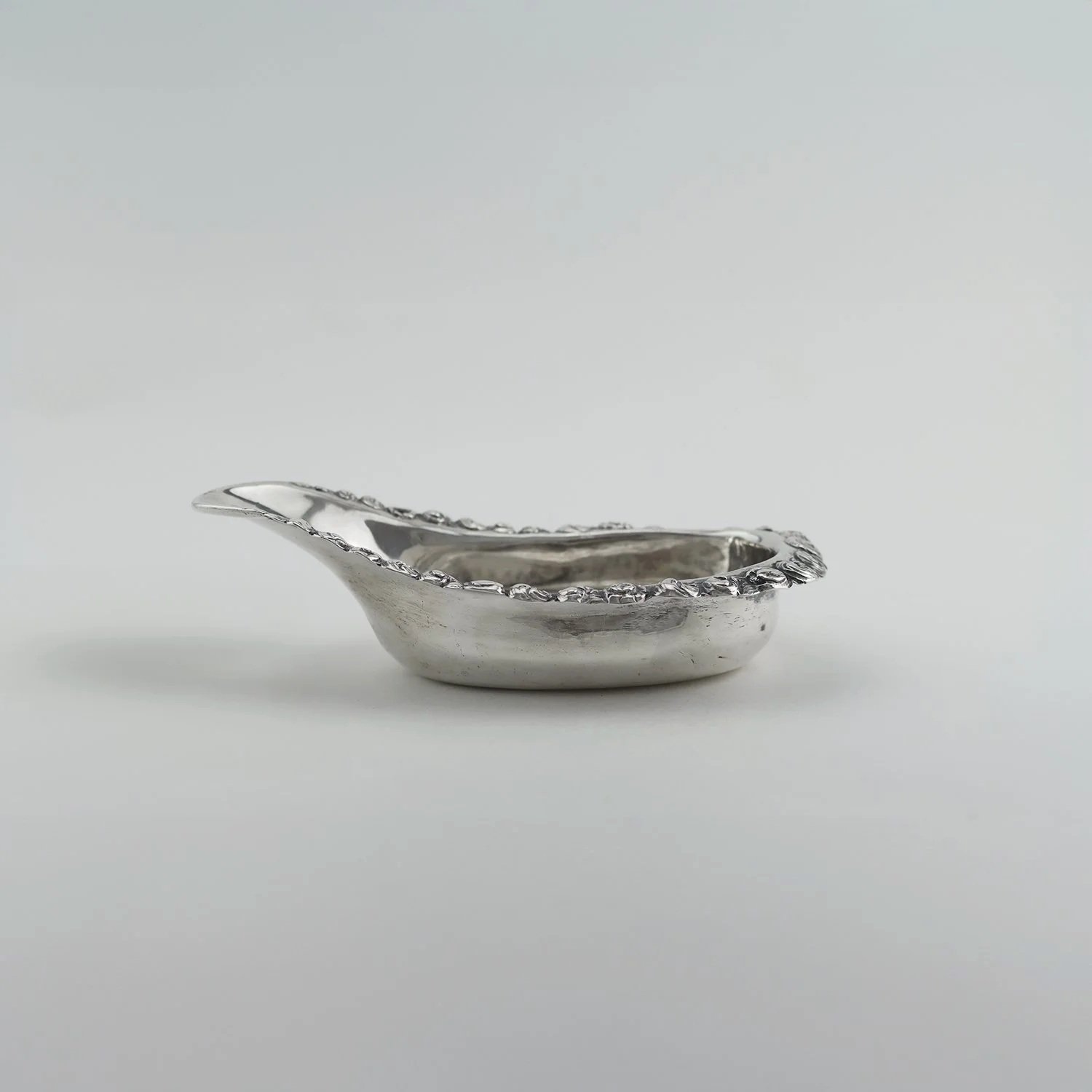
George III sterling silver pap boat, with flower scroll decoration to edge, hallmarked for London 1794 and maker John Wren. Size: 1.5 h x 5.5 w x 3 d C21308
Pap boats were popular in the Georgian period, most crafted between circa 1715 and 1830 when they were replaced by feeding bottles. The small shallow boat was used for feeding infants and those who could not feed themselves pap, a mixture of gruel and bread with milk. The shallow boat-shaped bowl is usually with a base and most often without a handle and incorporates a narrow feeding end and a rounded holding end. The design was usually very plain, sometimes with a decorated border.
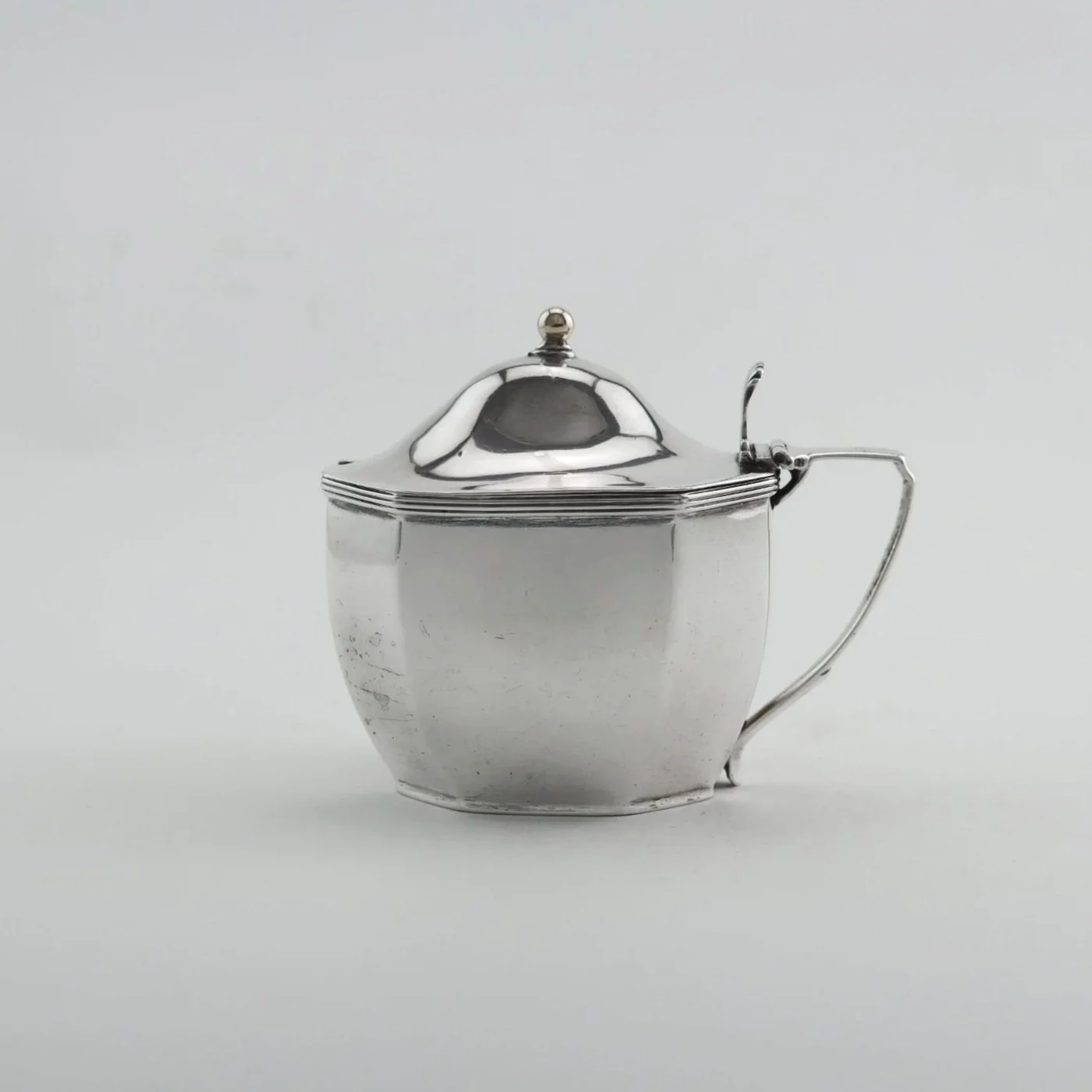
George III sterling silver octagonal mustard pot with domed hinged lid, hallmarked for London 1804 and maker Crespin Fuller. Size: 3 ¼ h x 4 w x 2 ¼ d C21323
Popular as a table condiment during the 18th century, mustard was served either dry or in a paste. Dry powder castors were left unpierced, or with a removable sleeve to block the holes. Paste was more common and served in a pot, often fitted with a spoon. Early mustard pots were usually cylindrical, often decorated with cut work to create a silhouette effect, sometimes to highlight a fitted glass liner (often of the popular cobalt blue colour). Usually finely crafted in sterling silver, by the mid 18th century mustard pots began to also be produced in porcelain
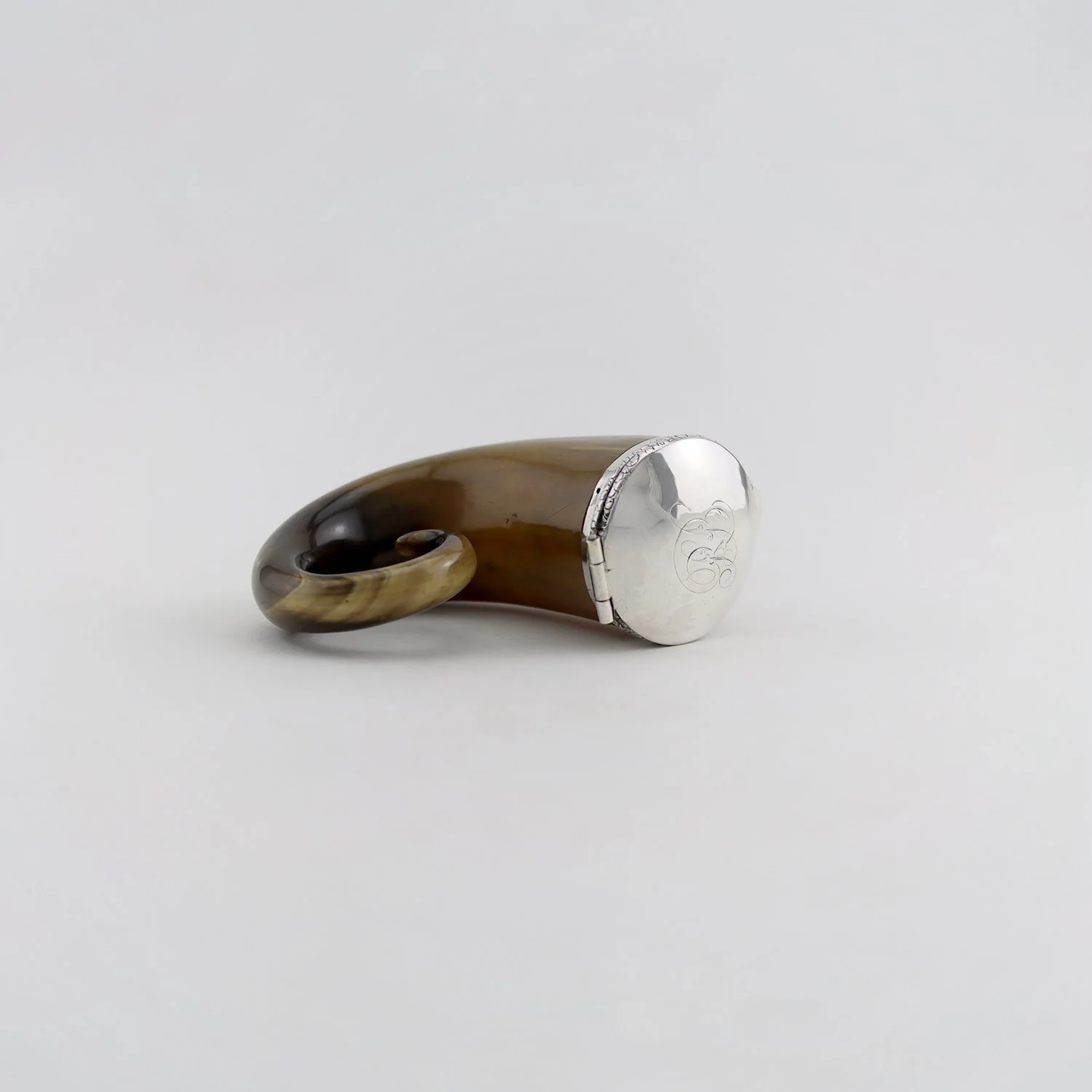
Antique Scottish snuff mull, with a curved horn body and silver mounts, engraved with a monogram to lid, 19th century. Size: 3 ¼ M21258
Snuff is a powdered tobacco flavoured with aromatic spices which is sniffed, or ‘snuffed’ into the nasal cavity. The name came from the shortened form of the Dutch word snuftabak, from the root words meaning sniff and tobacco. As addictive as smoking but without the smoke, snuff was thought to be more medicinal and thus more moral to use. Snuff originated with tobacco in the Americas and was in common use in Europe by the seventeenth century. Snuff varied enormously depending on its source, the most prized coming from Spain, France, and Scotland, with the most highly regarded from Brazil. Snuff mulls derive from the Scottish dialect for mill, where the snuff would have been ground to a powder, and come in a variety of forms with the most common fashioned from a ram's horn. The quality of the snuff mull is based on the tightness of the curve on the horn and quality of silver mount, which is often unmarked.
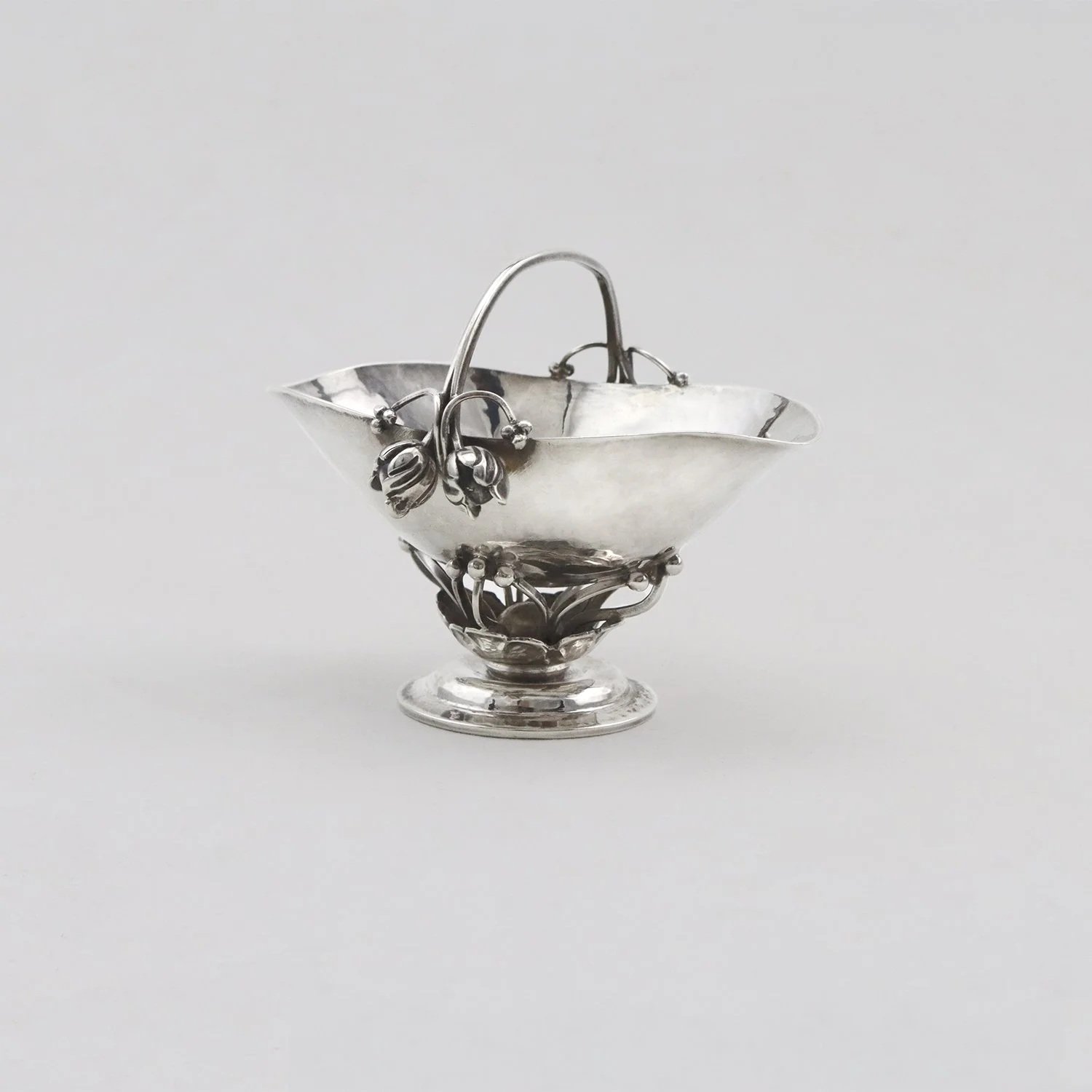
Sterling silver comport 235C, designed by Georg Jensen, bears impressed hallmarks to underside Georg Jensen 925S Sterling Denmark, circa 1917. Size: 2 ¼ h x 3 w x 2.40 d C20684
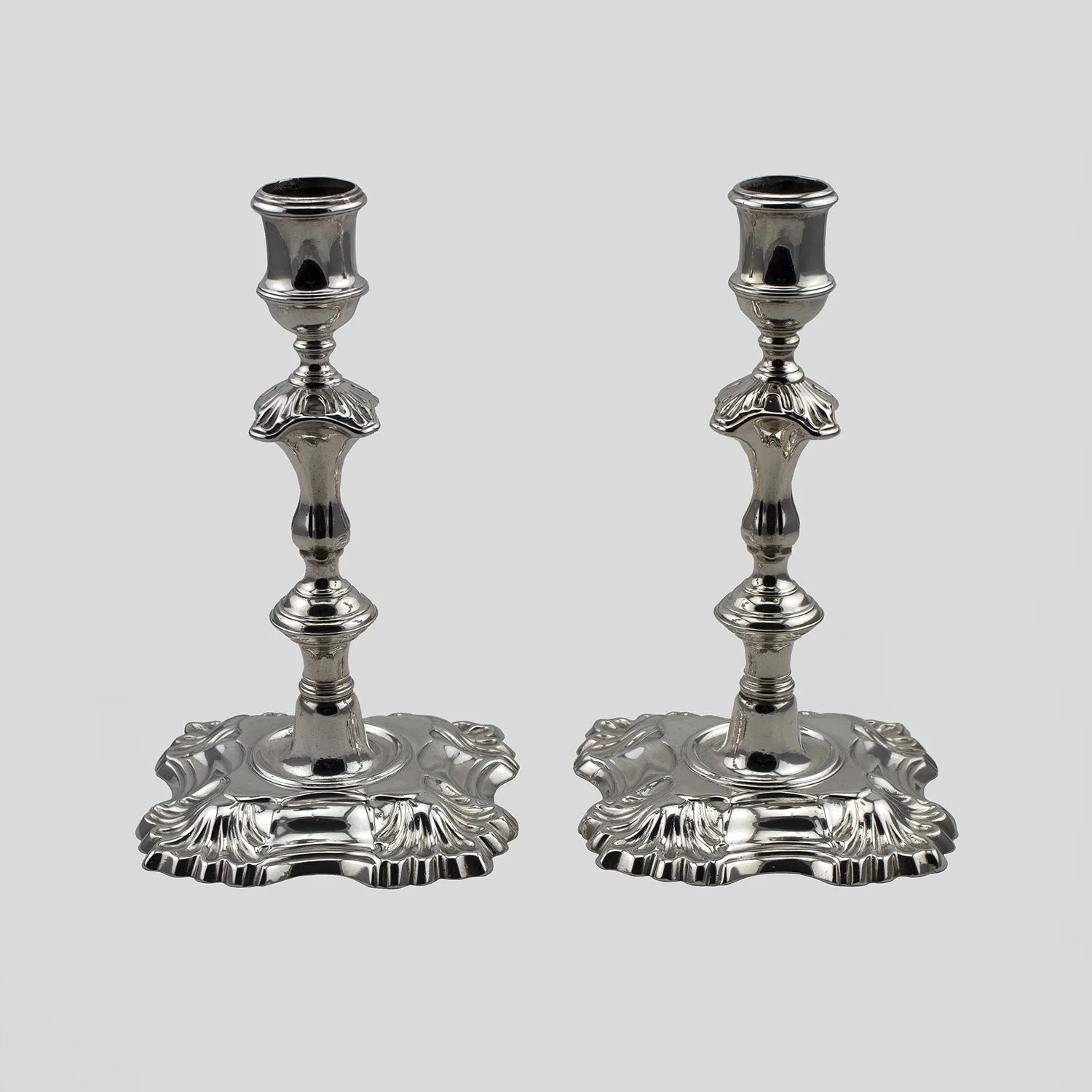
Pair of George II sterling silver candlesticks with cast shell form and square bases and double knot neck, London 1748, maker Hugh Mills. Size: 7 ½ h x 4 ½ w C19559
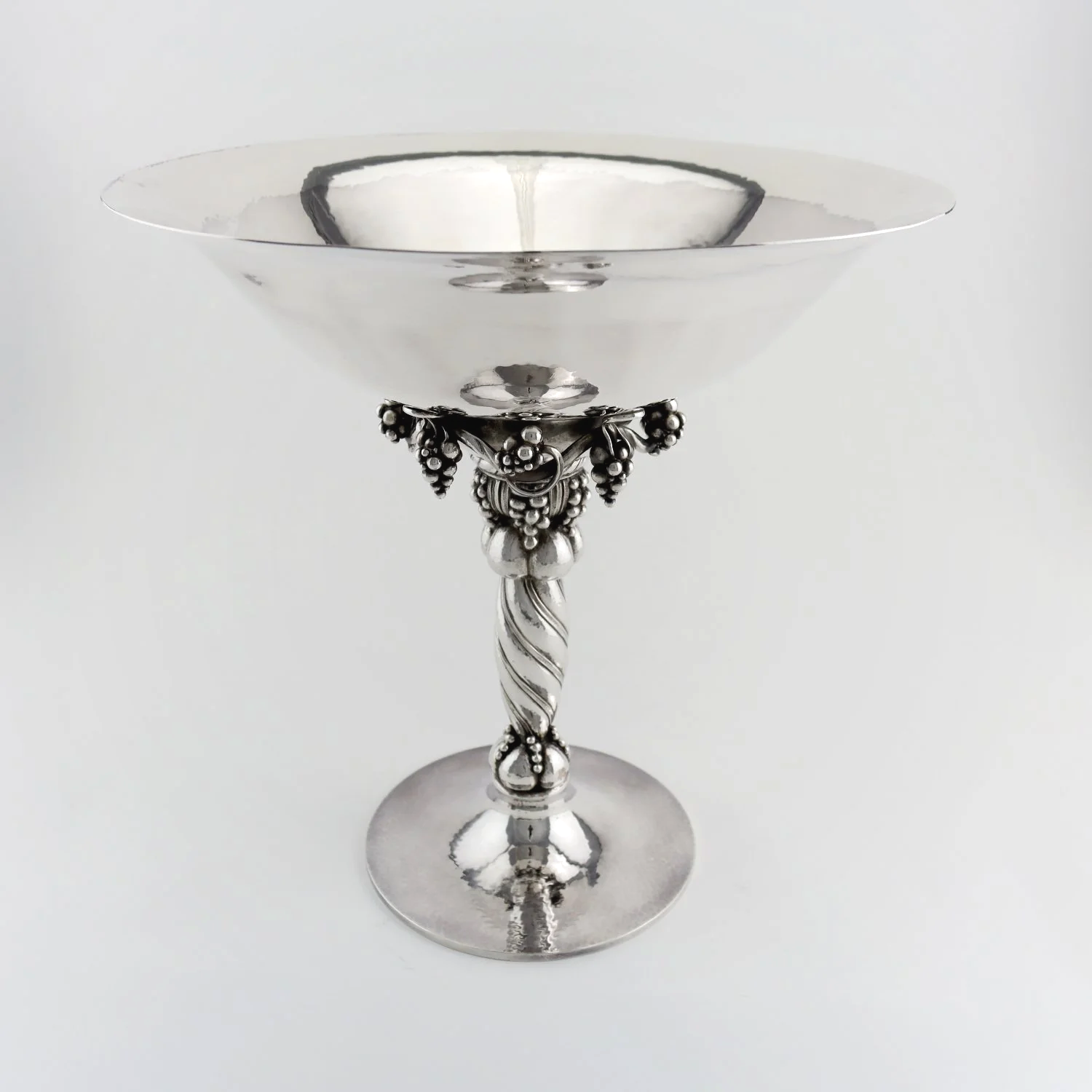
Large Georg Jensen sterling silver compote or tazza in the grape pattern, bears impressed hallmarks to underside Georg Jensen post 1945, Denmark Sterling and pattern number 264B. Size: 12 h x 11 7/8 d in C21230
The iconic Georg Jensen Grape Tazza was designed by Georg Jensen in 1918, and was made in 4 sizes of which this is the largest and most impressive. The grape cluster decoration is one of Jensen's most popular holloware designs and also used in candlesticks no. 264. A photograph of this bowl was taken at the 1939 World's Fair from the Danish Booth at the Exposition.
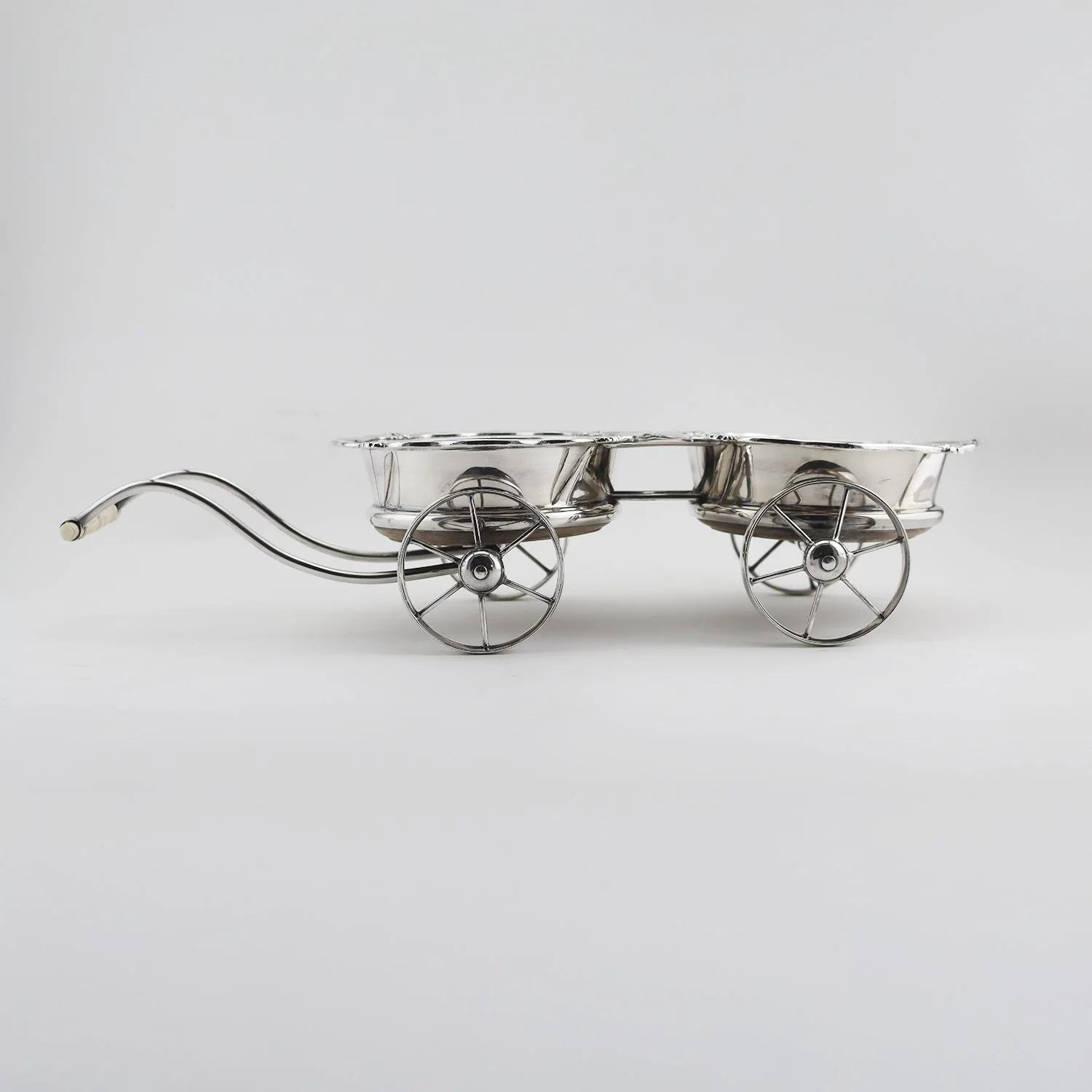
Victorian silver plated double decanter wine trolley on four wheels, the pivoting handle fitted with a turned ivory pull, each bottle trolley holding a turned wooden wine coaster, circa 1900. Size: 3 ¾ h x 17 ¾ w x 6 ¼ d in C21260
This style of double decanter wine trolley is designed for formal occasions to distribute the contents of wine decanters to guests seated at long dining tables. The wheeled trolley pivots in order to travel easily as it is pulled down the table by the handle. The invention of the wine trolley has been credited to Sir Edward Thomason in the early 1820’s. He described the events leading up to his invention in his memoirs that are recounted in the History of Old Sheffield Plate by Frederick Bradbury, published 1912. Our fine double decanter example is complete with turned wooden liners, mounted in silver plated surrounds each decorated with curved edges and four shells, which rolls smoothly on four wheels.
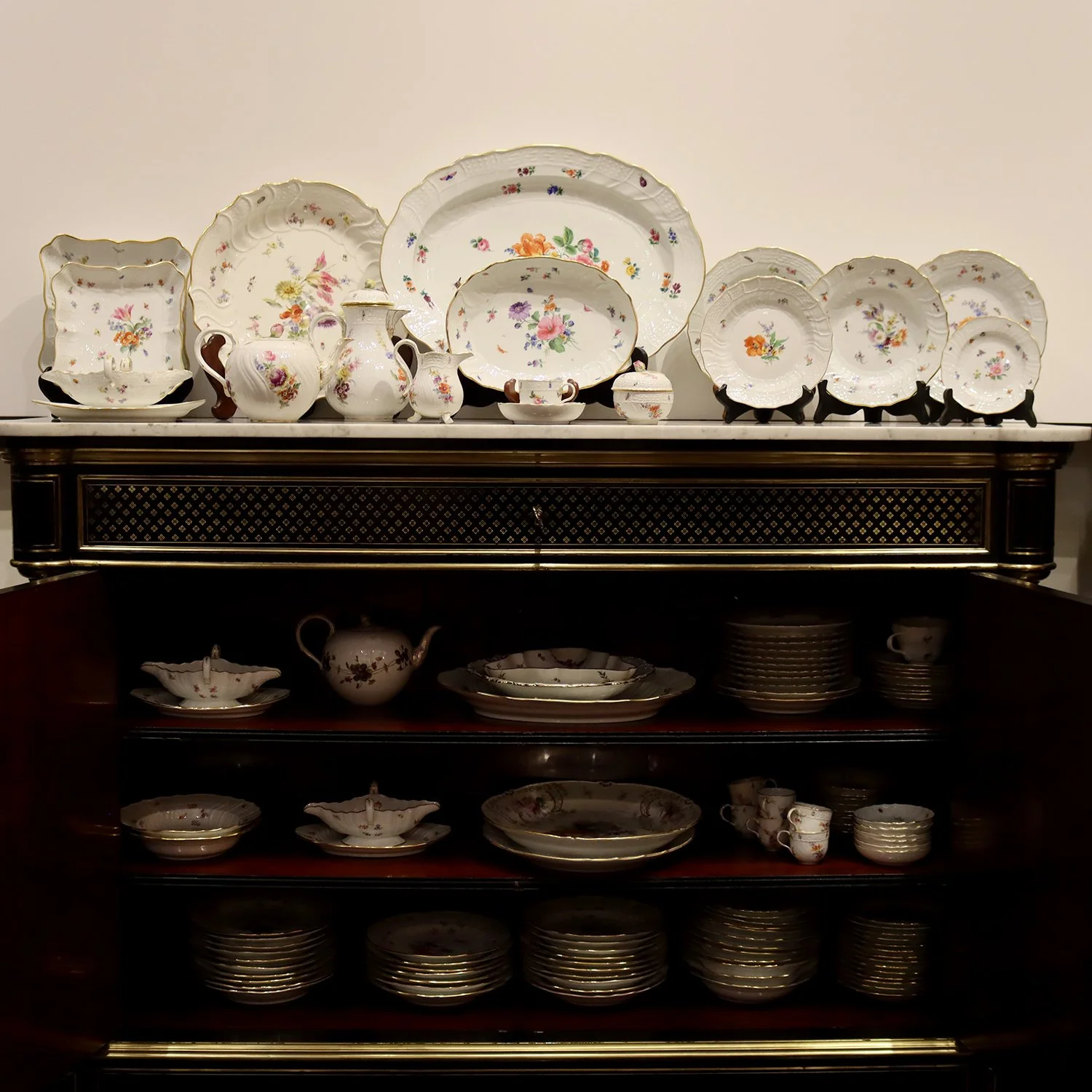
Extensive Meissen porcelain dinner service with moulded relief, mainly 19th century, decorated with hand painted polychrome floral motifs and most with gold rim, with underglaze blue cross sword marks to bottom. Comprising 95 Meissen pieces including 6 Kaiser Wilhelm II monogrammed pieces, minor chips, cracks and repairs. Together with additional 28 pieces in other patterns, other makers or majorly restored for a total of 123 pieces:
-28 dinner plates 9 1/2”
-12 deep soup plates 9”
-15 side plates 8”
-11 small side plates 5 ¾” - 6"
-2 gravy boats with attached tray and handles
-teapot with lid 5 ½”
-coffee pot with lid 8 ½”
-cream and lidded sugar
-14 piece coffee set (7 coffee cups with 7 deep saucers 5”)
-large oval platter 20” x 15”
-oval platter 11 ½” x 8 ¼”
-square serving dish 8” x 8”
Together with 6 pieces with Kaiser Wilhelm II monogram:
-large round platter Kaiser Wilhelm II monogram dated 1897 14”
-3 deep soup plates Kaiser Wilhelm II monogram dated 1898, 1903, 1908 9“
-dinner plate Kaiser Wilhelm II monogram dated 1910 9 ¾”
-square serving dish Kaiser Wilhelm II monogram dated 1897 9 ¼” x 9 ¼”
Together with additional 28 pieces in other patterns, other makers or majorly restored including:
-gravy boat with attached tray and handle
-large oval platter 16 ½” x 12”
-large round platter 14”
-rectangular serving dish
-round serving bowl 12”
-round KPM platter 13 1/2"
-tea pot with lid 5 ½”
-8 side plates with openwork edges 8 ½”
-8 fruit plates 7 ¾”
-plate 9"
-2 plates 9 1/2"
-tea cup
-vase 5 ½”