Secessionist Works from the Estate of Thea F. B. Bentley
We are pleased to present this very special exhibition highlighting works from the Estate of Thea F. B. Bentley, born in Vienna, Austria in 1918 to Joseph Stern and Adelheid (nee Herzfeld). In 1937 Thea married Robert Bloch-Bauer, nephew of sugar magnate Ferdinand Bloch, and the couple had a son George. Robert, Thea and George fled to Canada in 1938 and settled in Vancouver in 1939, which they loved and where Thea, fondly known as GG to her family, would live to the age of 106. She was an avid collector and her Shaughnessy house was filled with treasures not only brought with the family from Austria but also collected through the following decades.
Robert Bloch-Bauer was the nephew of Prague sugar magnate Ferdinand Bloch. Ferdinand was married to Adele Bauer, daughter of banker Moriz Bauer. The couple were avid art collectors who supported Austrian museums and established a salon where Vienna’s elite came together, and where patrons of artist Gustav Klimt whose portrait of Adele Bloch-Bauer I is now in the Neue Gallery, New York.
The highlight of this exhibition is a major lost painting by Carl Moll “The Nightmarket in Vienna with KarlsKirche (the St. Charles Church)” which has been part of the Bentley Collection for almost a century. The work is included in the Catalogue Raisonné of the artist in the Austrian Belvedere Gallery, Vienna under the Catalogue Raisonné no. GE 40. This is the first painting in Carl Moll’s oeuvre of the Nightmarket which he painted seven times, twice in 1889 including this work, and five in 1894, one of which is in the collection of the Belvedere.
Carl Moll was one of the founding members of the Viennese Secessionist movement, and the exhibition includes other works by artists from this era including Theodor von Hörmann, considered to be the movement’s founding father, and Rudolf von Alt, Honourary President.
Also included in this exhibition are objets and furniture such as a superb Austrian baroque marquetry secretary cabinet, a French gilt clock with a Roman charioteer, and a collection of excellent quality Austrian silver.
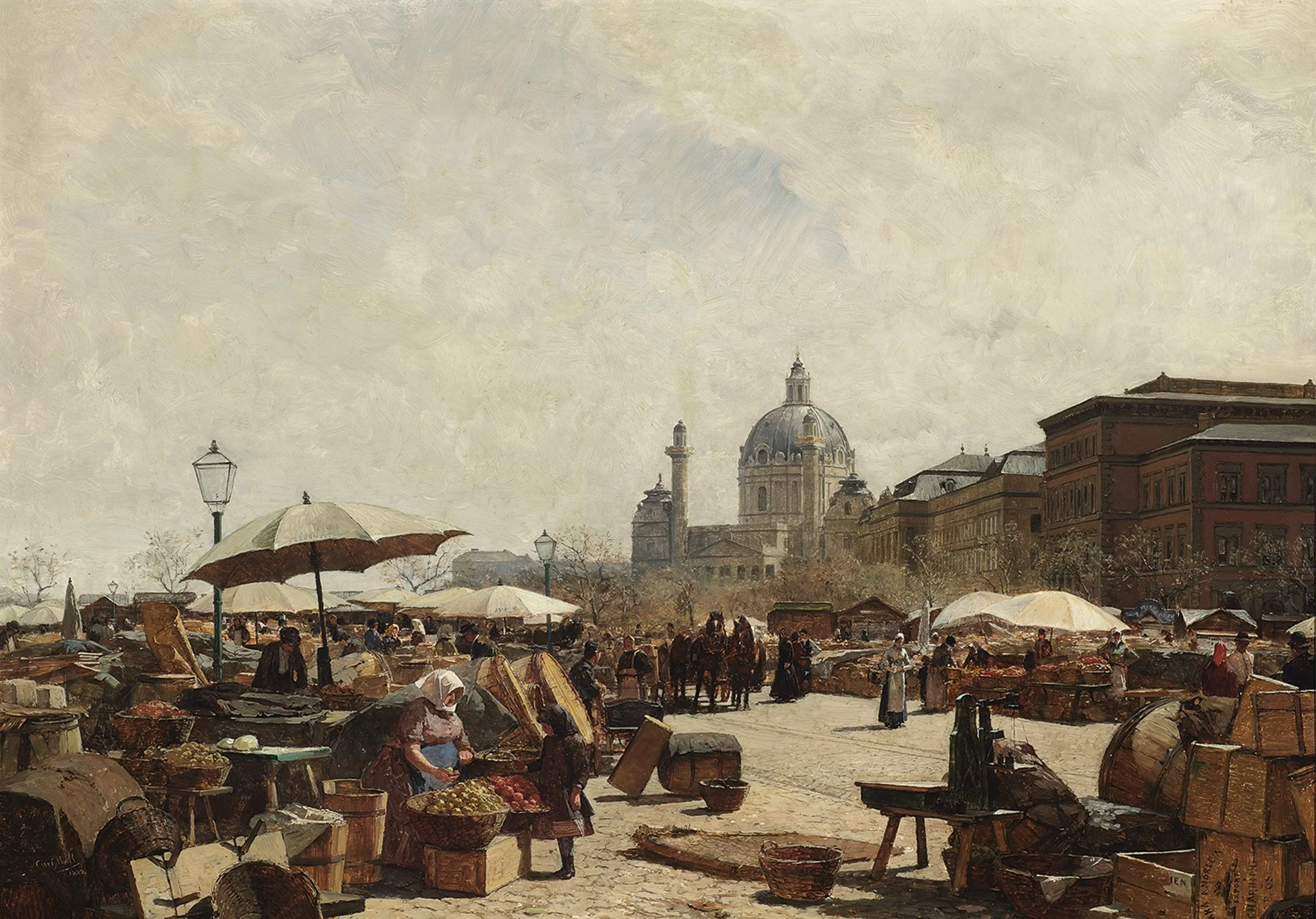
Der Nashmarkt in Wien Mit Der Karlskirche by Carl Julius Rudolf Moll (Austrian 1861-1945) oil on panel, signed and dated lower left "Carl Moll 1889" Listed in the online Catalogue Raisonné of the artist Carl Moll by Dr. Cornelia Cabuk in the Austrian Gallery Belvedere, Vienna under the Catalogue Raisonné no. GE 40 as "Der Naschmarkt in Wien mit der Karlskirche" Size in inches: 23.5 x 33.5 (with frame 28.25 x 38) Provenance: Auktionshaus A. Kende, Vienna (1934) Estate of Thea F.B. Bentley, Vancouver ZJ21795
Carl Julius Rudolf Moll (Austrian 1861-1945)
Born in Vienna, Austria, Carl Julius Rudolf Moll studied art at the Vienna Academy of Fine Arts where he was a student of Christian Griepenkerl and Emil Jakob Schindler, from whom he adapted his lyrical view of nature. As Vienna emerged as a vibrant center for avant-garde artists toward the end of the 19th century, Moll became a strong supporter of modern Austrian art and bringing international modern art to Vienna. He championed foreign artists such as Vincent van Gogh, encouraging the use of the Belvedere Gallery for exhibitions. Moll was a founding members of the Vienna Secession in 1897 and served as President from 1900-1901. The Secessionists advocated for art and lifestyle reform in line with European Modernism to showcase the latest developments in French Impressionism, Neo-Impressionism, and Belgian Symbolism, as well as international Art Nouveau. Moll was co-founder of the Wiener Werkstätte (Vienna Workshops) in 1903, and became Director of the Miethke Gallery in Vienna, where he took over artistic direction and presented an ambitious program of International Western modernism including works by artists such as Vincent van Gogh and Paul Gauguin. After leaving the Vienna Secession in 1905 with Gustav Klimt, Moll became Klimt’s exclusive representative for the Miethke Gallery. Carl Moll’s work is found worldwide in both private collections and public institutions, including the Belvedere in Vienna, and the Canadian National Gallery who purchased “Interior, Midday, Winter 1901” in 2020.
This lost painting by Carl Moll has been in a Vancouver private collection for almost a century. The subject matter, the famous vibrant night market in front of the beloved Karlskirche in the center of Vienna, is a theme that Moll painted often. This excellent example, painted on panel, is marked by the Austrian late 19th century realism, with strong contrasts between light and shadow.
The Nightmarket in Vienna with KarlsKirche (the St. Charles Church) is listed in the Catalogue Raisonné of the artist Carl Moll by Dr. Cornelia Cabuk in the Austrian Gallery Belvedere, Vienna under the Catalogue Raisonné no. GE 40. This is the first painting in Carl Moll’s oeuvre of the Nightmarket which he painted seven times, twice in 1889 including this painting and its study. Five views of the Nightmarket were later painted in 1894, one of which is in the collection of the Belvedere, Vienna.
The Vienna Secession
Vienna was a vibrant center for avant-garde artists in the latter part of the 19th century. Forward-thinking artists, including many who were rejected by the Academy of Fine Arts or the Kunstlerhaus Genessenschaft, began to meet and discuss the latest developments in modernist ideas. Two art societies were formed: the ‘Blaues Frehaus” became the home of the Hagendbund including many future Secessionists, and the Cafe Sperl the home of the Siebener Club which included architects Josef Hoffmann and Josef Olbrich. Both of these groups shared a commitment to new ideas and opposition to the conservative establishment. Based on the Berlin and Munich Secession founded in 1892, the new Secessionist Society was formed in 1897,in Vienna, led by well-known Gustav Klimt and with Rudolf von Alt as Honourary President. Members also include Josef Hoffmann, Otto Wagner, Koloman Moser, and Carl Moll. The Secessionist movement is considered the formal beginning of modern art in Austria.
Advocating for art and lifestyle reform in line with European Modernism, the Vienna Secession, otherwise known as the Union of Austrian Artists, fostered a modern, individualistic aesthetic by bringing international influences to the city. Their aim was to showcase the latest developments in French Impressionism, Neo-Impressionism, and Belgian Symbolism, as well as international Art Nouveau and searched for a synthesis of the arts in a forum where these new works could be exhibited. The first Secessionist exhibition was held in 1898 in the rented Horticultural Society building in the old Salon model. The success of this first exhibition including the presence of Emperor Franz Josef enabled the Secessionists to undertake construction of their own building in the corner of Karlsplatz centrally located beneath the Academy of Fine Arts and close to the Rinstrasse. This new exhibition hall, designed by Joseph Maria Olbrich in 1898 and took fourteen months to build and was the first dedicated gallery of contemporary art in Vienna. The Secessionist motto “To every age its art, to every art its freedom” was inscribed above the door, and the building served as the movement’s home as well as a symbol of modernism. The exhibition spaces had movable interior partitions and columns for versatile exhibition layouts incorporating multiple disciplines including paintings and sculpture. Between 1899 and 1903 the Secession presented international works including French Impressionists Pierre Bonnard, Edgar Degas, Manet, Claude Monet, Berthe Morisot, Camille Pissarro, Auguste Renoir, Alfred Sisley,Toulouse-Lautrec, and more. The 1902 exhibition was especially famous with a statue of Beethoven by Max Klinger highlighted with Klimt’s Beethoven Frieze around it.
The Sessionists promoted Gesamtkunstwerk, a synthesis or integration of fine arts, architecture and applied arts including furniture, glass and ceramics. This cross-pollination among disciplines to unite fine and applied arts drew inspiration from the English Arts and Crafts movement. Rejecting industrialization the group favoured quality handmade objects and incorporated some Jugendstil, French and Belgian Art Nouveau as well as Japanese elements. The Secessionists developed their own style with symmetry and repetition of recurring square, grid and checkerboard motifs inspired by Charles Renee Macintosh. There was also a large influence from Japanese design including woodblock prints, with elements such as restrained use of decoration, preference for natural materials and handwork and balance of negative and positive space, which were incorporated by both Egon Schiele and Gustav Klimt. Vienna Secession was a major influence on many European movements and artists. In 1903 the Wiener Werkstatte society was formed by Hoffmann and Moser to reform the applied arts.
With changing presidents came growing disagreements and internal divisions within the Secessionists concerning the association objectives and whether applied artists such as designers and architects should be included in the exhibitions. In 1905 the movement split when the Galerie Miethke in Vienna sought the curatorial advice of Carl Moll to use the gallery as a commercial outlet for the member artists. Seen as a conflict of interest by Gustav Klimt and his followers, the Klimt group resigned from the Secession but left behind the iconic building, reducing the members from 64 to 48. After leaving the Vienna Secession in 1905 with Gustav Klimt, Moll became Klimt’s exclusive representative for the Miethke Gallery which presented an ambitious program of international Western modernism including works by artists such as Vincent van Gogh and Paul Gauguin.
The group continues to function to this day and still holds regular exhibitions in the Secession Hall. Later members and exhibitors include major international artists Frank Brangwyn, George Clausen, Paul-Cesar Helleu, Peter Severin Kroyer, Sir John Lavery, Leon Augustin L’Hermitee, Charles Renee Mackintosh, Henri Martin, Constantin Meunier, Ily Repin, Auguste Rodin, John Singer Sargent, Fritz Thaulow, James McNeill Whistler and Anders Zorn.
Theodor von Hörmann (Austrian 1840-1895)
Theodor von Hörmann is considered by some to be the founding father of the early Vienna Secession art movement as he was the first to put into practice and enforce their ideals. Born in Tyrol, von Hörmann pursued a military career before studying at the Academy of Fine Arts in Vienna, where he met landscape painter Emil Jacob Schindler. Von Hörmann travelled and exhibited internationally and was influenced by the French Impressionists before living in Paris. He later travelled through Bretagne, the Channel Islands and Barbizon, tracing the steps of the plein-air painters and working to capture the atmosphere at certain times of the day. He spent four years painting in Znaim in Southern Moravia, and later travelled to Munich where he was influenced by Munich Secessionist ideas and would subsequently become an advocate for the movement. He exhibited at the Vienna Künstlerhaus, the Kunstverein in Munich, settling in Vienna in the Neuer Markt area. His dreams of a state gallery for modern Viennese art, later realized by the Secessionists, was cut short by illness and he died in 1895. A memorial exhibition and sale with 234 paintings was held by his estate, the “Freunde des Künstlerhauses”, with a portion of the proceeds going to create a foundation for young artists.
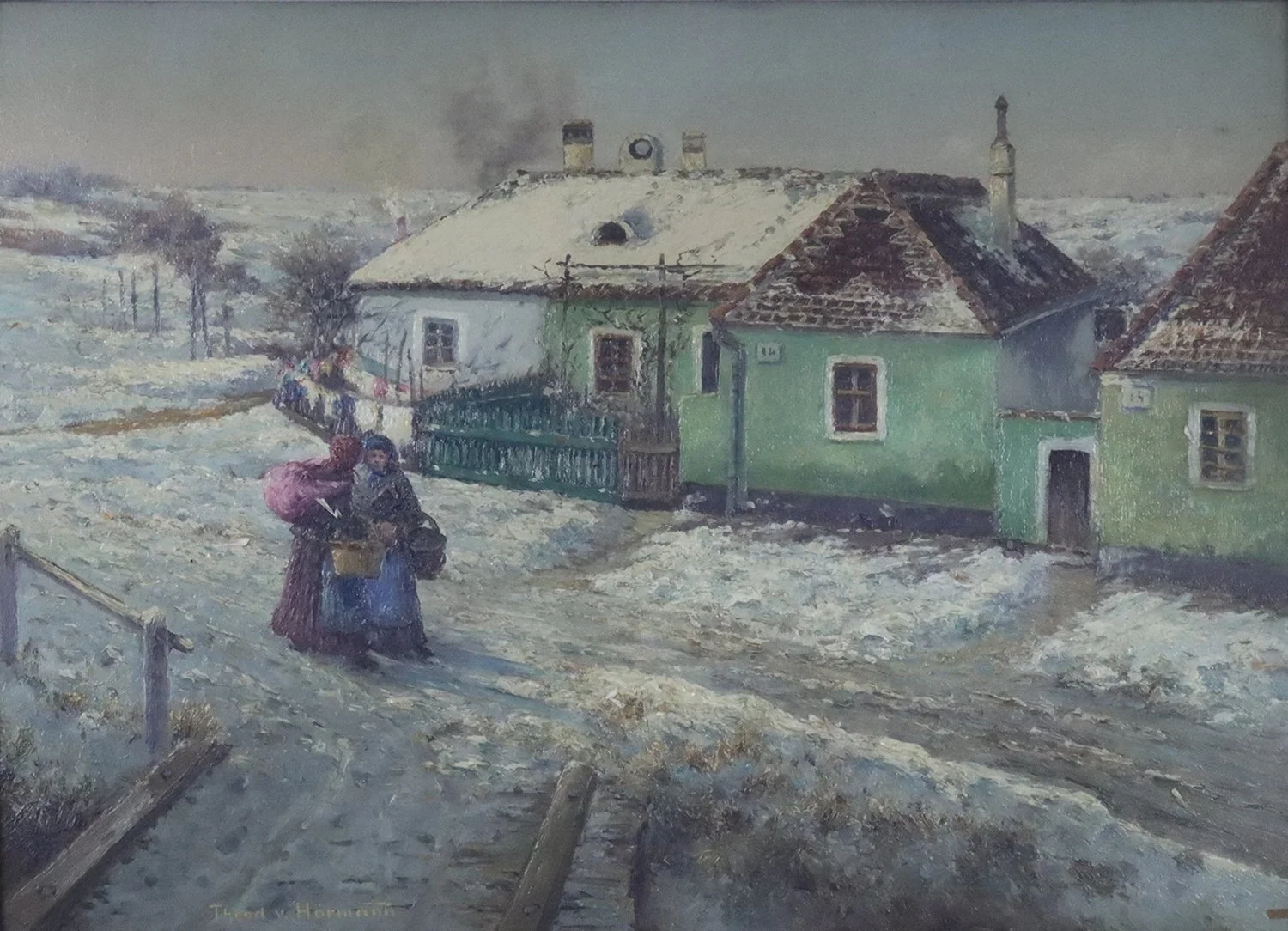
Street in Znaim by Theodor Von Hormann (Austrian 1840-1895) oil on panel, signed lower left "Theod. V Hormann", inscribed on reverse "Theod. Von Hormann Znaim" and "Motiv bei Znaim" Size in inches: 10.75 h x 15.5 w (with frame 22 h x 26.5) Provenance: Estate of Thea F.B. Bentley J21805
Returning from studying in Paris in 1894, Theodor von Hörmann and his wife Laura spent four years in the town of Znaim (or Znojmo), a walled town in the winemaking region of South Moravia, Czech Republic. This was an important time in the artist’s life, when his colours became richer and more powerful capturing the atmosphere and sparkling light in the countryside.
Rudolf Von Alt (Austrian 1812-1905)
A member of Austrian nobility, Rudolf von Alt was educated at the Academy of Fine arts in Vienna, a founding member of the Vienna Künstlerhaus and honourary President of the Vienna Secession. He is considered one of Austria’s greatest watercolour artists and a master in depicting space and light, able to capture the topographical landscapes and architecture of Austria in a detailed, realistic manner.
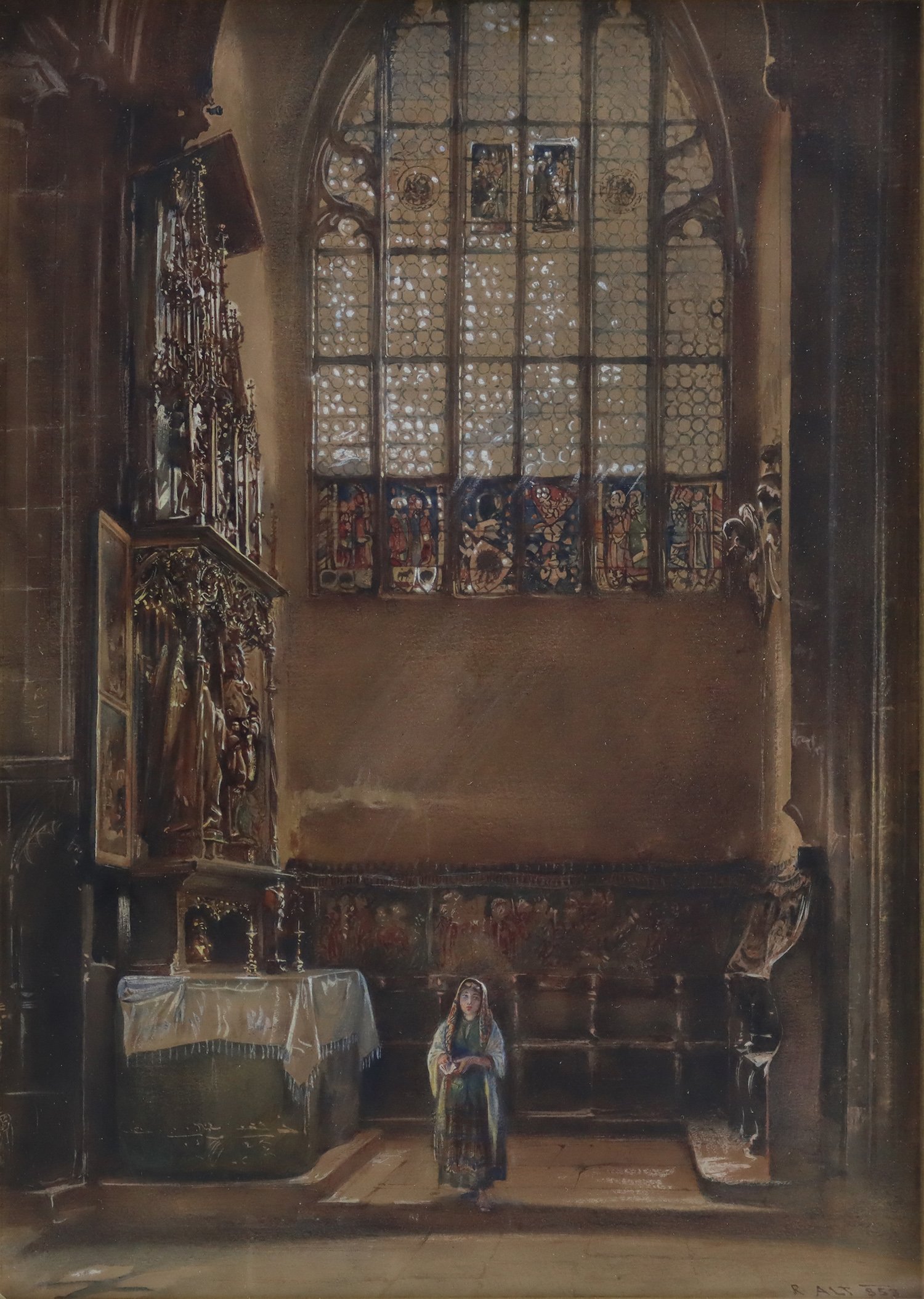
Chapel Interior by Rudolf Von Alt (Austrian 1812-1905) watercolour on paper, signed and dated lower right "R. Alt 1853" Size in inches:12.25 x 9.25 in (with frame: 21.25 x 16.5 in) Provenance: Estate of Thea F.B. Bentley ZJ21800
Inspired by a trip to Italy in 1833, Rudolf von Alt painted architectural subjects including everyday objects and interior views which became one of his strong points. While painting on hiking trips through the Austrian Alps and Northern Italy he developed a detailed, realistic style which became very popular. He received many commissions for glamorous interiors documented the splendour of the aristocratic palaces of early 19th century Viennese society and was chosen by the Austrian government to document their most impressive buildings. During his eight-decade career, not only did he depict both exterior and interior views of popular castles and noble palaces, but also veduta, buildings and public spaces including the rapid changes in the Viennese cityscape.
Julius Von Blaas (Italian/Austrian 1845-1923)
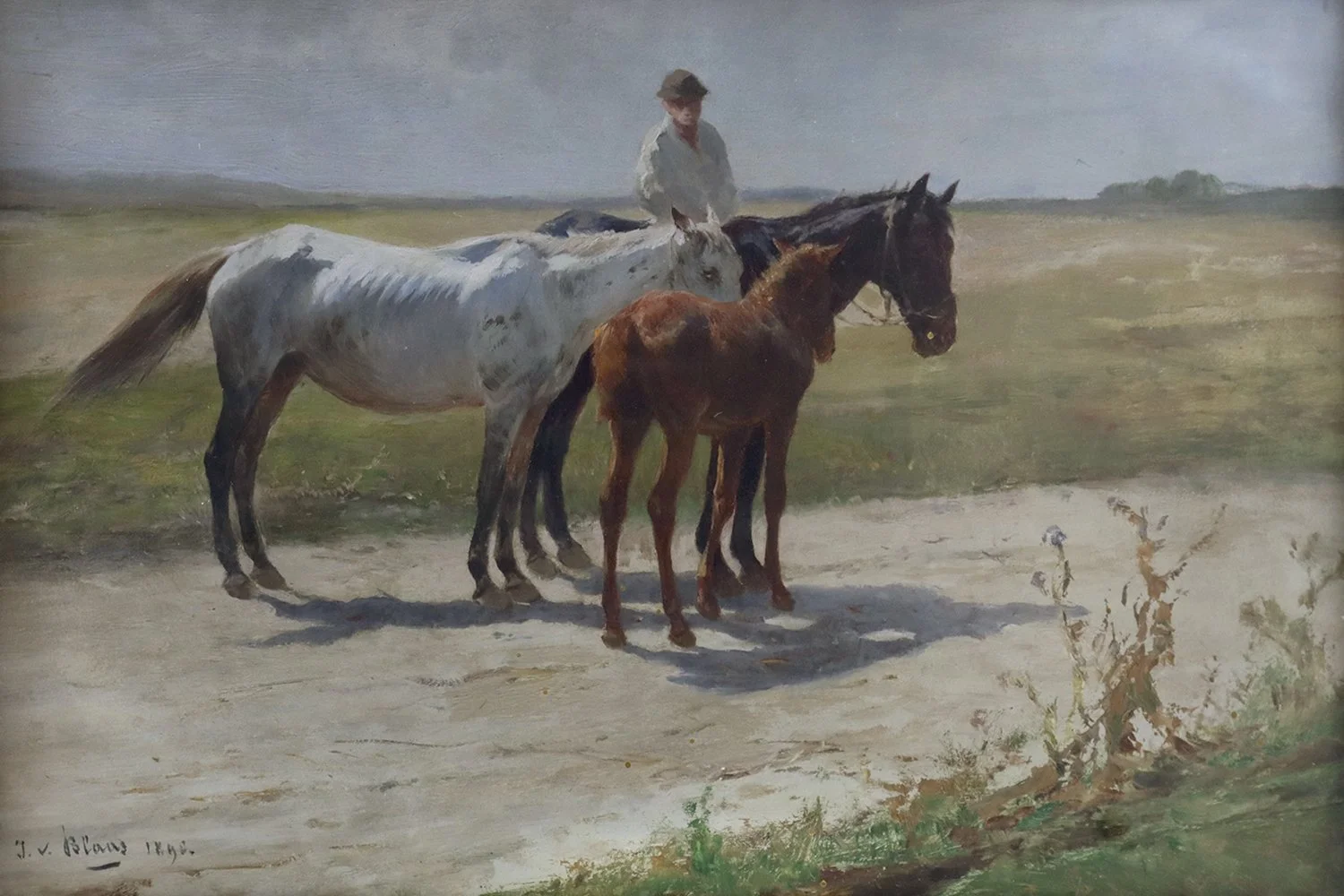
Three Horses with Rider by Julius Von Blaas (Italian/Austrian 1845-1923) oil on board, signed and dated lower left "J.V. Blaas 1896" Size in inches: 10 h x 12 w (with frame:17.25 x 21.5) Provenance: Estate of Thea F.B. Bentley ZJ21798
Born in Italy, Julius von Blaas studied under his father Karl von Blaas in his Venice studio and was also influenced by his celebrated older brother Eugen von Blaas. Julius studied in Florence and Rome before attending the Academy of Fine Arts in Vienna where he later became a professor. He painted historical works, portraits and battle scenes, but devoted himself to equestrian subjects which were greatly admired. Employed by the Austrian court as a portrait painter he completed almost 50 portrait commissions, including equestrian portraits of the Emperor and his wife Empress Elisabeth. He was a member of the prestigious Vienna Künstlerhaus artists association, and received the Archduke Carl-Ludwig Medal.
Joseph Feid (Austrian 1806-1870)
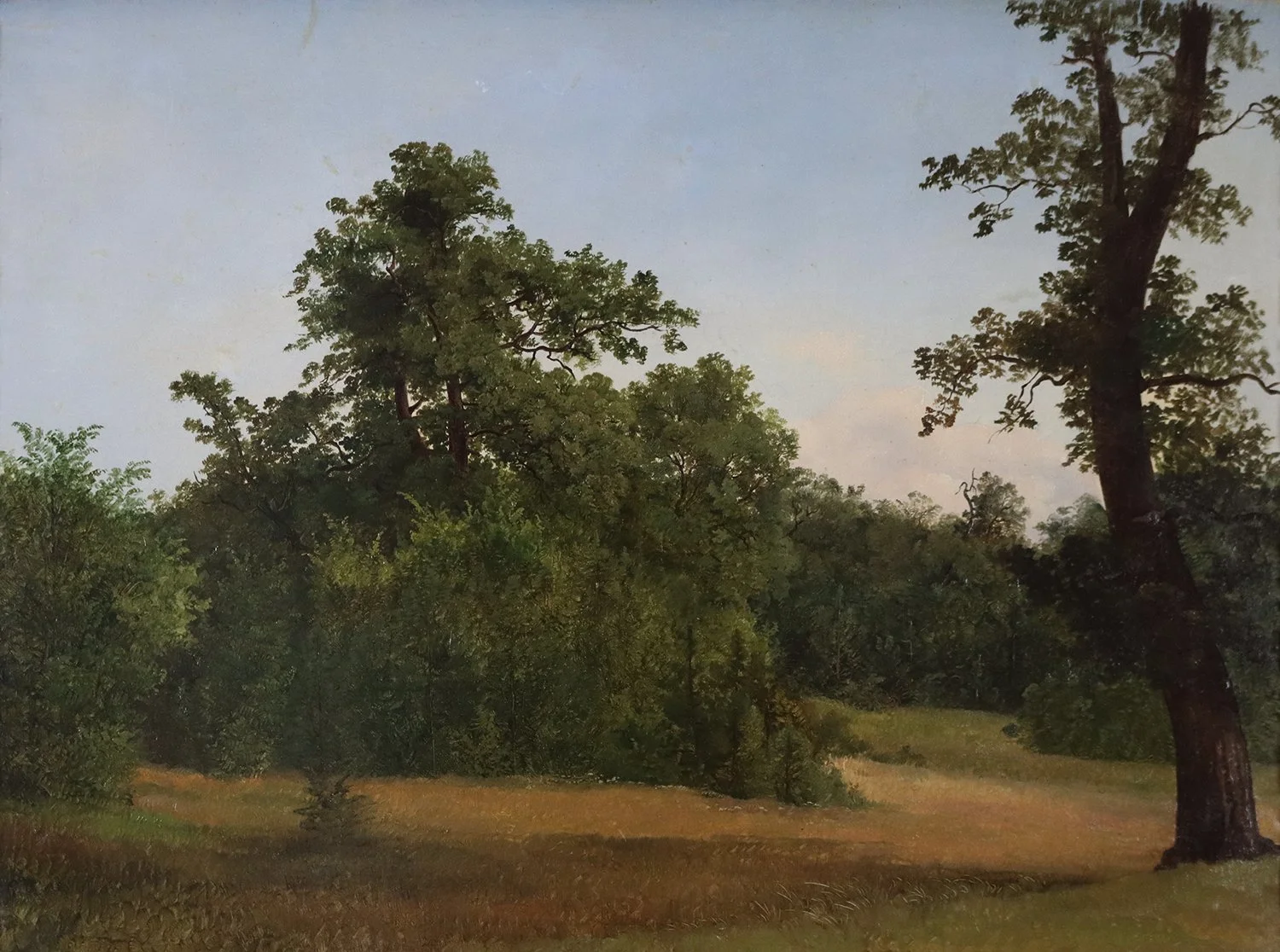
Wooded Landscape by Josef Feid (Austrian 1806-1870) oil on board, with label on verso from C J Wawra. Size in inches: 14 h x 20 w in (with frame: 21 h x 26 w) Provenance: Estate of Thea F.B. Bentley ZJ21799
Josef Feid first studied architecture at the Fine Art Academy in Vienna before turning to painting. His favourite subject matter was forest landscapes and he was very talented at depicting foliage and forest life. He painted in the large Prater Park and surrounding area in Vienna, as well as the Austrian Alps in the Salzkammergut region near Salzburg. The art critic Ludwig Hevesi nicknamed Feid the “forest man from the Vienna Woods” in 1903.
Maximilian Pfeiler (German 1656-1746)
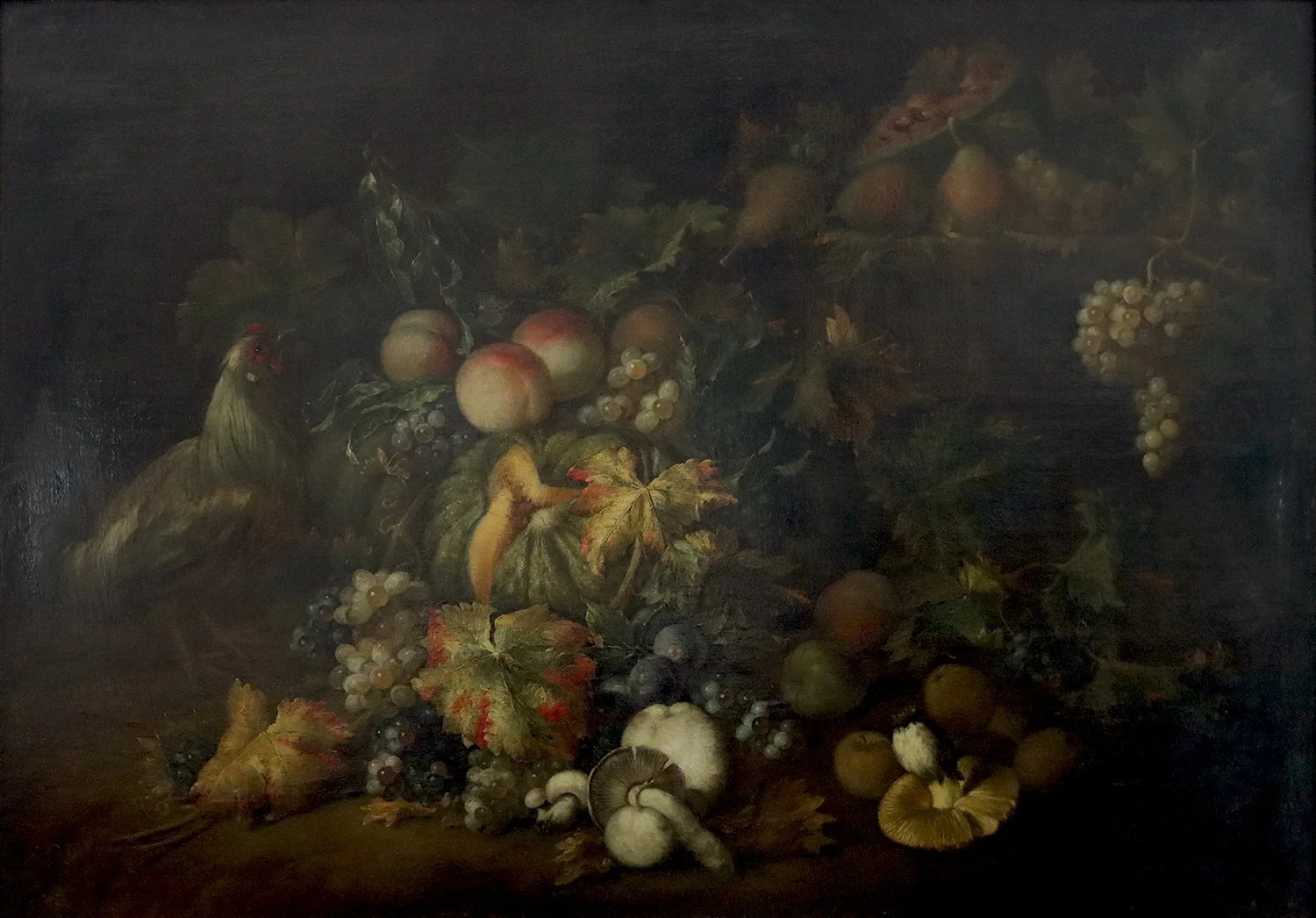
Still Life of Fruit, Mushrooms and Chicken by Maximilian Pfeiler (German 1656-1746) oil on board, signed lower right "M. Pfeiler". Size in inches: 36 h x 52 w (with frame 40.75 h x 56.25 w) ZJ21797
Born in Germany in 1656, Maximilian Pfeiler became a member of the Prague Lesser Town Painting Guild in 1683. He lived in Rome from between 1694 and 1721 where he was influenced by the works of his teacher Christian Berentz, as well as Franz Werner. Pfeiler is also known to have collaborated with Francesco Trevisani and Michele Rocca.
Influenced by Northern European art and working in the fashion of the late Baroque, Pfeiler specialized in naturalistic still life paintings incorporating fruit and metal plates in elegant and balanced compositions. He rose to be one of the best-known still life painters of the first half of the 18th century.
Impressive Austrian Baroque Marquetry Secretary Cabinet
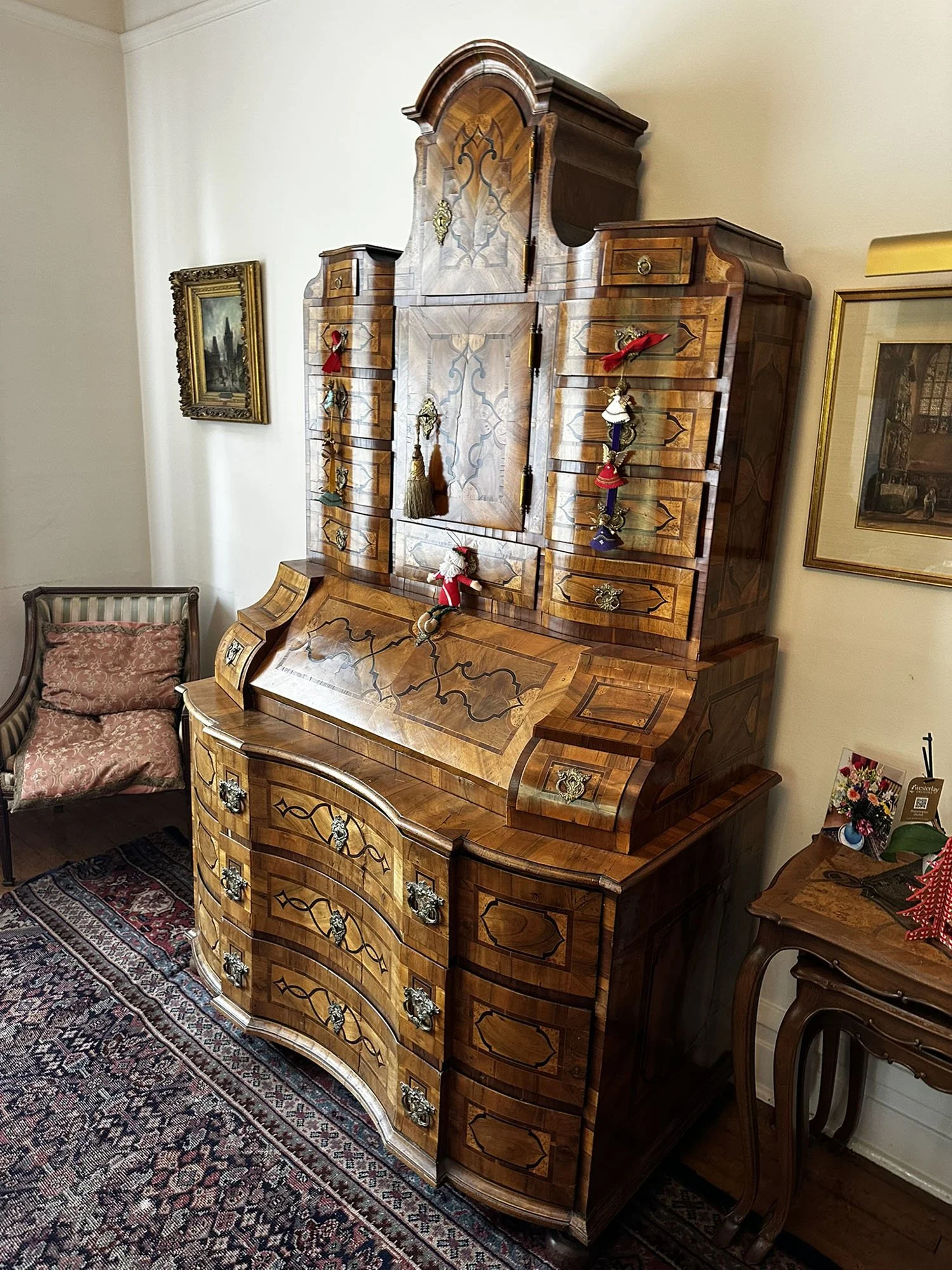
Impressive Austrian baroque marquetry secretary cabinet, veneered with thick, hand-cut walnut, and enriched with sophisticated marquetry in geometric patterns of maple and ebony. Provenance: Estate of Thea F.B. Bentley. Size in inches: 85 h x 45 w x 30 d. A21802
Constructed in two sections, the upper section with a curved cornice and two centrally positioned doors, flanked by a total of ten small drawers, five on each side, all with shaped fronts and original fittings. The cabinet has an additional refined internal locking feature, allowing the drawers to be locked simultaneously. Beneath the doors is a single wide drawer. The lower section has a sloping fall-front opening to a writing surface, flanked by two drawers. Behind the fall-front the interior is arranged with seven smaller drawers. Below are three large, gracefully curved drawers with richly profiled and inlaid fronts. The cabinet retains its original gilt bronze mounts and locks. Austrian, first half of the 18th century.
French gilt clock with a Roman Charioteer
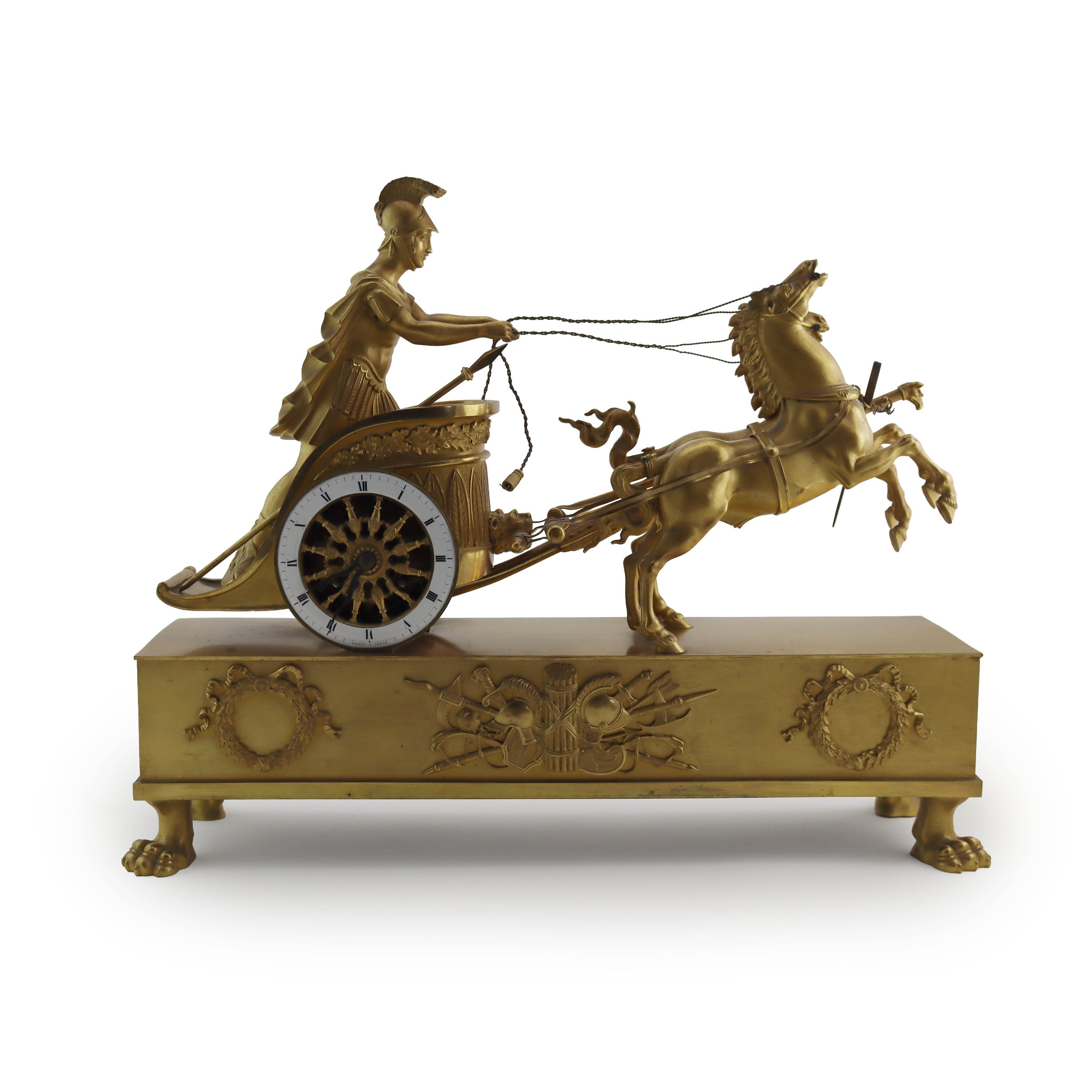
French gilt clock with a Roman Charioteer, face with enamelled dial, signed "Leroy a Paris", 19th century. Provenance: Estate of Thea F.B. Bentley, size 15.5 h x 19 w x 6 d ZJ21804
Austrian Silver
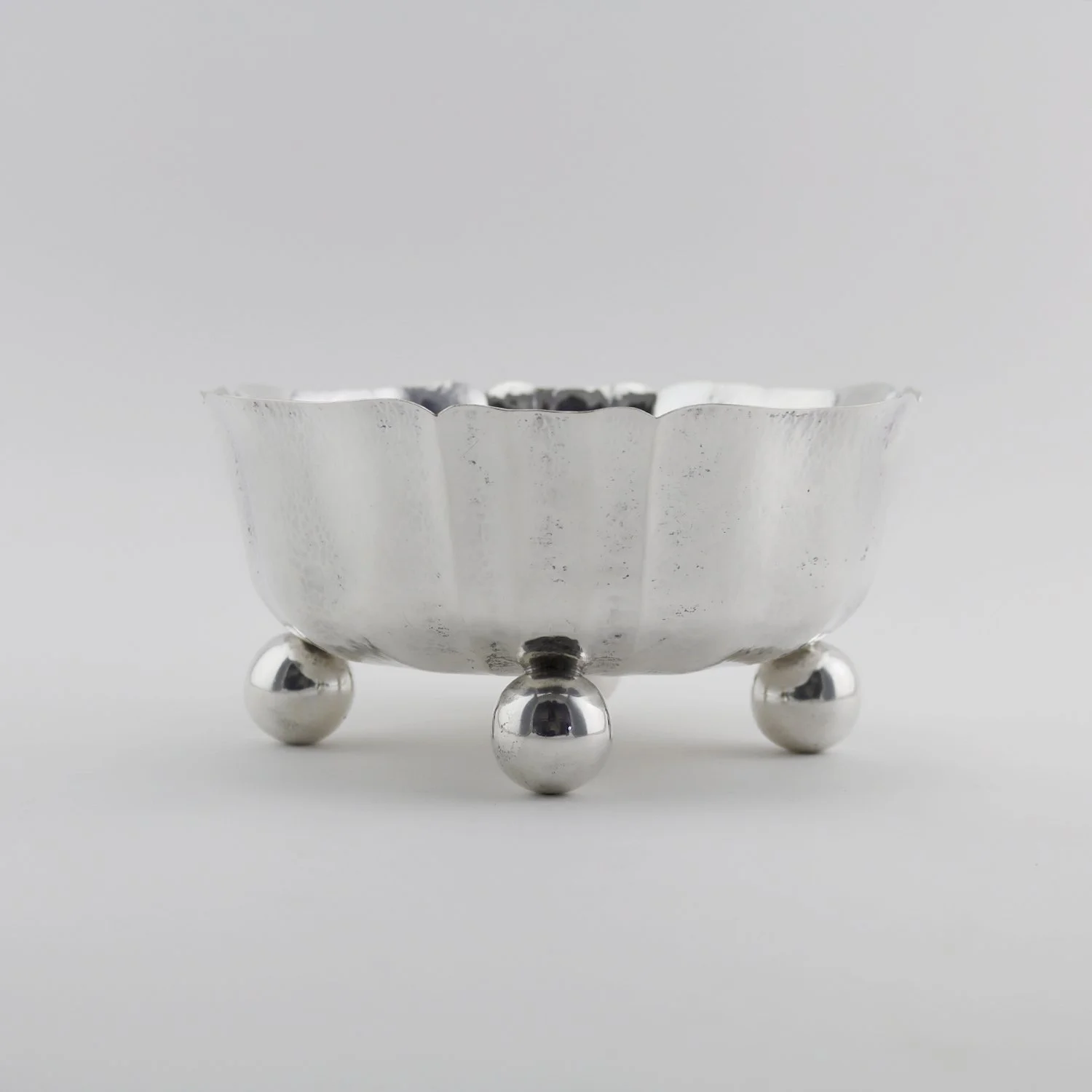
Austrian silver hand hammered scalloped bowl, resting on four ball feet, hallmarked for DUB Vincent Carl (1886-1924), Vienna, weight approximately 268 grams Size in inches: 3.25 h x 6.5 w x 6.5 d C21847 SOLD
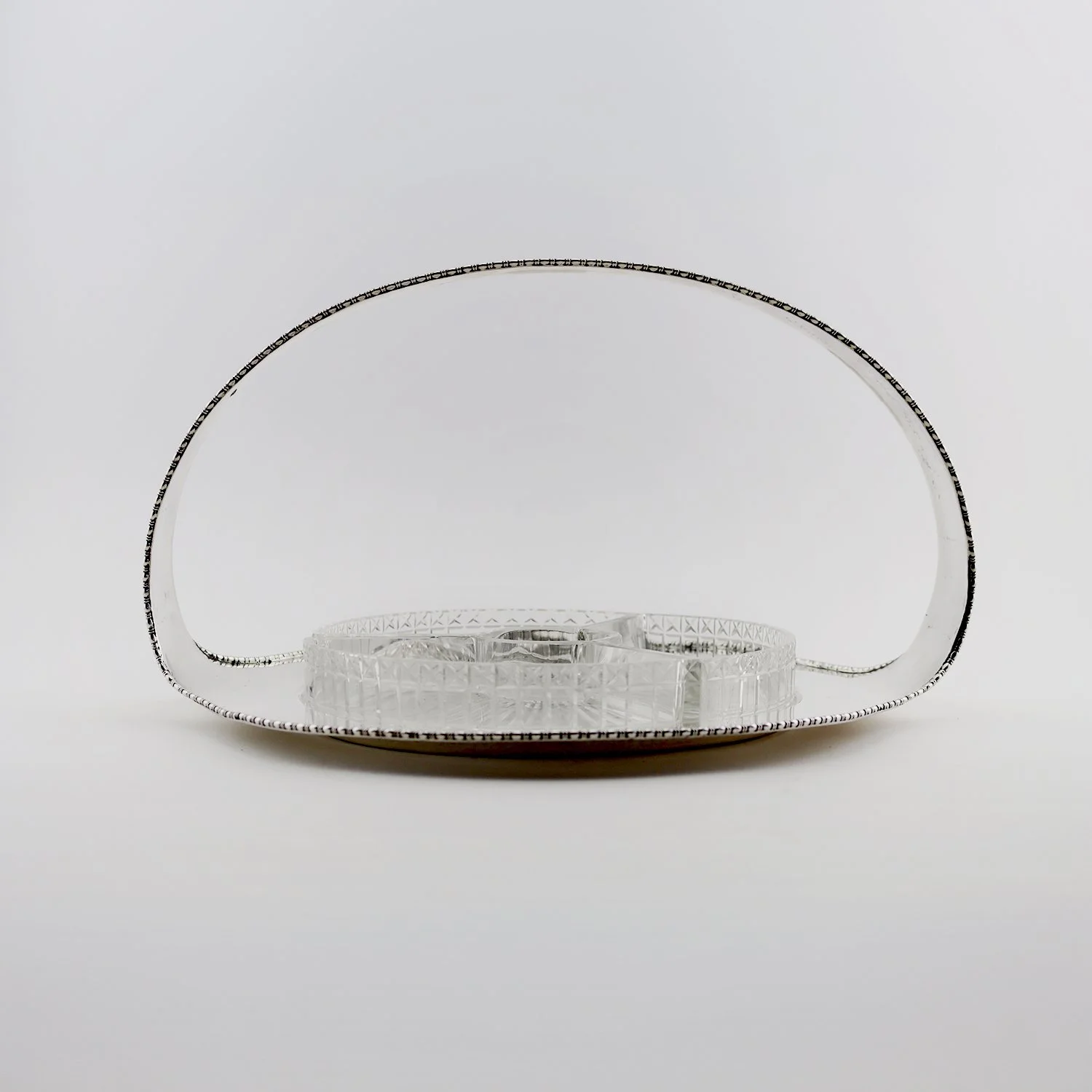
Austrian round serving tray with oval carrying handle, edges decorated with beading, fitted with three glass trays, hallmarked 800 Vienna, with illegible mark, weight approximately 653 grams. Size in inches: 7.5 h x 13 w x 10.25 d C21846
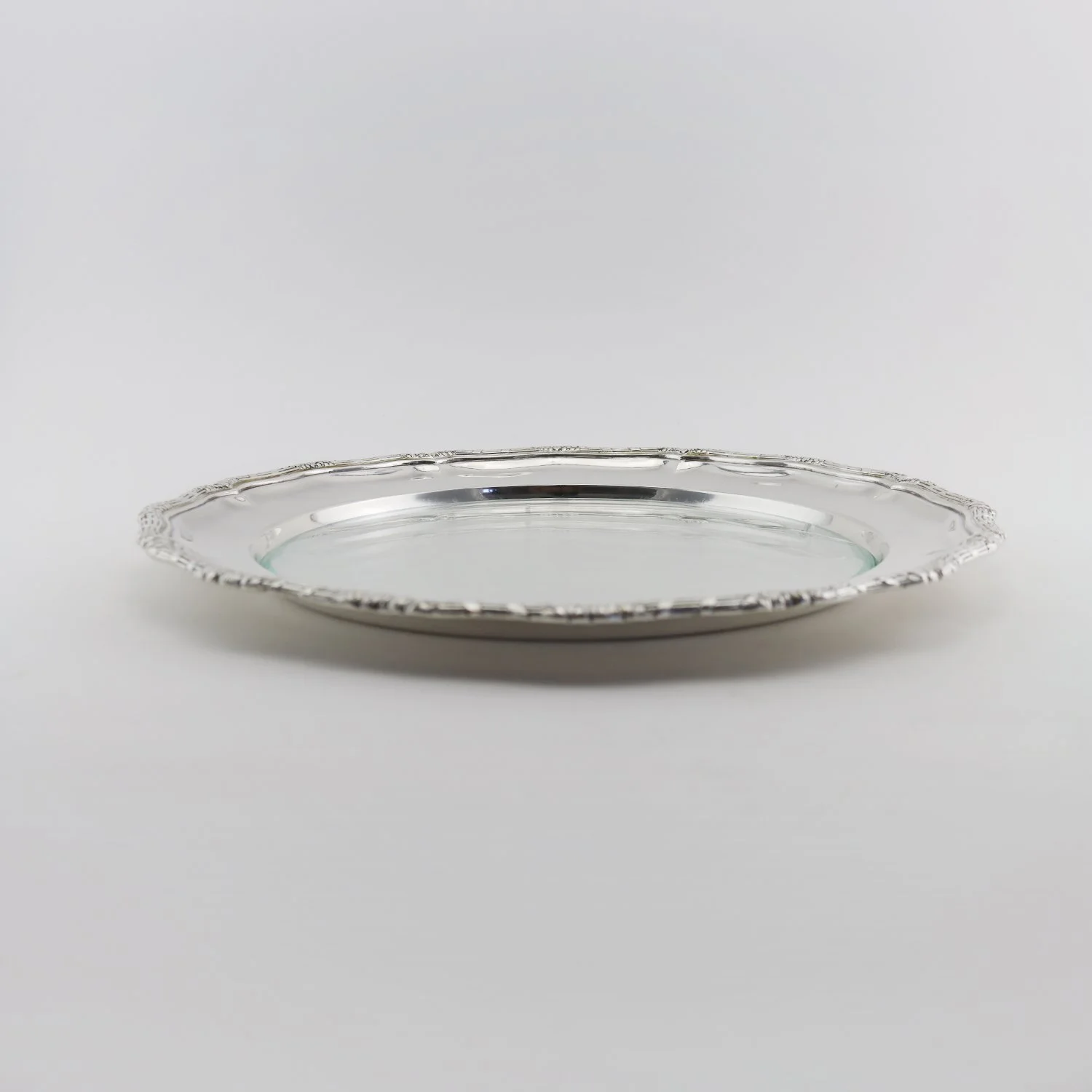
Austrian round tray with scalloped edge decorated with flowers, with glass insert (chip), hallmarked 800 Vienna, inscribed underneath with initials "BB", weight approximately 1092 grams. Size in inches: 1 h x 13.25 w x 13.25 d C21845
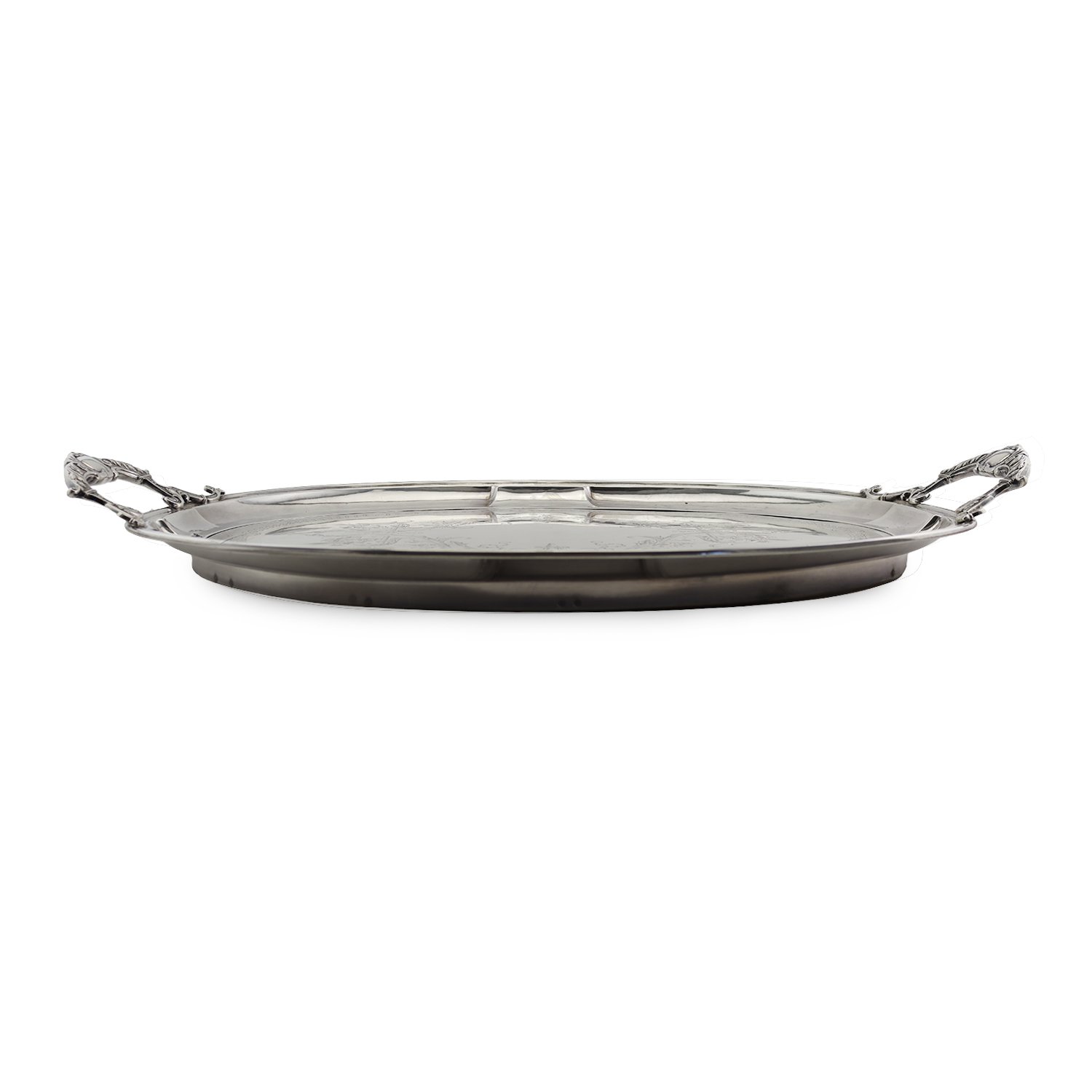
Austrian silver oval tray with handles, interior with scalloped edge, with floral decoration and looped surround, with wooden support base underneath, hallmarked Vienna .750, initials EG, other marks illegible. Size in inches: 3 h x 16.5 w x 25.25 d C21842
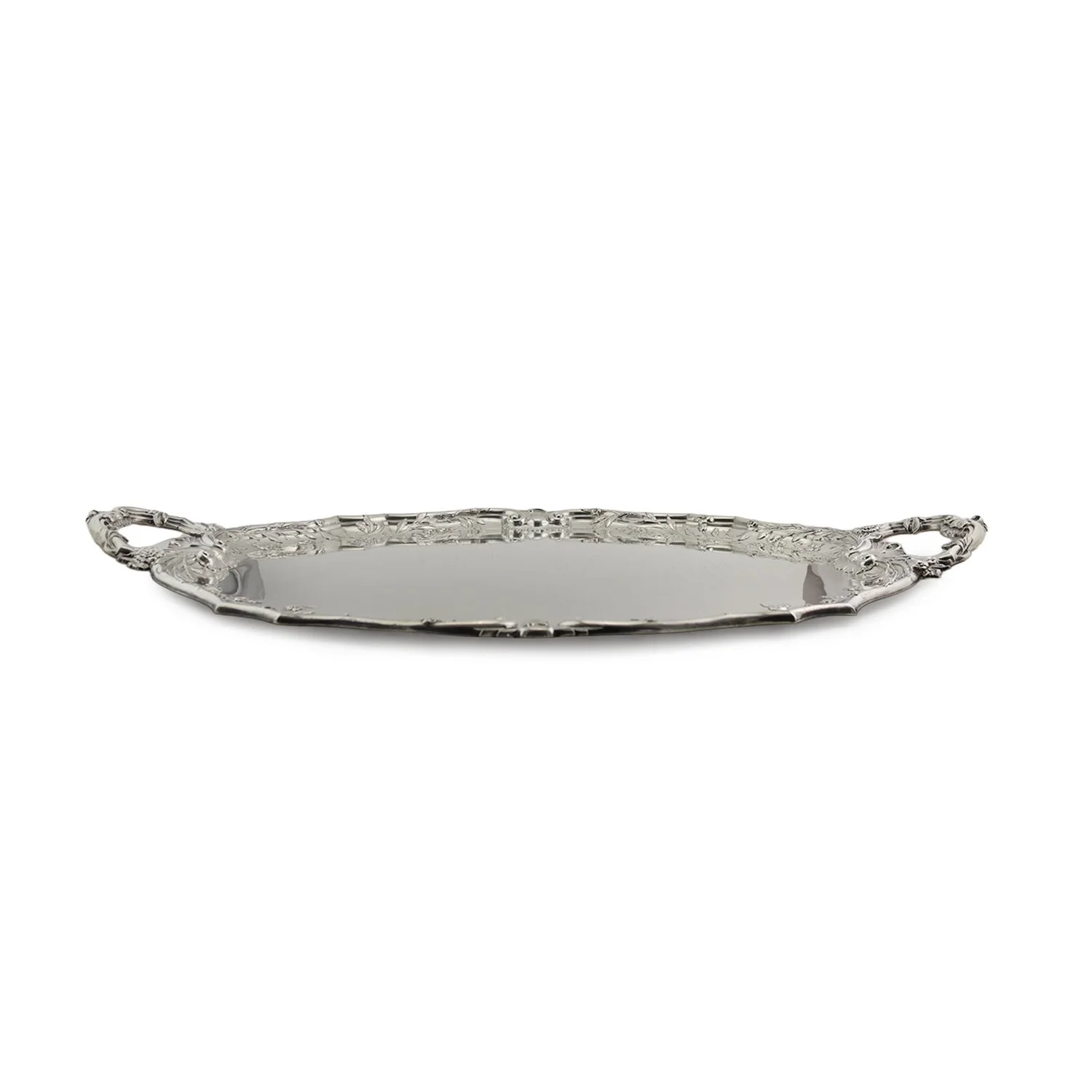
Fine double handed oval tray with Art Nouveau finely decorated with floral swags, hallmarked J.C. Klinkosch, Vienna 1872 .800, weight approximately 4009 grams. Size in inches: 1.75 h x 19.5 w x 31 d C21839
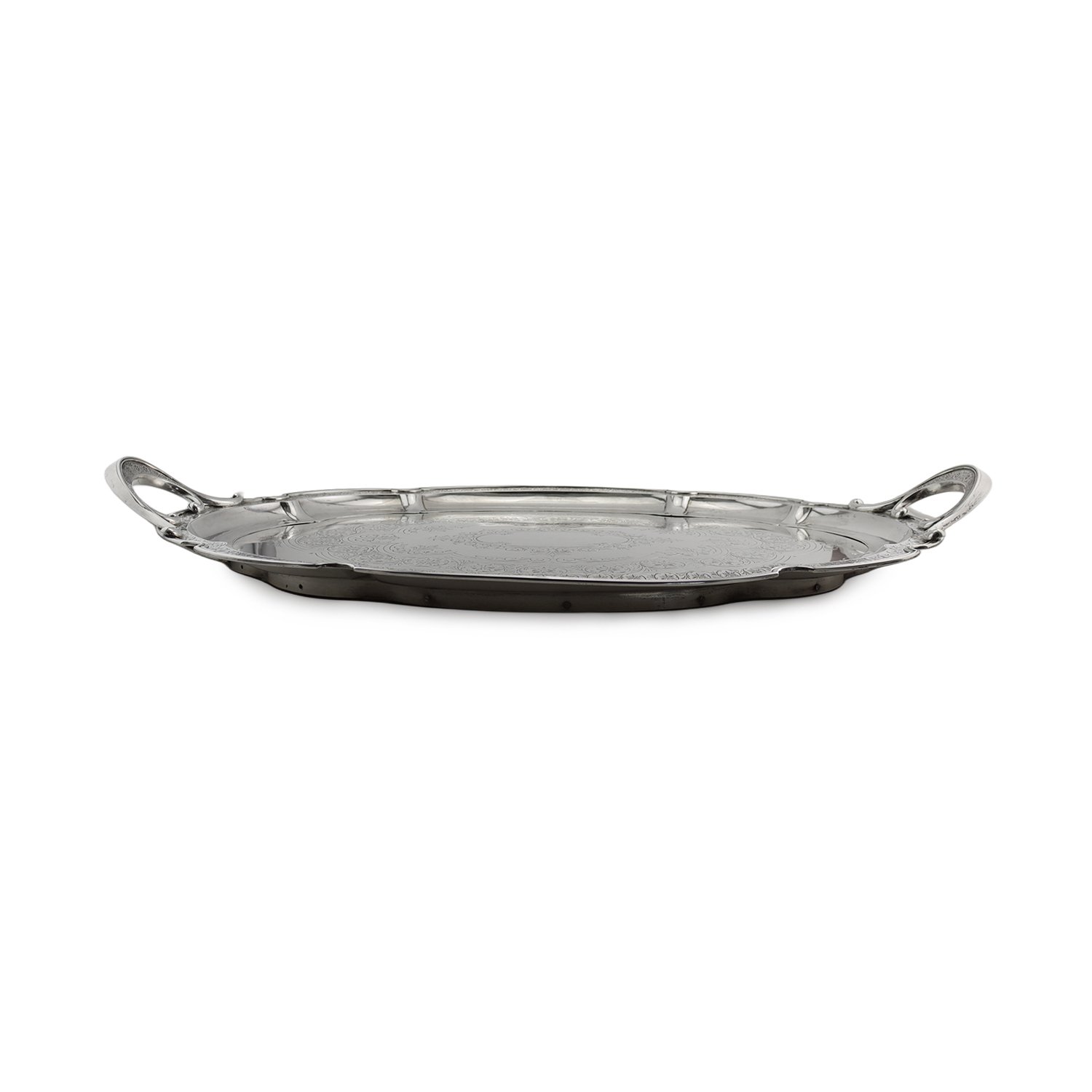
Austrian silver oval tray with scalloped border, the interior with floral decoration, with wooden support base underneath, hallmarked Vienna .750, initials BAC?, with further illegible mark. Size in inches: 3.5 h x 21 w x 30.25 d C21843
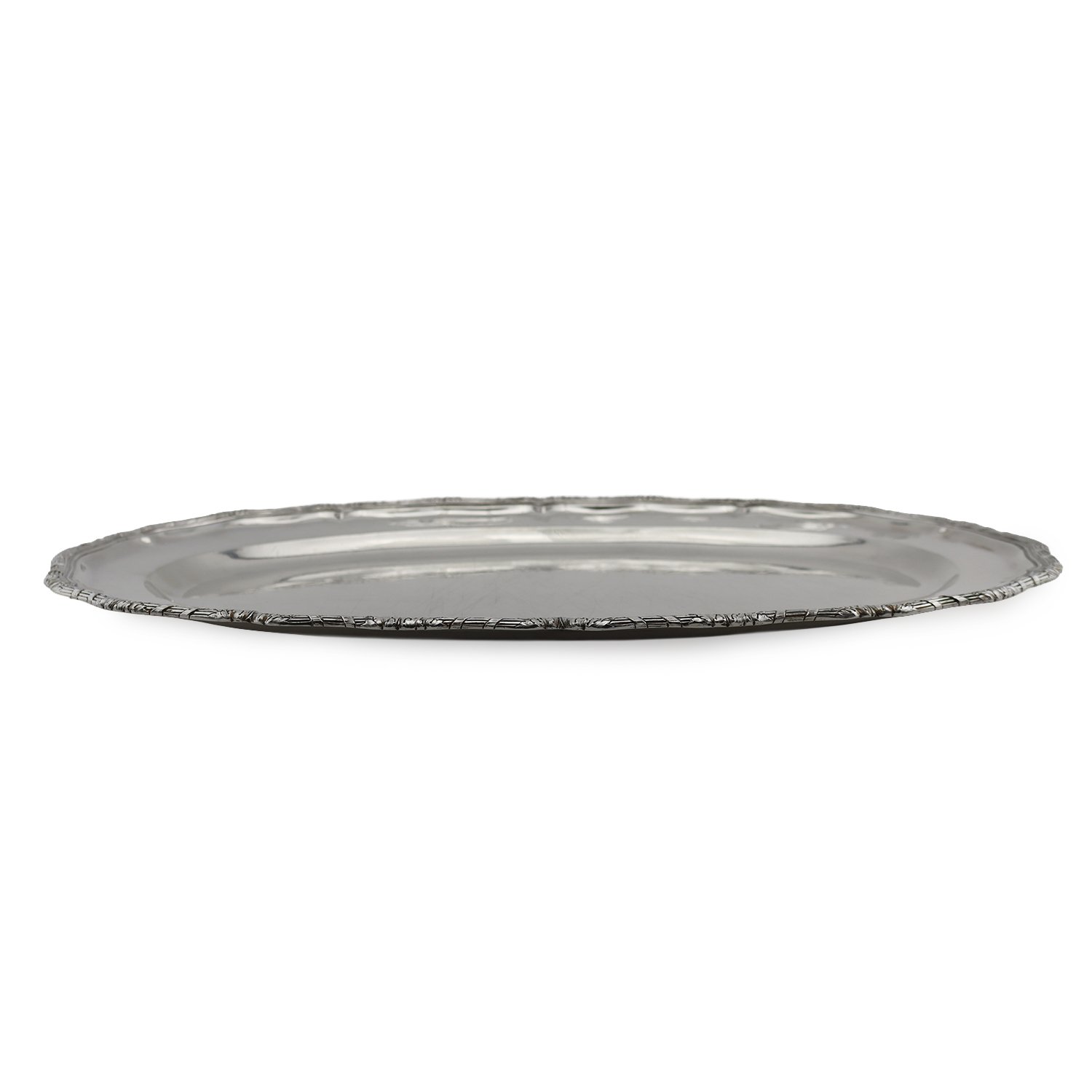
Austrian oval platter with scalloped edge decorated with flowers, hallmarked 800 Vienna, with later wooden carving insert, inscribed underneath with initials BB, weight approximately 1354 grams. Size in inches: 1 h x 13 w x 20 d C21844
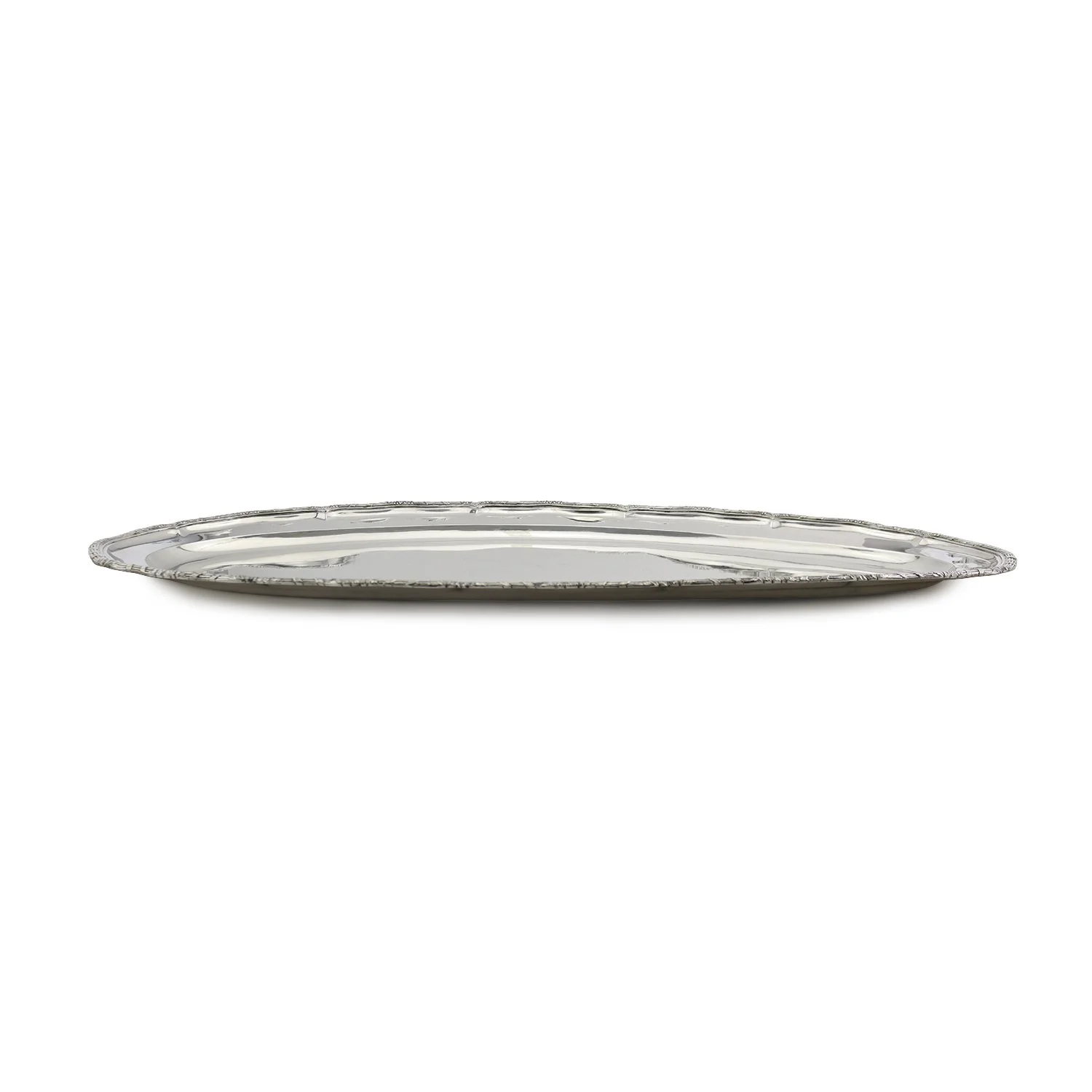
Oval silver tray with scalloped edge decorated with flowers, hallmarked Austria .800, additional hallmarks illegible, inscribed underneath with initials "BB", weight approximately 1822 grams. Size in inches: 1.25 h x 12.5 w x 28.25 d C21838
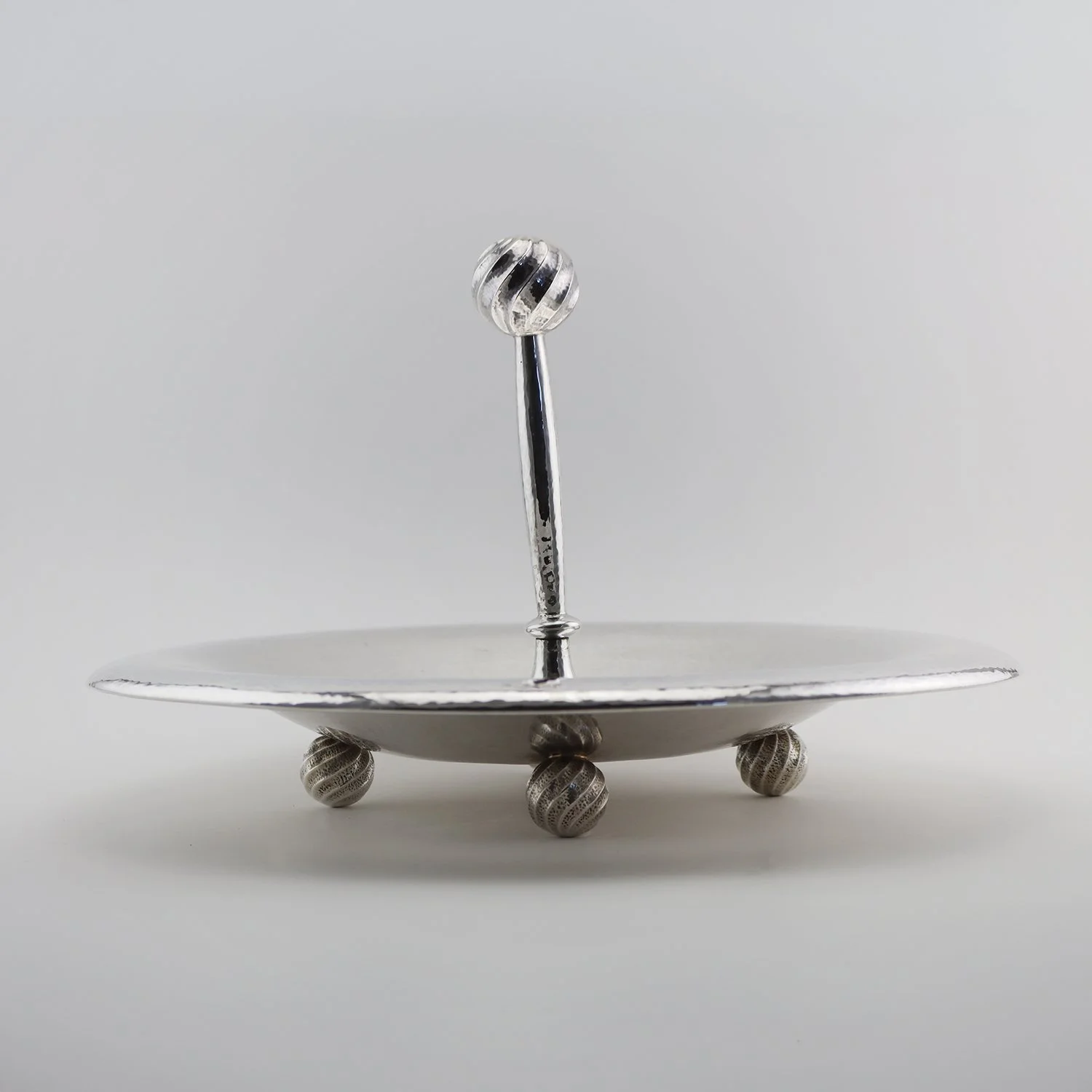
Fine Austrian hand hammered tray with center handle with ball, sitting on four ball feet, hallmarked 800 Schwarz & Steiner, Vienna .750 A*N, weight approximately 871 grams. Size in inches: 9.5 h x 13.75 w x 13.75 d C21840
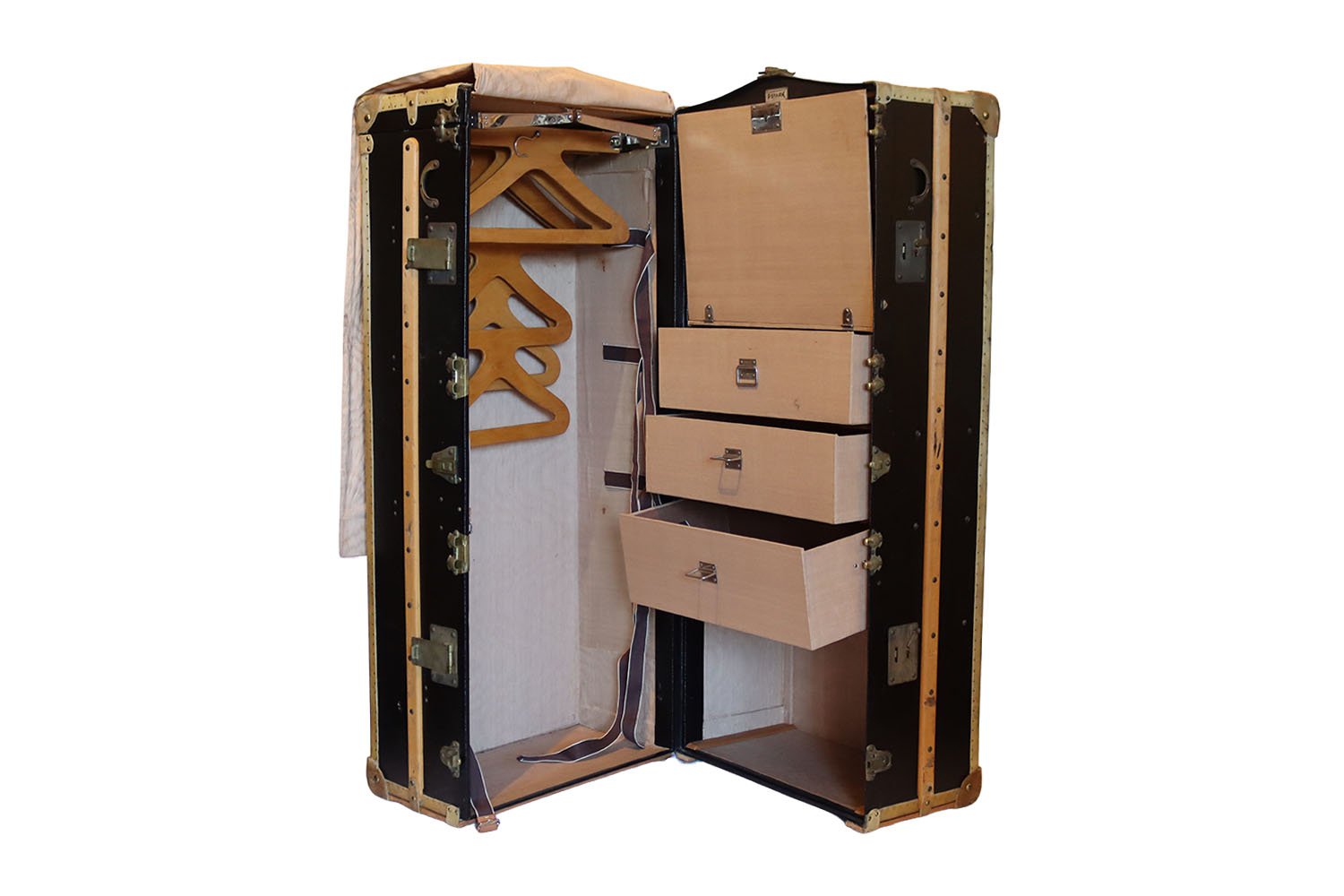
Austrian Leather Covered Travelling Wardrobe Suitcase
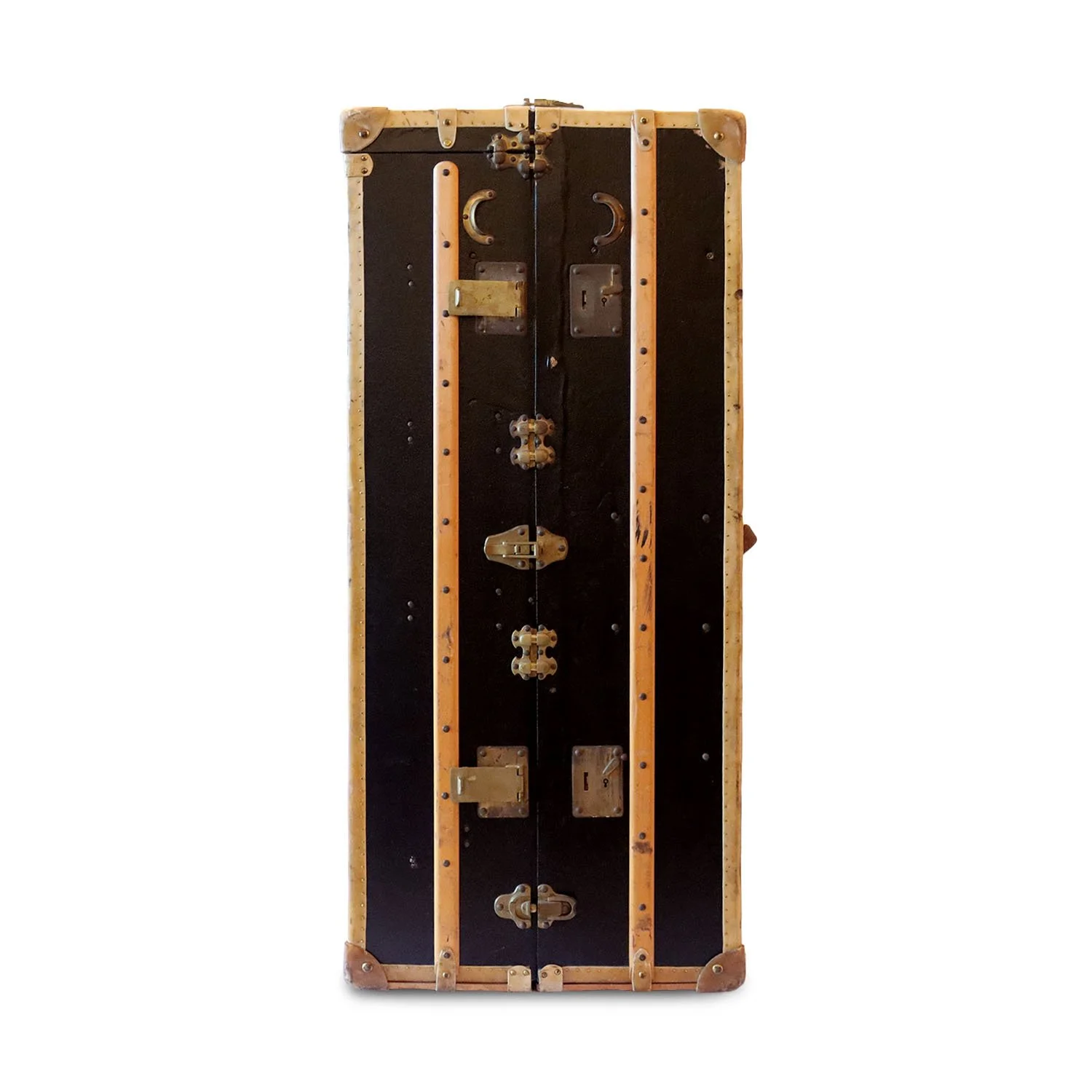
Austrian leather covered travelling wardrobe suitcase/trunk, by Vienna based luggage workshop Paul Stark, circa 1920. Size in inches: 53 h x 22.5 w x 21.5 d M21796