
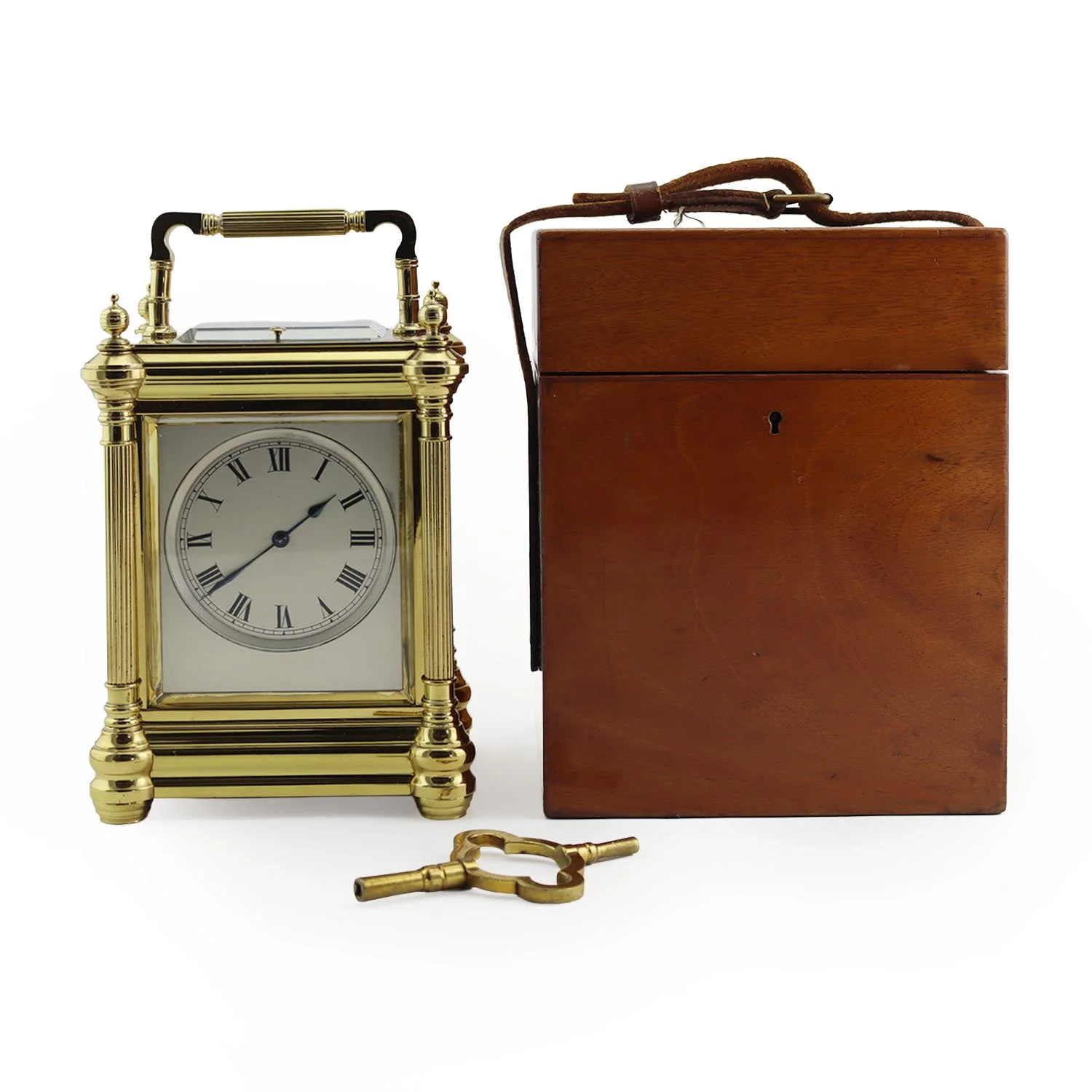
Rare French gilt brass carriage or mantle clock of large proportions by Alfred Drocourt, Paris, circa 1875, with Grande Sonnerie striking movement with repeater, silvered face with Roman numerals and spade hands, the back with AD oval stamp and numbered 16654, complete with original wooden fitted case with leather strap and numbered double-ended winding/setting gilt brass key.
Size: clock 9 3/4" to top of handle x 6" x 5" (size of box 10" x 7 1/4" x 6 1/8")
This exceptional and rare repeating Grande Sonnerie carriage clock by Drocourt has an eight-day spring-driven movement. The silvered dial has a circular Roman chapter ring with an outer minute track with Arabic five-minute markers, the time indicated by a fine pair of spade hands. The substantial brass gorge case is in original gilt condition and is surmounted by a carrying handle, with fluted round pillars, rounded corners with ringed capitals standing on further blocks and placed on a nicely moulded plinth. There are faceted glass panels to all sides including the top to reveal the moving escapement. The Grand Sonnerie movement stikes the hours and quarters on two gongs, with each being sounded at each quarter strike. The movement can be set to Silent, Striking or Full Striking on the undercase. The top has a repeat button, with which the last hour and quarters can be repeated at will. At the back there is a glazed door giving access to the winding and setting arbors. The backplate is stamped with the oval embossed and clock Drocourt hallmark, Drocourt serial number 16646, and with the word HANDS and an arrow to indicate the function of the arbor and the direction in which to turn. The speed can be adjusted regulator pin which can be seen through the window in the top and is accessible thorugh the back door. The clock comes complete with original wooden fitted case with leather strap and numbered double-ended winding/setting gilt brass key.
In the 19th century, Paris France, was the site of much of horological innovation. Pierre and Alfred Drocourt were the most celebrated makers of the second half of the century, with factories in Paris and St. Nicholas-d'Aliermont. Their highly decorative and innovative clocks won a series of medals at the Paris Exhibition, cementing their status. Born in 1819, Pierre Drocourt founded the company as early as 1846, although his first recorded clock was five years later. The firm went through a series of name changes throughout the century from Drocourt, to Drocourt et Fils in 1870 as Alfred became a partner, reverting to Drocourt by 1873 confirming the hand-over from Pierre to his son Alfred. Alfred was very active in Paris horological circles and was one of the first 21 members included in the newly formed Chamber Syndicale de l’Horlogerie de Paris. By 1889 The firm had received multiple awards at the Paris Exhibition including a gold medal. Alfred continued to run the business with great success until it sold in 1904.
Carriage clocks can be traced back to a clock first created for Napoleon in the late 18th century by Abraham Louis Breguet. Originally called an Officer’s Clock these had a balance rather than a pendulum so they could be transported without having to be reset. Originally made in the Empire style, by the 19th century rail and road travel was becoming increasingly common and by the 1860’s these portable time pieces were being produced on a grand scale. Many of the most valuable styles of carriage clocks were produced toward the second half of the 19th century, exquisite examples with intricate gilt cases. Most carriage clocks will strike on the hour and half past the hour. The Petite Sonnerie system strikes the number of hours on the hour, and strikes each quarter hour, while the Grande Sonnerie, the movement of this exceptional clock, strikes the number of hours on the hour, and the number of hours and quarters on each quarter-hour strike. The finest examples include a repeat button, with which the last hour and quarters can be repeated at will.
Serial No.: 16646
Movement: No blanc number
Case: Giant fluted rounded pillars with original gilding
Movement: Grande Sonnerie on 2 gongs with repeater
Platform: Angled, two part bridge
Dial: Silvered, dots to the 5 minutes with black Roman numerals, unsigned
Rear of dial: Unknown
Hands: Spade
Backplate: Stemped with Drocourt serial no. 16646, oval embossed and clock Drocourt stamp
Regulation script to top of backplate: S/F
Holding screws: Double
Gong block: FD
Size: 9.75 h x 6 w (size of box 10 h x 7.25 w x 6.125d)
D21867
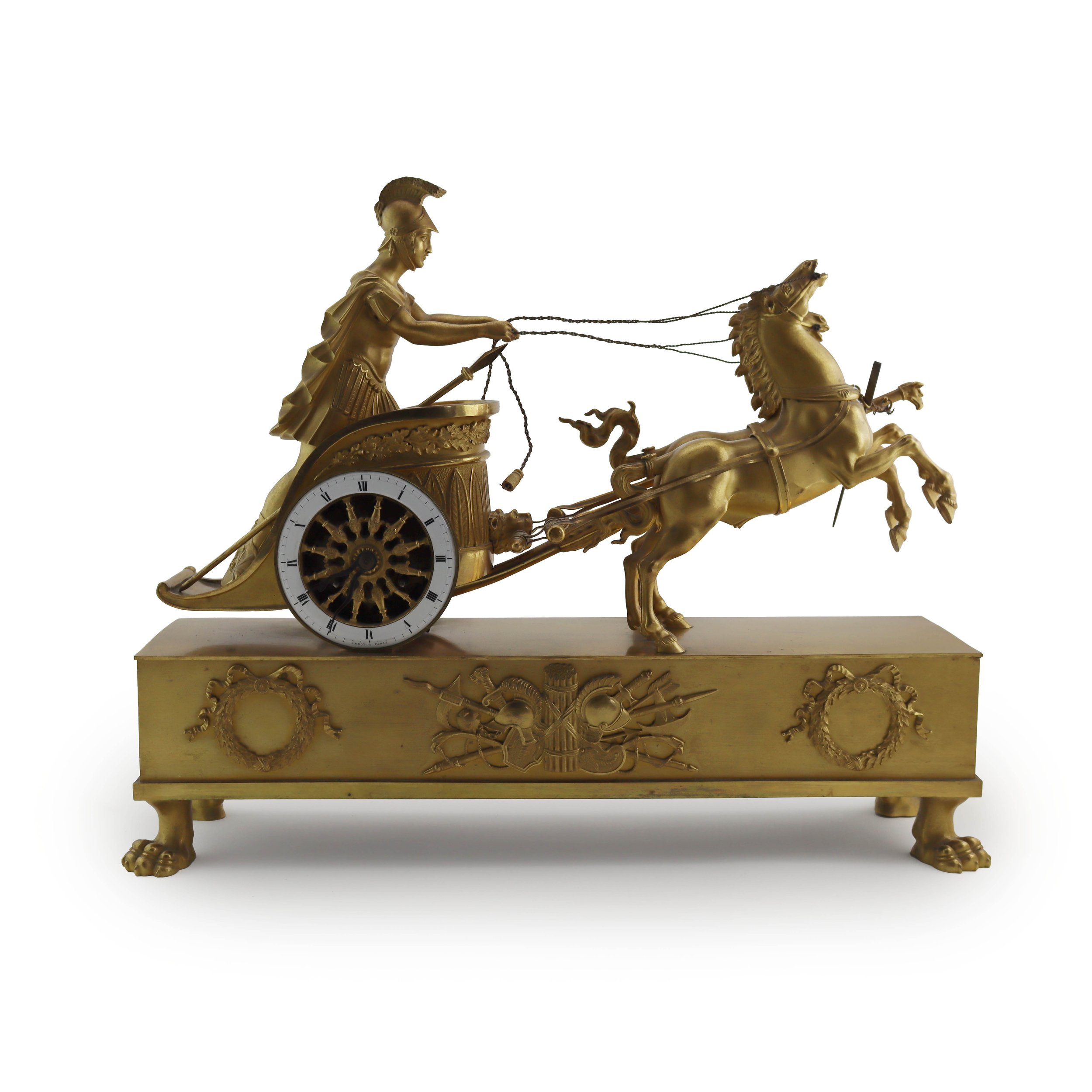
French gilt clock with a Roman Charioteer, face with enamelled dial, signed "Leroy a Paris", 19th century.
Provenance: Estate of Thea F.B. Bentley
Size: 15.5 h x 19 w x 6 d
H21804

George III black japanned tall case clock, maker Hewes Carter, Cambridge, circa 1790, with key
Size: 89” h
H18644
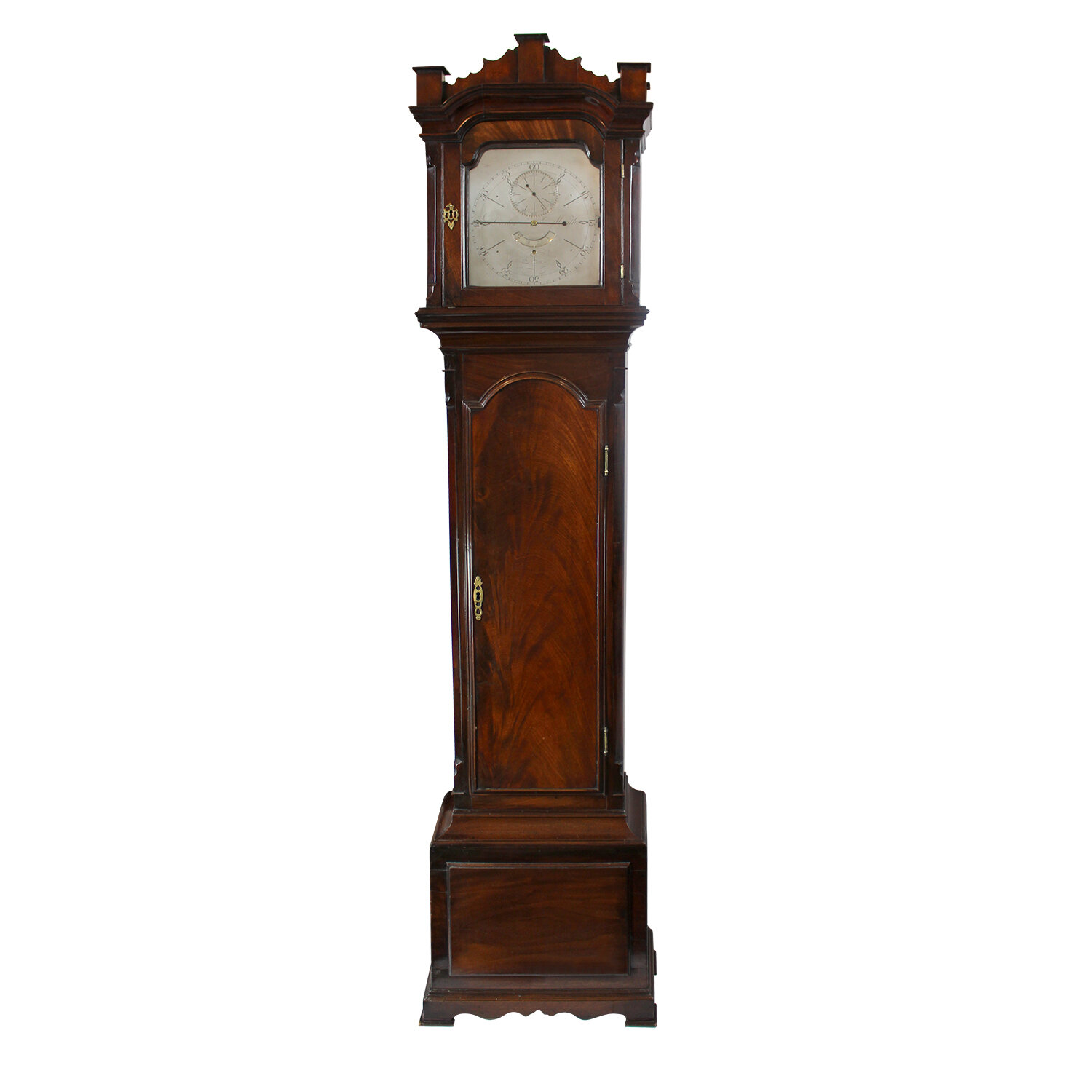
Darlow Mather, London George III mahogany tall case regulator, circa 1790. The 10" signed silvered dial with shallow ogee arch, Arabic outer minute track with observatory indices, large subsidiary seconds dial and sector shaped hour aperture, the deadbeat movement with chamfered upper corners, six knopped posts and bolt and shutter. Case of dense flame mahogany, base with raised panel, break arch trunk door and hood., with key.
Size: 81 ½ h in
H17309
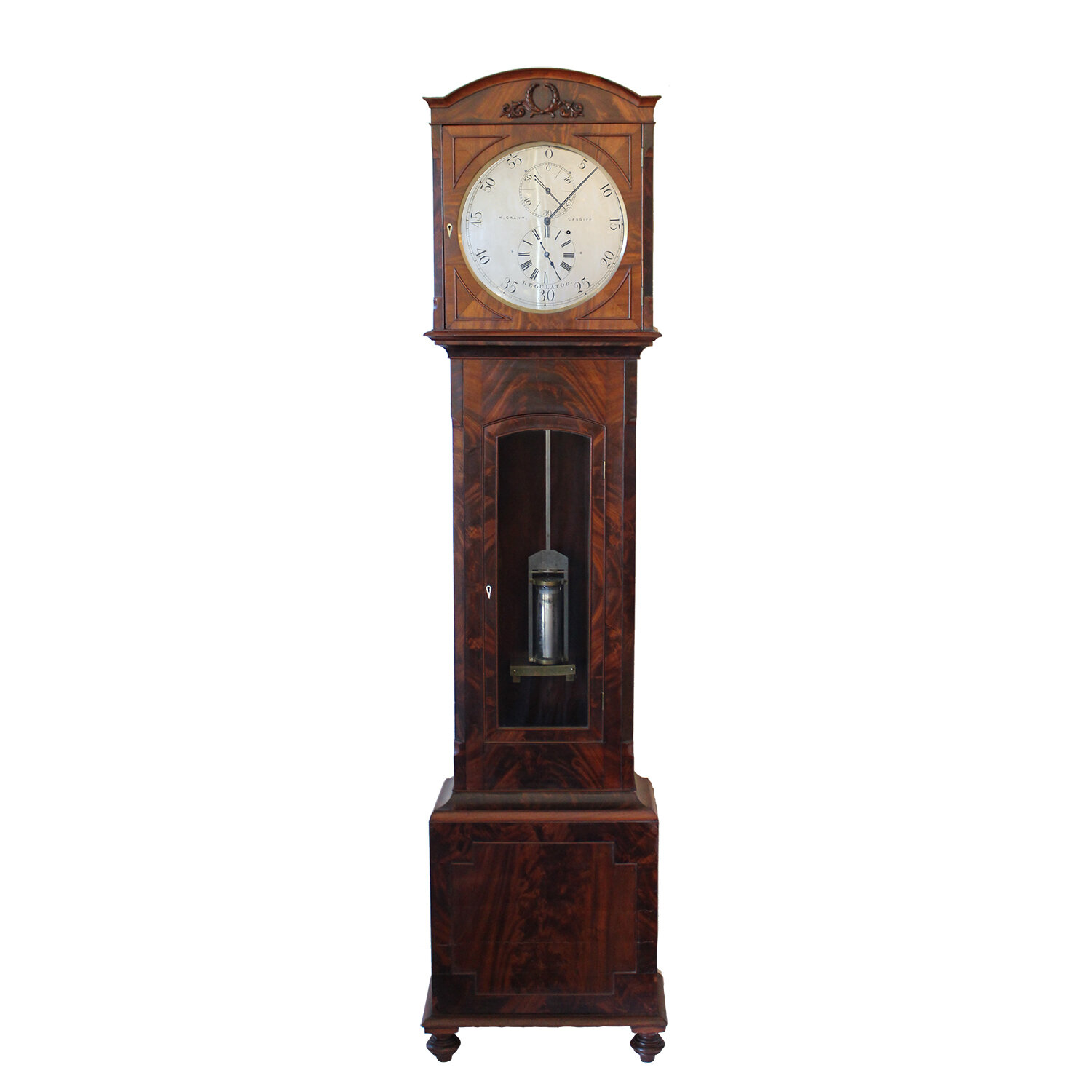
Longcase regulator clock by Henry Grant of Cardiff, Wales, mid 19th century, dial inscribed "H. Grant, Cardiff". With conventional silvered dial and mercurial pendulum in a flame mahogany case, six pinned pillar movement with a beat setting adjustment at the top of the crotch, and strong angle brackets for fixing to seat board. Henry Grant worked in Portsmouth, Christchurch, in Cardiff from 1844 to 1855, after which time he immigrated to Canada, where he is listed as working in Belleville in 1862 and in Montreal after 1866
Size in inches: 87 h
ZH19887
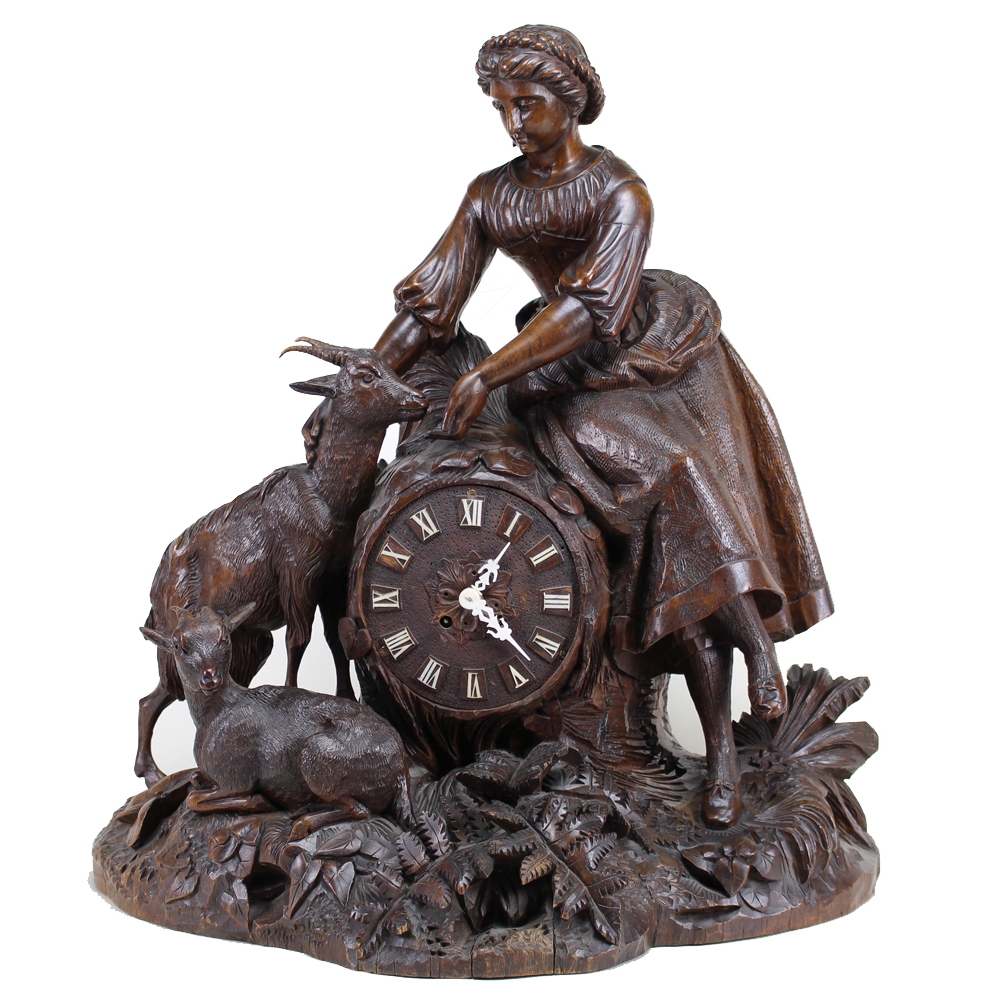

French ormolu and bronze mantle clock, depicting a woman in classical dress sitting on rock holding a lyre, mid 19th century
Size: 21 x 15 x 5 ¼ in
H19093
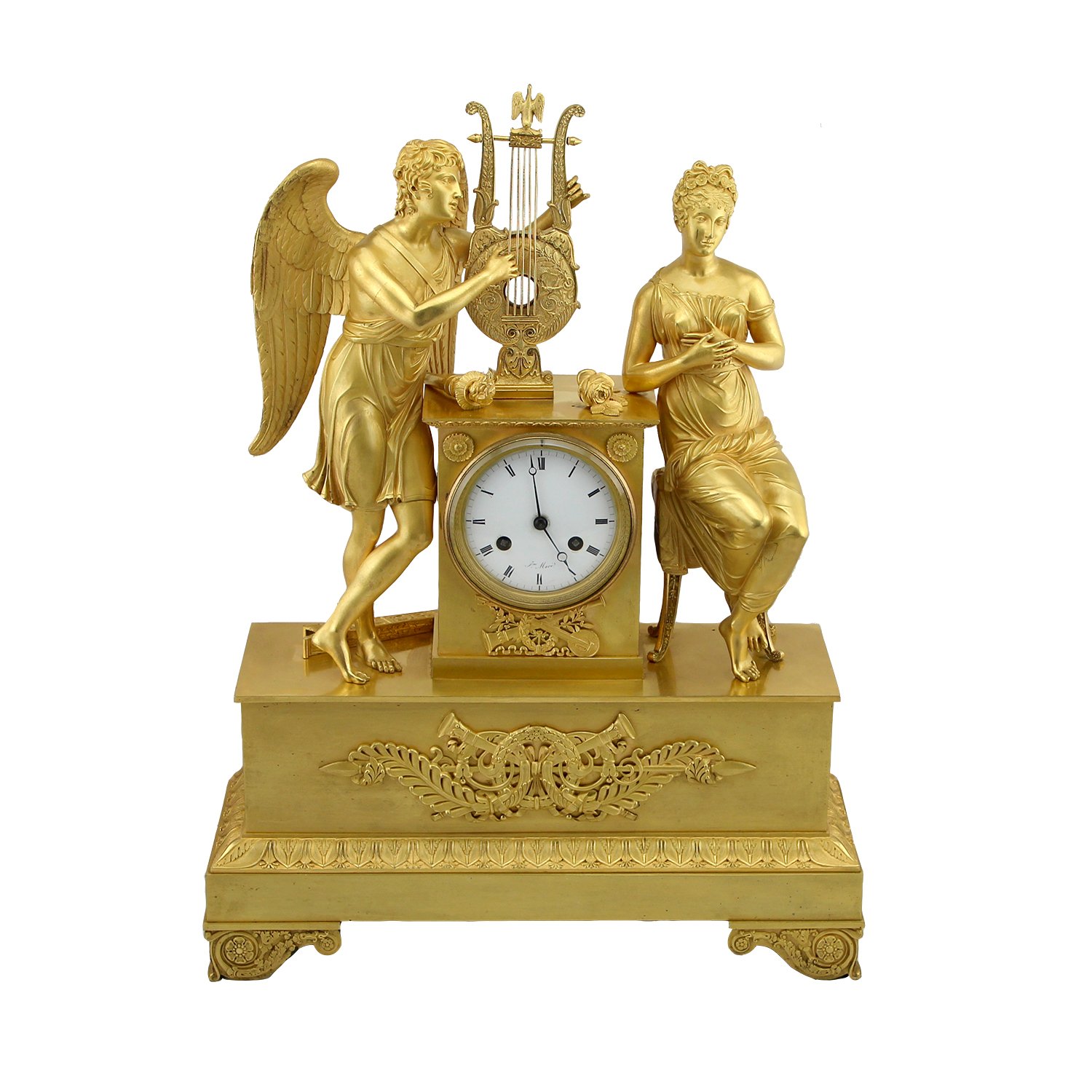
French Empire gilt bronze mantle clock depicting Cupid and Psyche, dial signed "Joc. More", circa 1840, with key
Size: 22 h x 17 w x 6 d in
H20091
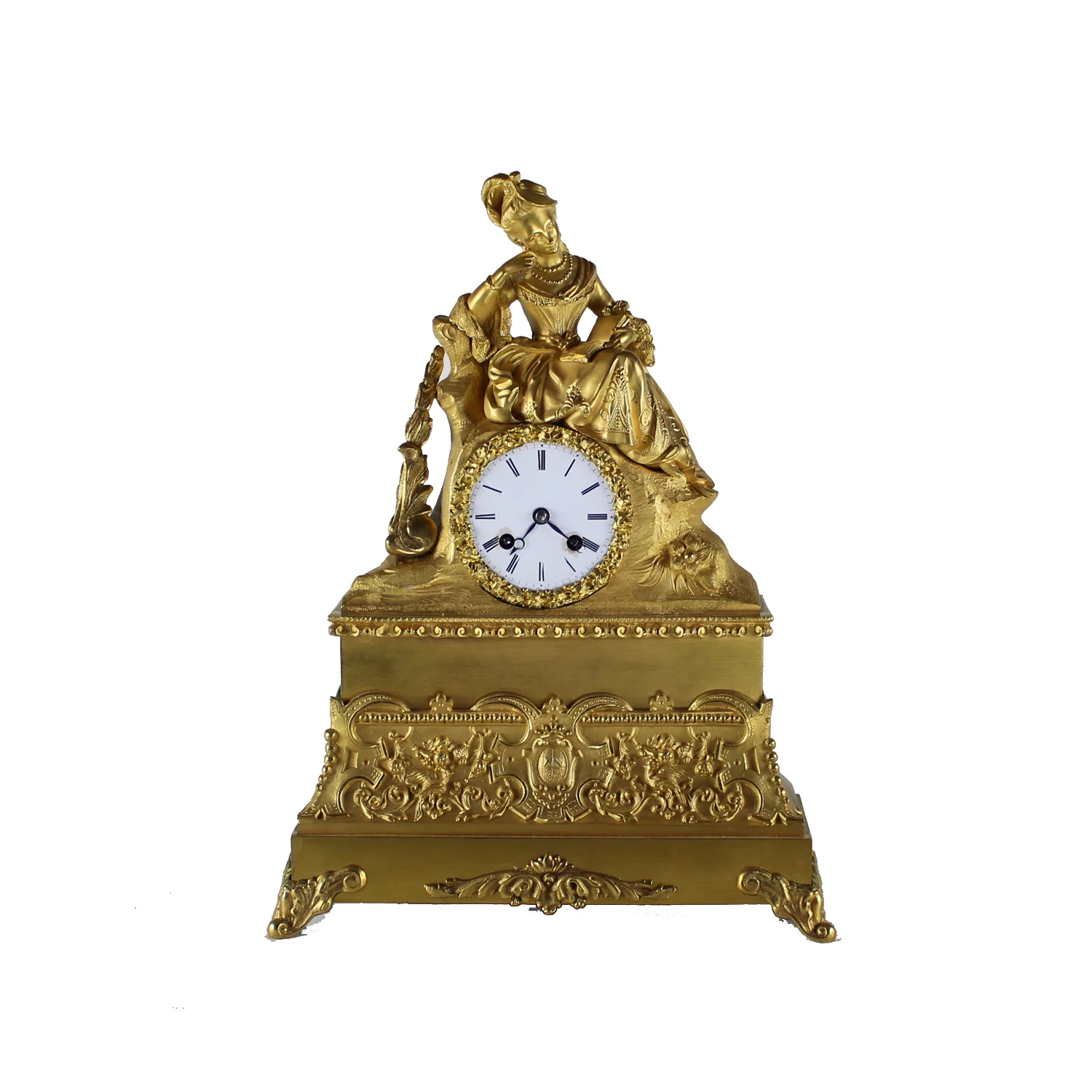
French ormolu clock depicting a lady in court dress reading a book, with French chiming movement, circa 1860
Size: 16 x 12 x 4 ¼ in
H19092
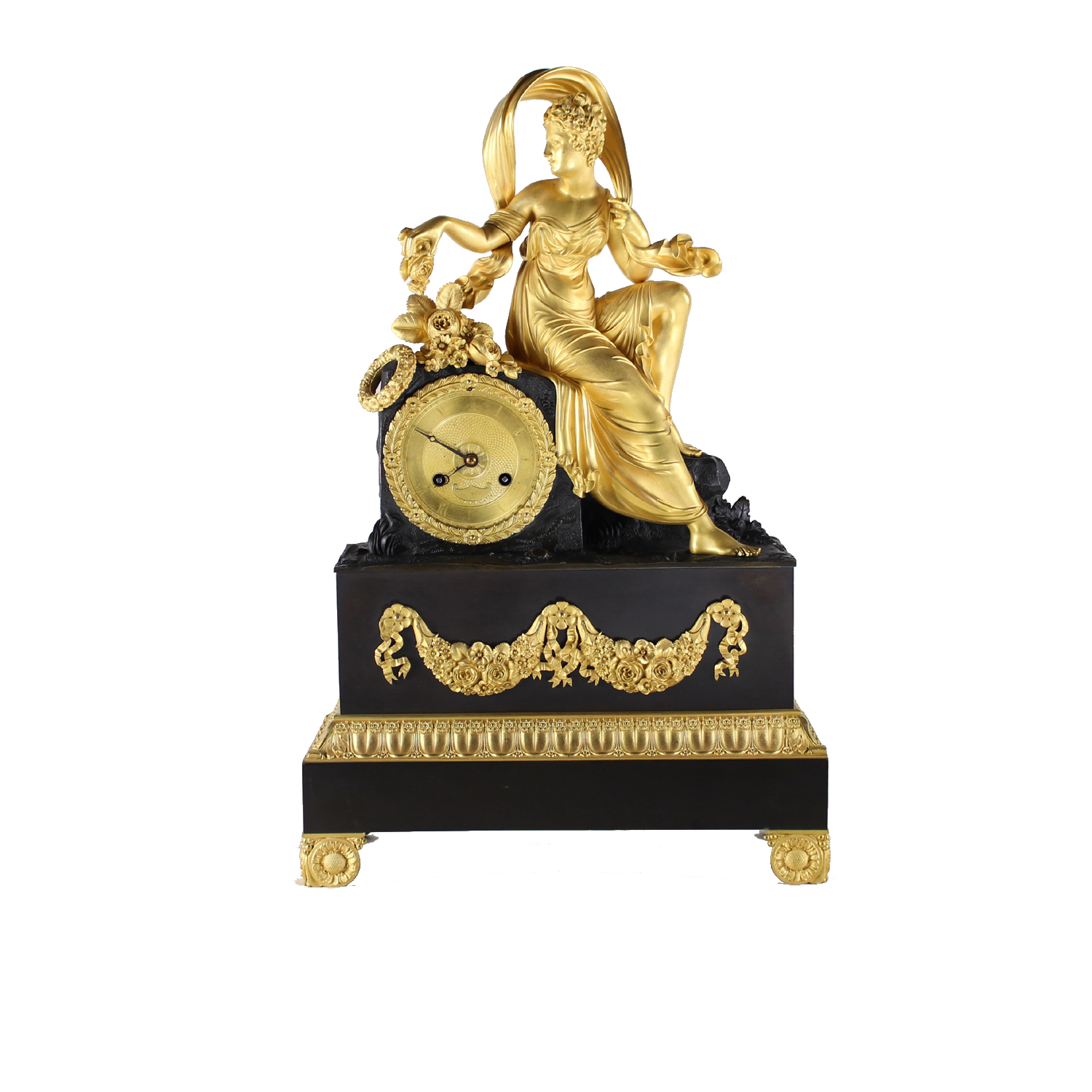
Gilt mantel clock, with female figure with flowers, French circa 1835, by Bourdon à Lille
Size: 20 x 13 x 5 in
H18336
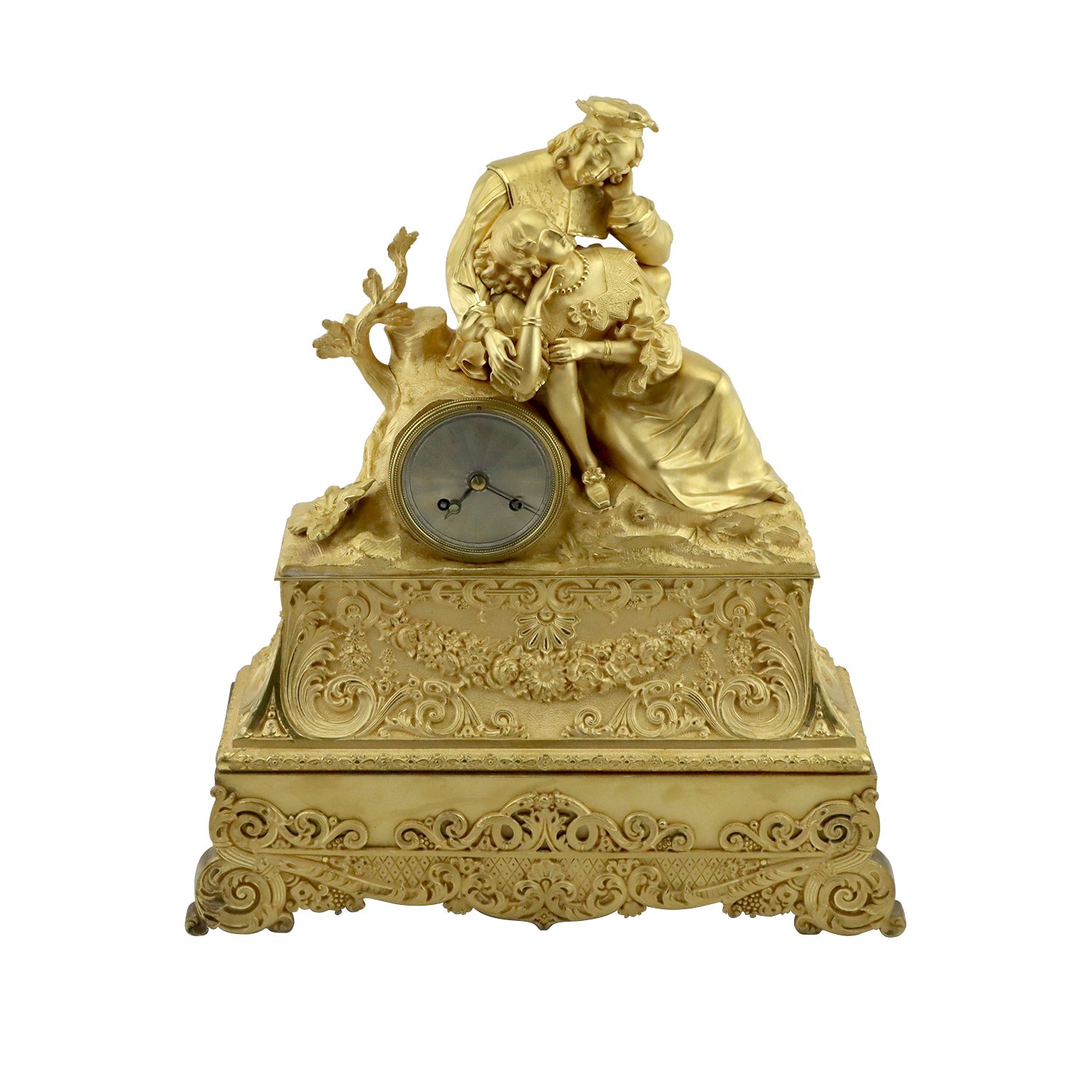
French elaborately cast gilt bronze mantel clock depicting a courting couple, the face engraved with Roman numerals and striking on the hour and half hour, the silk escapement movement stamped "Nicolas Douillon", circa 1830-40, with key
Size: 19 ½ h x 16 w x 5 d in
H20237
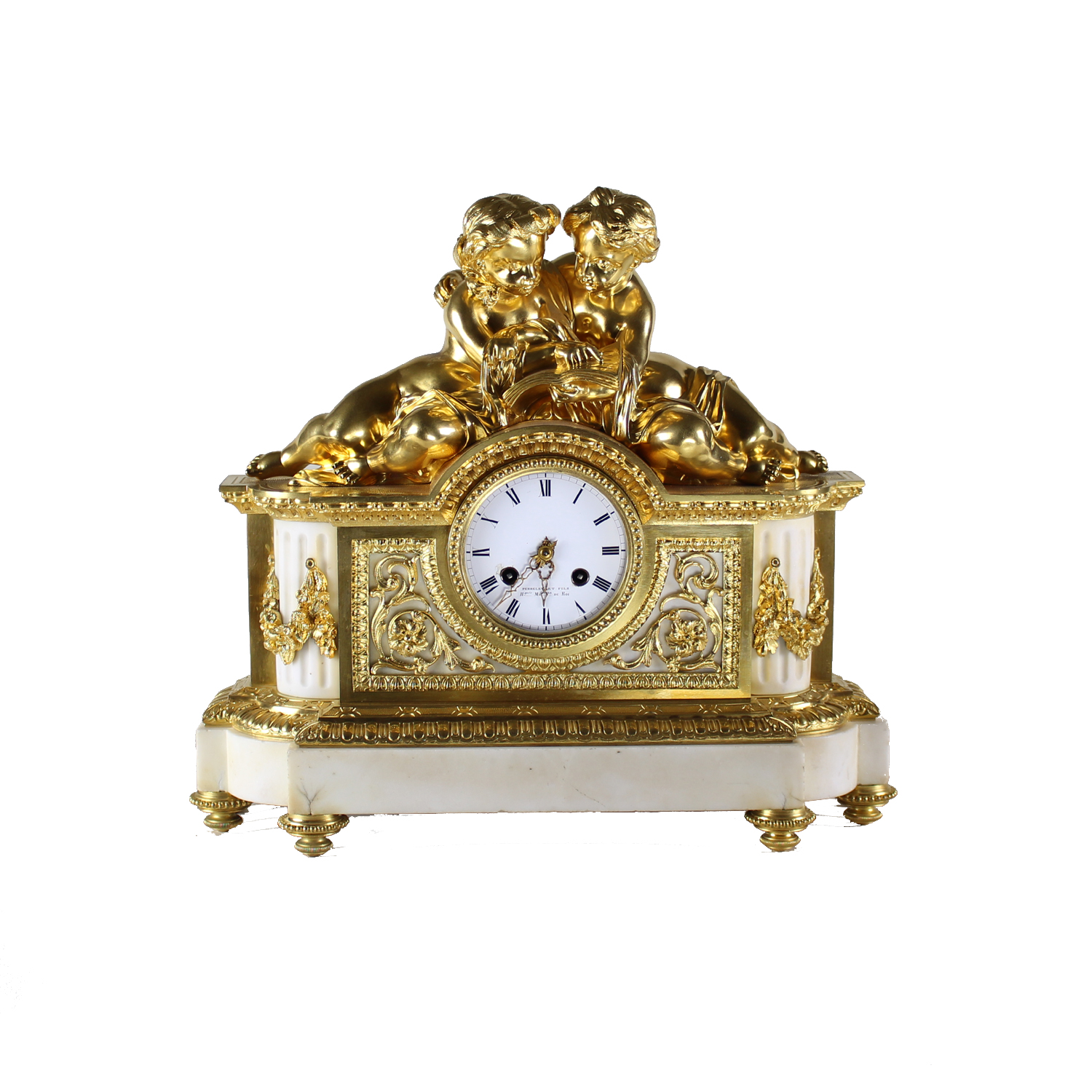
French gilt-bronze and white marble mantel clock by Perrelet et Fils, Paris. The case is decorated with children reading, sides and front decorated with floral garlands and foliage. White enamel dial with Roman numerals, signed Perrelet et Fils, Horlogers Mecaniciens du Roi (clockmakers to the King), circa 1850, with key
Size: 15 x 16 x 6 in
H18019
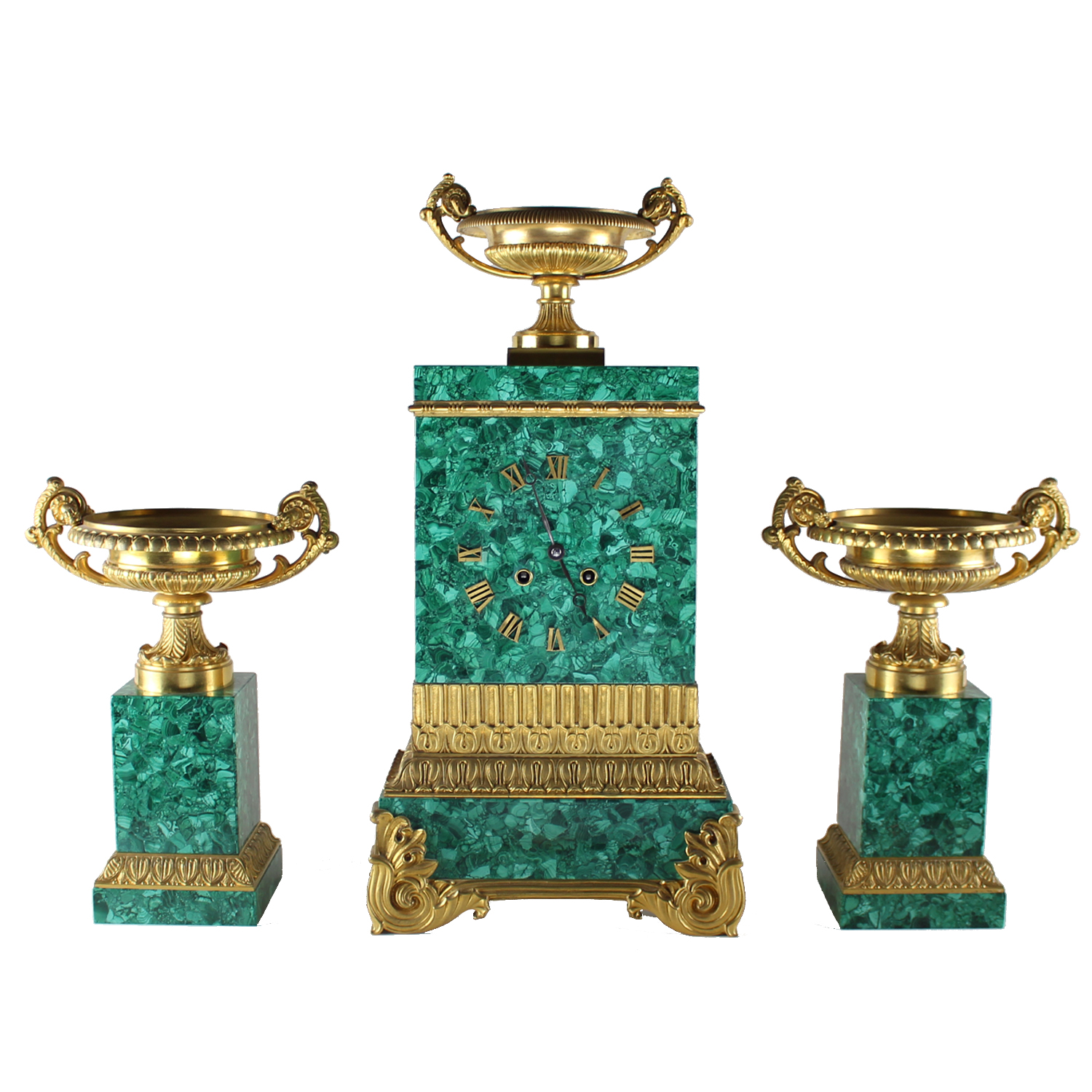
Rare Russian malachite garniture set including clock and pair of comports; the malachite veneered onto marble in the typical Russian manner and mounted with fire gilt bronze; the movement is French; similar to pieces in the collection of the Hermitage; circa 1840; with key
Size: clock 20" high 10" wide - comports 12" high
H12778