
In Celebration of Mothers
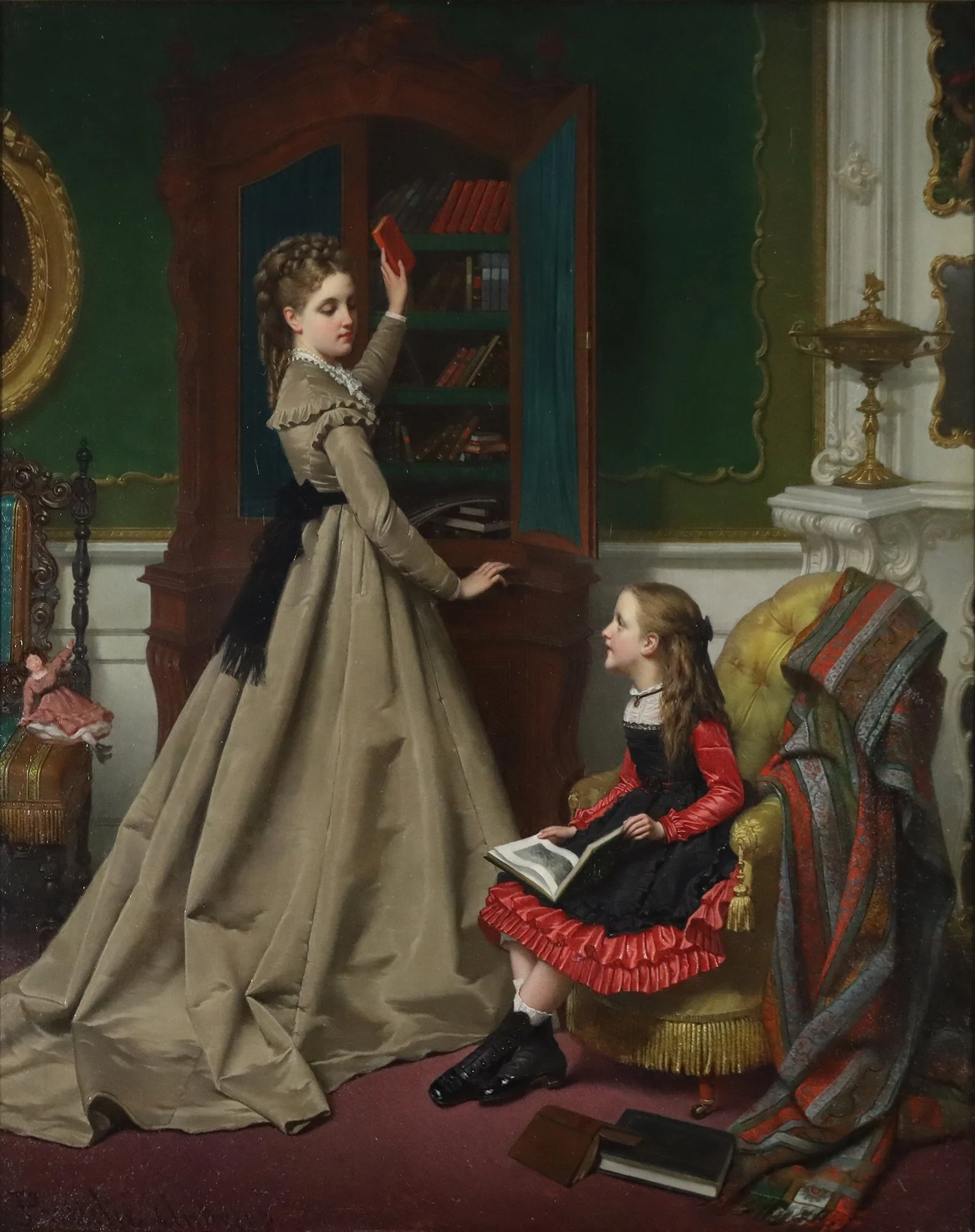
‘The Library’ oil on wooden panel, signed and inscribed lower left "J Portielje Antwerp" Size: 30 h x 24 w (with frame 39.25 h x 25.24 w in) J21483
Mother’s Day is a celebration of motherhood, a nurturing, calming, caring and affectionate force in our lives. The present day version is based on traditional celebrations of mothers and motherhood dating back to ancient times such as the Greek cult to Cybele, Rhea the Great Mother of the Gods, and the Roman festival of Hilaria.
“Mothering Sunday”, a Christian celebration originating in the United Kingdom, falls on the fourth Sunday in Lent (Laetare Sunday). In the 16th century, domestic servants were given the day off to visit their ‘mother church’, the church where they were baptized, their parish church or local cathedral. Many times this was the one day when families could gather due to conflicting work schedules, hence the term “to have gone ‘a-mothering’”. Children would gather wild flowers along the journey and the tradition of gift giving evolved.
North American celebrations date back to before the Civil War. There were many strong women pioneers who fought for mothers’ rights and education in the 19th century. Prior to the Civil War Ann Reeves Jarvis of West Virginia founded “Mothers’ Day Work Clubs” which taught local women proper childcare. These clubs became a strong unifying force and in 1868 Jarvis organized “Mothers’ Friendship Day” which gathered mothers and former soldiers (both Union and Confederate) to promote reconciliation. In 1870 Julia Ward Howe asked mothers to unite in promoting world peace in the “Mother’s Day Proclamation”, and in 1873 promoted a “Mother’s Peace Day” every June 2. There were many other strong women pioneers, but the founder of the North American Mother’s Day we know today was Anna Jarvis. Jarvis fought for the adoption of a special day honouring motherhood, and organized the first North American celebration in 1908 in a Methodist Church in Grafton, West Virginia. By 1912 the day had been accepted by many states and in 1914 President Woodrow Wilson officially established the second Sunday of May as Mother’s Day. However, Jarvis fought against the commercialization of the holiday and died penniless despite the many opportunities afforded her from her minor celebrity status. Later in the 20th century the day was often used for political or feminist causes such as marches in support of underprivileged women, equal rights or access to childcare. Today Mother’s Day is celebrated with gestures of appreciation in many different ways and on different dates throughout the world.

Victor Silvestre (French, 19th/20th century), A bronze group of a girl and a goat; circa 1920; the young woman, kneeling nude, opposite a young leaping goat. Signed V. Silvestre and bears foundry stamp; green patination. Size in inches: 11.5 h x 32.5 w x 7 d in. G14919

Johannes Hansen (Danish, 1903-1995), Nude Standing, bronze of a nude woman standing contrapposto with long flowing hair, monogramed "JH" and foundery stamp "L.Rasmussen Köbenhavn” Size in inches: 16 h x 7 w x 4 d in. G20365

Charles E. de Belle (Canadian, 1873-1939), Women in the Garden, Mixed media on paper board, unsigned, Size: 20 h x 29 w in (with frame 26.25 h x 35 w in) J18872

Sevres style blue ground potpourri and cover, with gilt metal mounts, French circa 1800, Size in inches: 8 h x 7 w x 5 d in. E19141

Mogens Vantore (Danish, 1895-1977), Still Life with Flowers, Lemons, Limes and Brown Jug, oil on canvas, signed lower left" Vantore", Size in inches: 27.5 h x 23.5 w in. J20515
The Danish artist Mogens Vantore is one of our favourite artists. Motivated to paint at an early age, Mogens was influenced by his father who was also a painter and who studied under the famous Danish artists P.S. Kroyer and Laurtiz Tuxen, both central figures in the Skagens Plein Air School. Studying at the Copenhagen Technical School Mogens was inspired by Impressionist painters especially Gauguin, Van Gogh and Cezanne. He travelled to France where he settled near Paris in Nogent Sur Marne, and these Parisian works were extremely well received. Upon returning to Copenhagen he became an uncensored exhibitor at the Royal Danish Academy, his strong and bold palette of greens, yellows becoming signature in his work. His bright and colourful still lifes bring a splash of cheer to any room.

Mogens Vantore (Danish, 1895-1977), Still Life with Tulips in a Glass Vase with Fruit, a Book and a Blue Bowl, oil on canvas, signed lower left "Vantore", Size in inches: 25.5 h x 21.75 w (with frame: 30.25 h x 26.25 w in) J20517

Mogens Vantore (Danish, 1895-1977), Still Life, oil on canvas, signed lower right "Vantore", Size in inches: 26.25 h x 20 w with frame 28.5 h x 22.25 w in) J19699
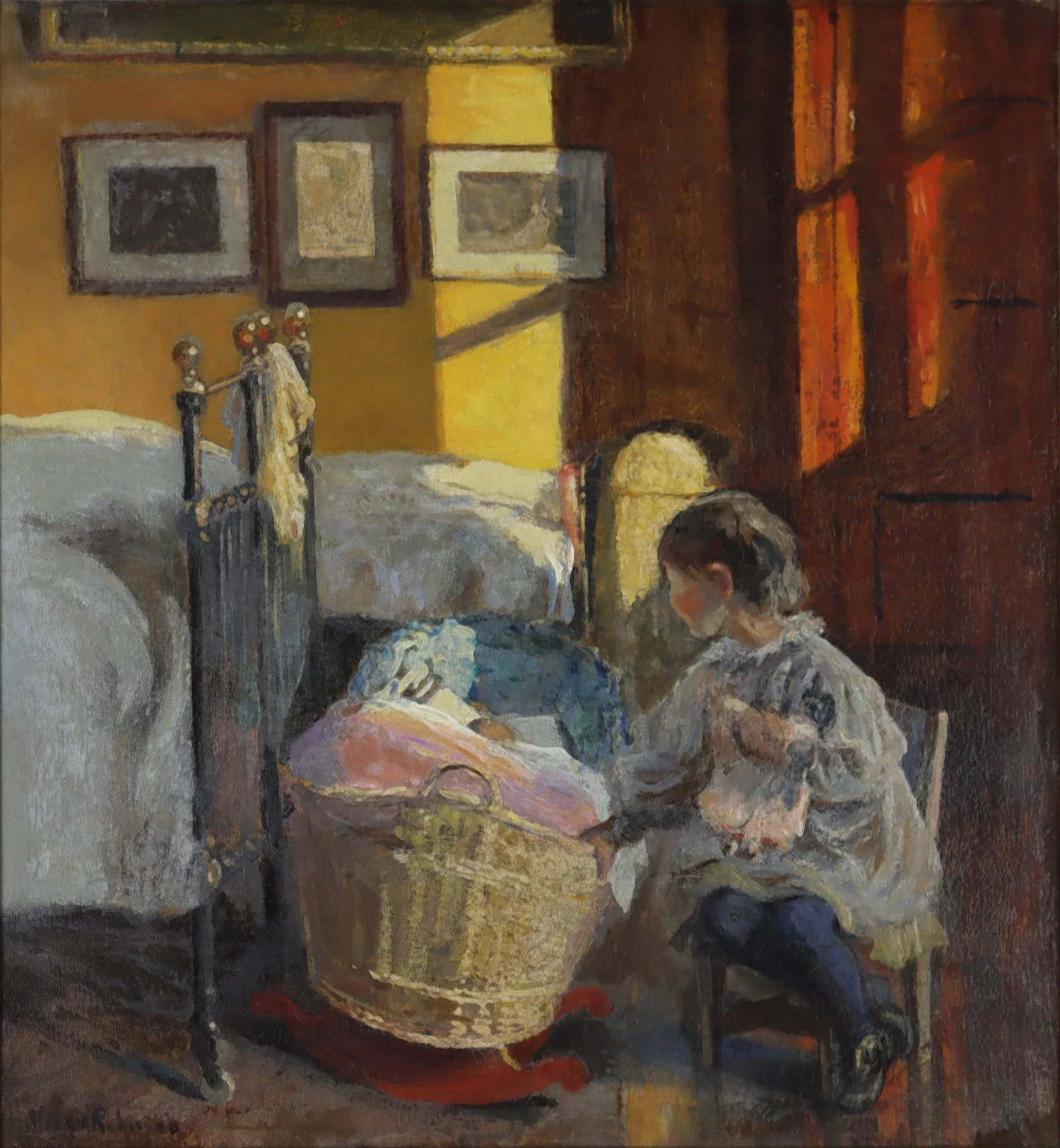
‘By the Cradle’ by Viggo Pedersen (Danish 1854-1926), oil on canvas, signed lower left "Viggo Pedersen", in a Kleis frame. Size: 15.25 h x 14.25 w (with frame 19.25 h x 18.25 w in) J21493
Although undated, this painting most likely depicts one of Viggo Pedersen's children watching the new baby in the cradle. It could be painted in the family home at Karlsberg. Pedersen often painted his five children, four from his first wife Elisbeth and the last from his second wife Johanne.
Well-known Danish artist Viggo Pedersen began his artistic career as a traditional naturalist, following the ‘plein air’ trend of Danish landscape painting in the 1880's. He attended the Royal Danish Academy from 1871 to 1878 and his work was decisively influenced by close contact with the Danish artists P.C. Skovgaard and Janus La Cour. It was under the influence of Skovgaard that Pedersen adopted the bright colours which he often used in his rendering of figures. During his travels throughout Europe he was influenced by the Barbizon School and its Romanticist depictions of rural life in nature. He exhibited widely including with the Danish Royal Academy and the Free Exhibition founded by the Danish Artist’s Association, and is represented in major museums throughout Scandinavia.
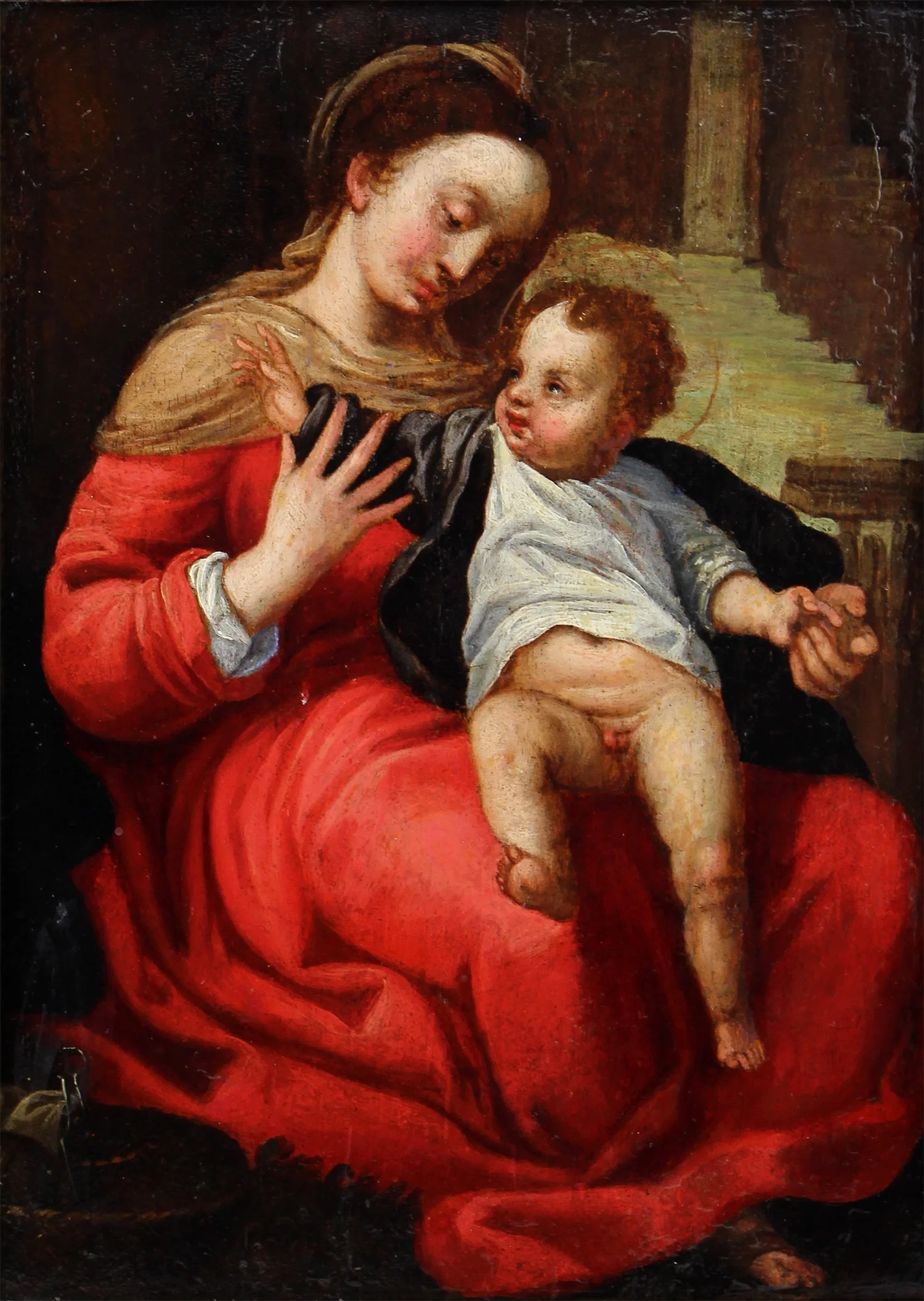
‘The Madonna of the Basket’ Italian School, 17th century, oil on panel, with wax seal on reverse "DIEU ET MON PAYS/IM" ("God and My Country"), copy of Correggio's "The Madonna of the Basket" in the National Gallery London. Size: 12.5 h x 9.25 w (with frame 15.75 h x 12.125 w in) J16744

Bronze Arts and Crafts plant stand, circa 1890, Size in inches: 10.5 h x 11.5 w in. G13241
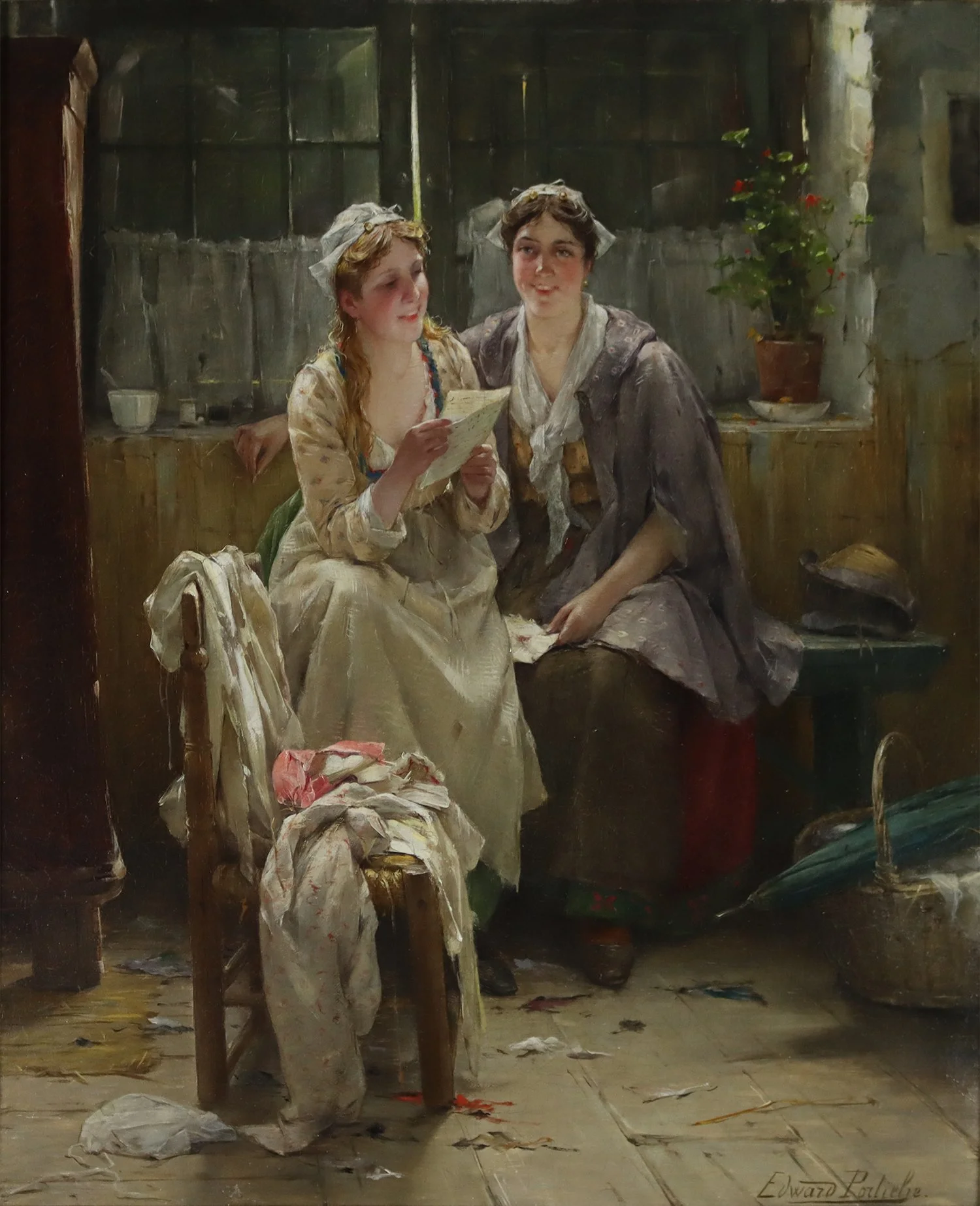
‘The Letter’ by Edward Portielje (Belgian 1861-1949), oil on canvas, signed lower right “Edward Portielje” Size: 18.25 h x 15 w (with frame 22.25 h x 19.25 w in) J21492

Unsigned floral still life, Danish, circa 1830, Size in inches: 18.5 h x 15.25 w (with frame: 22.5 h x 19.25 w in) J21136
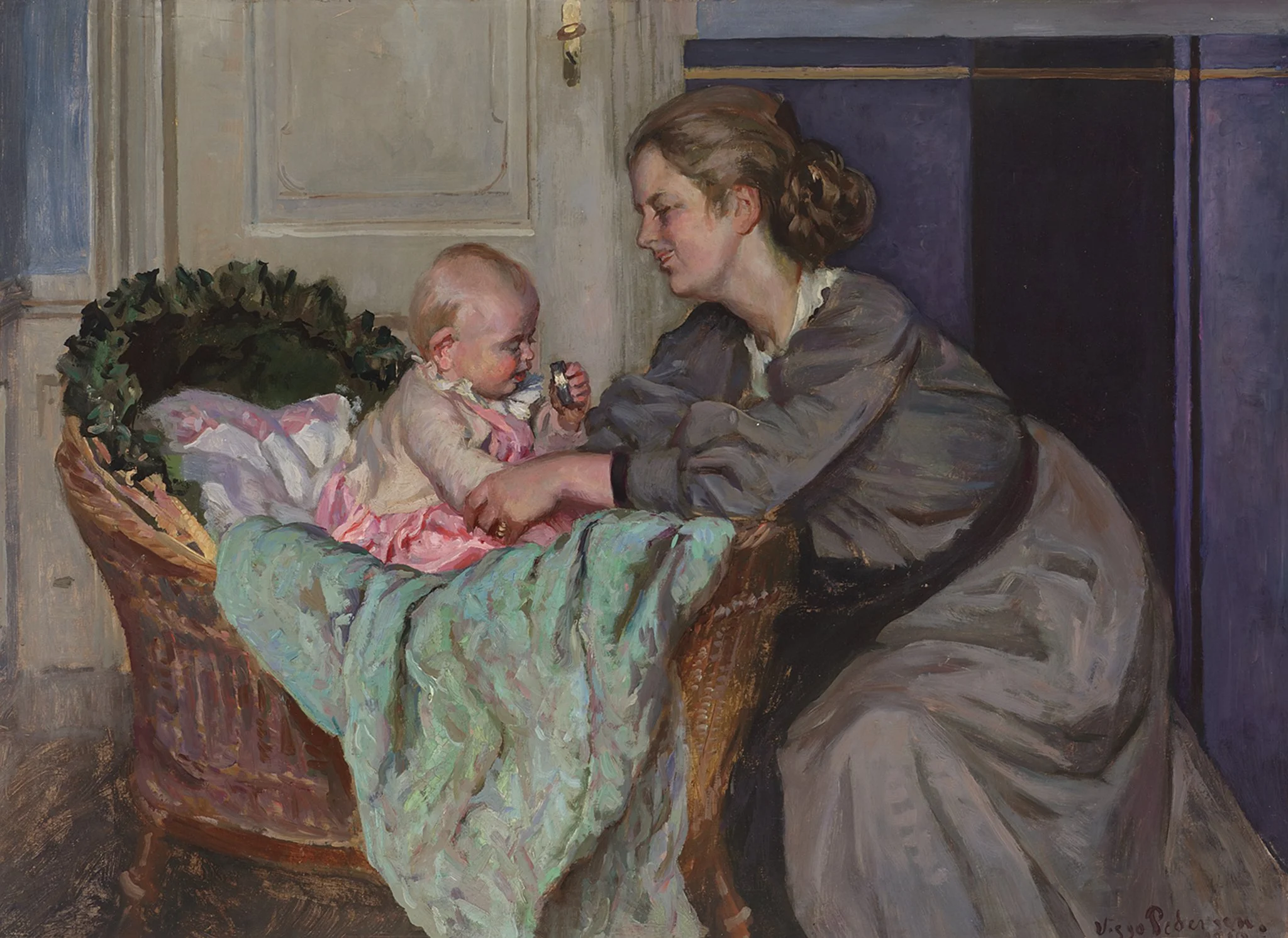
‘The Artist’s Wife and Child’ by Viggo Pedersen (Danish 1854-1926) oil on board, signed lower right "Viggo Pedersen" Size: 22 h x 29.5 w (with frame 28.25 h x 36 w x 2.5 d in) J21239
This painting depicts the artist's first wife Elisabeth with one of their children, possibly Stefan or Johannes. Viggo Pedersen was married to Elisabeth Borup in the early 1880s. She was to have four children with him between 1885 and 1896, Ruth Sora Viggo Pedersen, Christen Jul Viggo Pedersen, Stefan Viggo Pedersen, and Johannes “Ais” Viggo Pedersen. In 1898, the Pedersens moved to one of the structures in the historic Karlsberg estate. When his wife Elisabeth died in 1905 at the age of only 45, Viggo Pedersen remarried to Johanne Louise Aagaard with whom he had one more son, Enoch Viggo Pedersen. The family continued to live at Karlsberg until 1911.
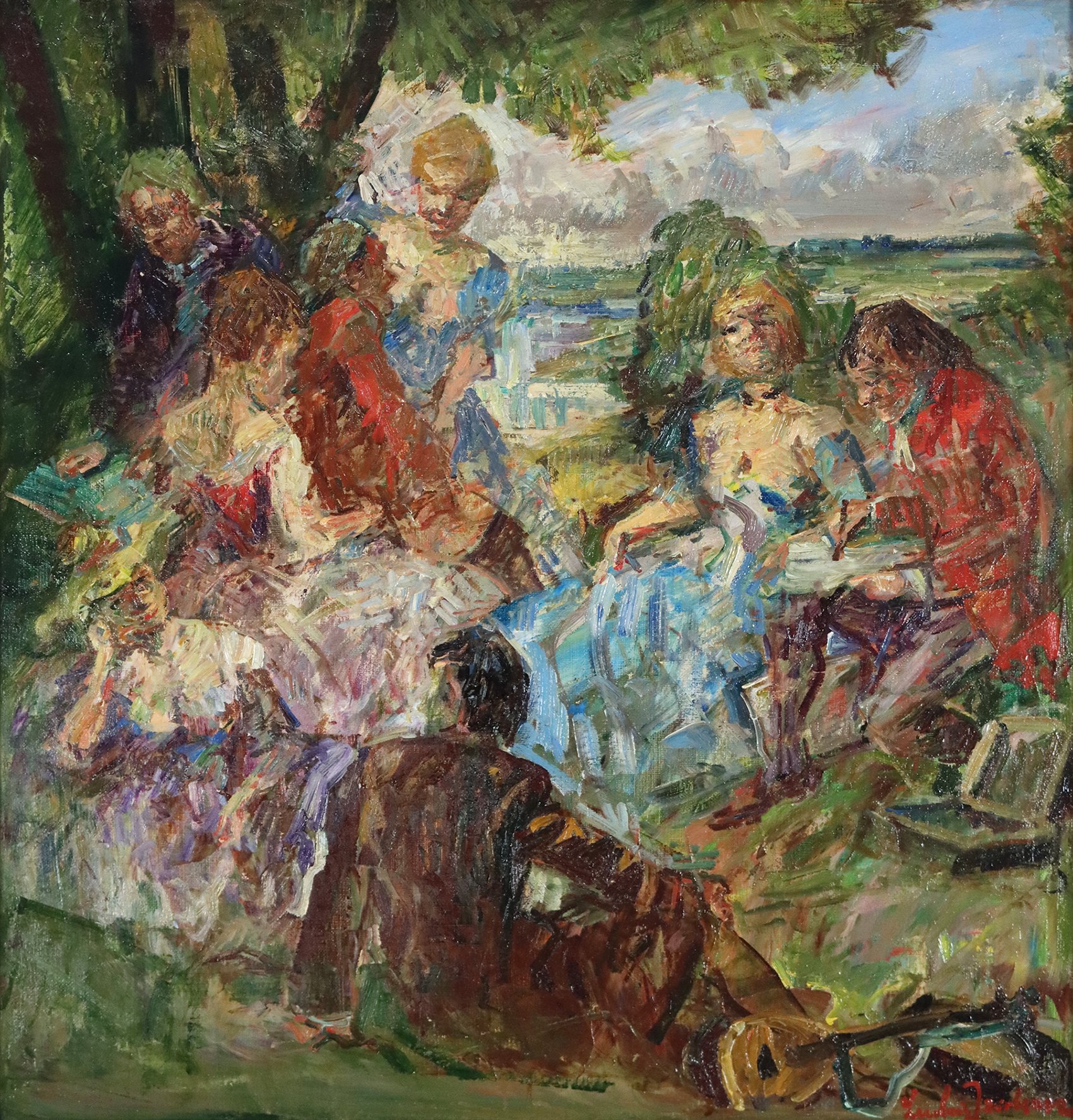
‘Excursion à la Campagne’ Oil on canvas, signed lower right "Ludvig Jacobsen"
Size in inches: 21.25 h x 21 w (with frame: 28 h x 27.25 w x 2 d) J20389

Fine 18th century Rococo iron sewing vice or 'bird', exceptionally carved and decorated with rocaille and floral patterns, complete with pin cushion, inlaid in gold with a stag and dog on the vice, and inscribed "i.i. HANSEN", Size in inches: 7 h in. G20302
These devices first appeared in the 18th century and were commonly used throughout the 19th century. They acted as another hand to firmly hold pieces of fabric in place so that the sewers had both hands free to maneuver the fabric or stitches as needed. The pin cushion on the top helped to keep needed pins in arms reach. As most clothing was produced by hand, these clamps where much needed. Sewing clamps were often given as gifts to young ladies for special occasions like weddings or birthdays. By the end of the 19th century, they had become much more elaborate taking on the shape of animals and including holders for thimbles, spools, and other sewing supplies. They continued in popularity until clothing manufacturing and the sewing machine made them obsolete.

Georg Jensen (Danish, 1866-1935), sterling silver Georg Jensen combined letter opener and bookmark with finial in the shape of a fish, design #198 by Harald Nielsen. The blade is for opening letters, the long chain coming from the mouth of the fish, ending in a small charm, is a bookmark. Stamped Sterling Denmark, 198, George Jensen (post 1945). Size in inches: 4.5 h x 0.625 w (13.75” with chain) C21200

Georg Jensen (Danish, 1866-1935), 133 Piece Cypress Pattern Sterling Flatware, Set of Cypress pattern sterling silver flatware, designed for Georg Jensen in 1953 by famed Norweigian designer Mathias Gerhard "Tias" Eckhoff. C19554
Harald Nielsen (1892-1977) was Georg Jensen’s closest colleague and leading designer. His silver designs define classic Scandinavian style with ageless elegance that transcends time. The younger brother of Georg Jensen’s third wife, Harald Nielsen was drawn into the Georg Jensen silversmithy at the age of 17. He worked his way up to designer of the smithy school of apprentices, becoming director in 1954. His role was particularly important after Georg Jensen died in 1935 as Nielsen insured the continued high quality of the firm’s design by recruiting and training young designers according to Georg Jensen standards. He became artistic director of the company in 1958, a position he held until his retirement in 1962.

Lane Gordon Thorlaksson (Canadian, 1937-2009), Pottery dish with wide flared edge, green and black glaze with custom made base, No. 30-55, Size: 3 ¼" h (5" h with base) x 12 ¾" w in. E19873 SOLD
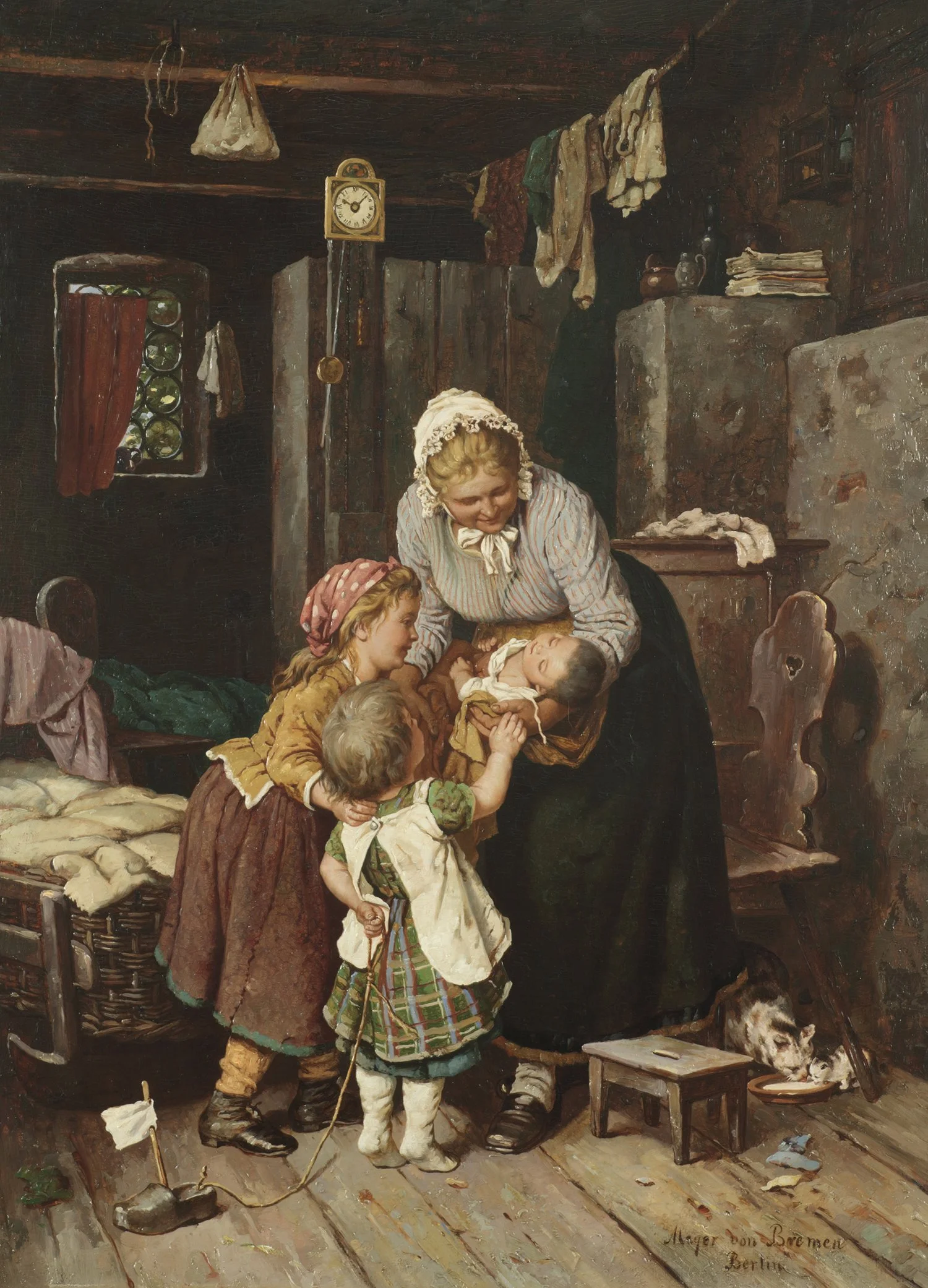
‘Admiring the Baby’ by Johann Georg Meyer Von Bremen (German 1813-1886) oil on panel, signed and inscribed lower right "Meyer von Bremen Berlin" Size: 18 h x 13.25 w (with frame: 24.5 h x 19.75 w in) J20696
“Admiring the Baby” is a superb example of von Bremen’s detailed interiors. Near photographic in its accuracy, the viewer is drawn into the narrative of the family scene where two children are admiring the infant held in their mother’s arms. Painted on wood panel, the details of the interior including the costumes, figures, wooden shoe toy boat, clock, kittens at their bowl are exceptional.
Trained at the Düsseldorf Academy, Meyer von Bremen was known first for his finely detailed religious and allegorical works and later for paintings focusing on family life and peaceful childhood scenes highlighting cultural and regional influences. He was made a member of the Amsterdam Academy of Arts in 1857, later appointed professor, and a member of the Berlin Academy of Art. Very well respected during his lifetime, his idyllic vignettes were extremely popular and widely reproduced in the form of lithographs, engravings and photographs. He exhibited widely and received many awards and accolades including the Order of Leopold and the Gold Medal of Prussia.

Pair of George III brass candlesticks, the fluted tapered neoclassical columns threaded to incurved pyramidal bases, English circa 1800-1820, Size in inches: 8 h in. G20017

Pair of American Sterling silver candlesticks in the Georgian style, with slim baluster stems terminating on notched bases, marked "Crichton and Co. LTD. New York" and "Sterling", Size in inches: 7 h x 4 w x 4 d in. C20394
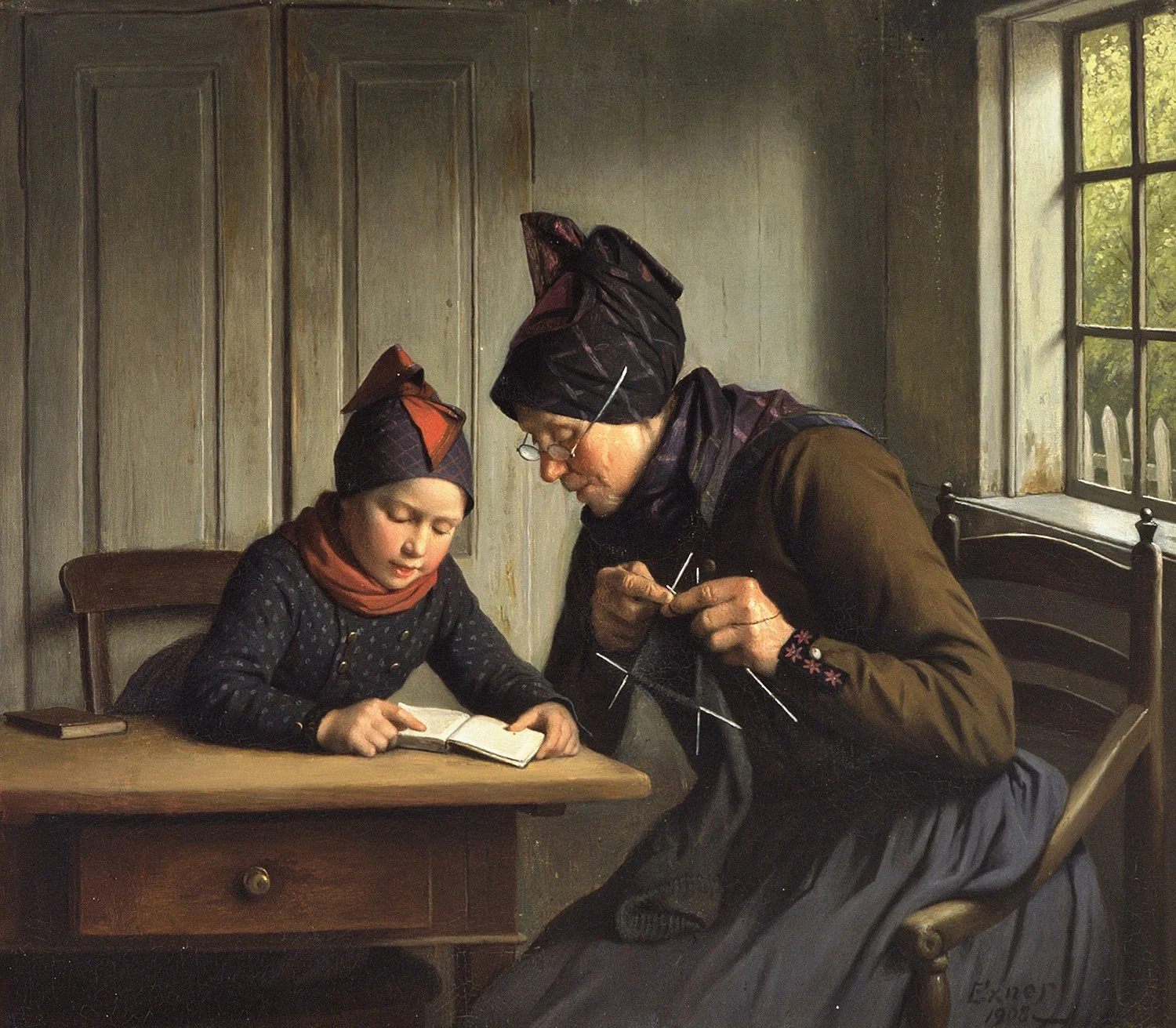
‘The Lesson’ by Julius Exner (Danish 1825-1910) oil on canvas, signed and dated lower right "Exner 1908" Size: 20 h x 23 w (with frame 29.5 h x 32.5 w in) J20925
Danish painter John Julius Exner was born in Copenhagen in 1825 and showed interest in painting and drawing from a young age. He received private instruction prior to being admitted to the Danish Royal Academy, where he studied under Golden Age painter Wilhelm Eckersberg. Exner first exhibited at the Royal Academy where he was well received. He received a travel bursary from the academy which allowed him to travel throughout Europe for two years. In 1864 he became a member of the Royal Academy, member of the exhibition committee of The Danish Royal Academy Charlottenborg in 1879, and head of the committee in 1890. He was also a professor at the Academy from the mid 1870’s and was responsible for teaching many of the students who would go on to form the Skagen painters including Paul Fischer, Vilhelm Hammershøi, Julius Paulsen and P.S. Krøyer. He exhibited widely including at the Charlottenborg Spring exhibition almost every year from 1844 until his death in 1910.
Exner’s early work consisted mostly of historical subjects and portraits before he was encouraged to depict regional Danish subjects in the new nationalistic art movement. He discovered Amager, an island south of Copenhagen settled in 1521 by Dutch farmers whose lifestyle and traditions were little known to the rest of Denmark. Exner’s romantic depictions of the villagers propelled him to even greater recognition, and many of his works were reproduced as prints. Exner’s painted in Amager for many years, and as he became more skilled his works expanded to combine interiors and landscapes and include larger groups and traditional costumes. His paintings offered the Danish public the opportunity to learn about a community that they knew little about, and they were fascinated. His work encompassed a strong sense of patriotism and he expanded his subjects to other small villages and communities throughout Denmark including the island of Fano where he would spend summers with his family capturing a way of life quickly being lost to industry and social change.

Child's wooden painted rocking toy, late 19th century, Size in inches: 13.5 h x 35 w in. M20393

Robert Davidson (Haida/Canadian, b. 1946), Dogfish Oval Pin, silver, inscribed "Davidson '71", Size in inches: 1.87 h x 2.5 w in. R20412

Robert Davidson (Haida/Canadian, b. 1946), Bear Bracelet, Silver, inscribed "Haida Art Davidson", Size in inches: 1.25 h x 3 w x 2.25 d in. R20410
The internationally renowned visual artist, carver and jeweler Robert Davidson is credited with a reawakening of the Haida culture. He began his carving career at the age of 13, and was majorly influenced by his great-grandfather Charles Edenshaw and his grandmother Florence Davidson who had 13 children, providing a large number of ‘aunties’ to whom Robert was very close. Robert met Bill Reid in 1966 with whom he would develop a lasting relationship and during his apprenticeship learn the fundamentals of two-dimensional design…read more.

Pair of Danish silver sauce pots or brandy warmers with ebony handles, stamped with Copenhagen three tower mark (.826) and dated 1958, Size in inches: 1.75 h x 5 w x 8.25 d in. C20355

Large round Danish Art Deco sterling silver bowl with flat lined rim, stamped with Copenhagen three tower mark (.830) and dated 1937, and assayer's mark for Johannes Stittgard (1832-1960), inscribed "Lis og David Ker 18-6-1960 Mormor." Small dent in bowl. Size in inches: 12.5 h x 12.5 w x 2.5 d in. C20353

Scottish sterling silver stuffing spoon, fiddle pattern, marked for Edinburgh 1809 & maker Alexander Henderson, Size in inches: 12 ½ x 2 in. C20345
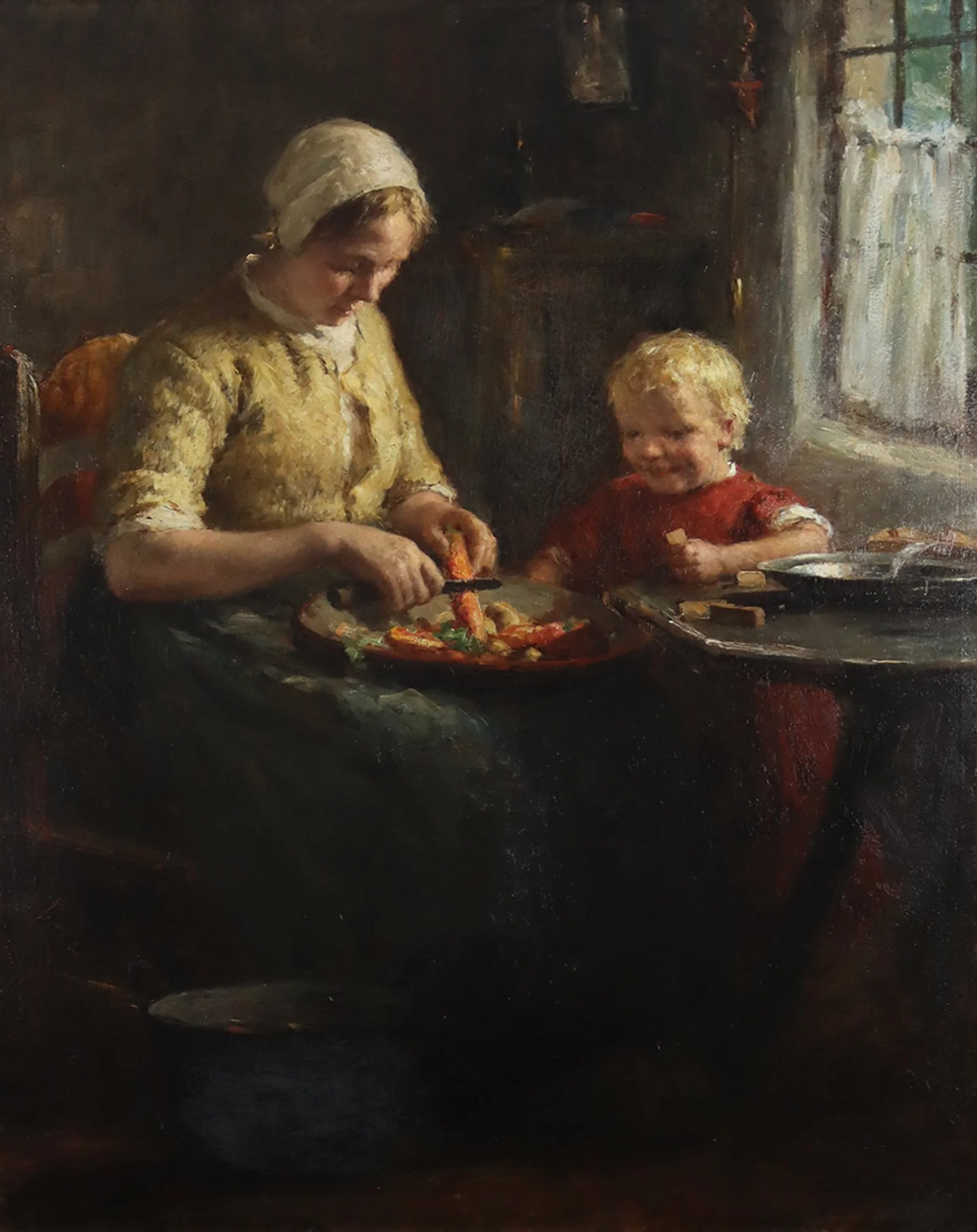
‘Mother and Child Peeling Carrots’ by Evert Pieters (Dutch 1856-1932) oil on canvas, signed lower right "E. Pieters" Size: 48 h x 36 w (with frame 63 h x 50.5 w in) J 20928
Dutch artist Evert Pieters is best known for his genre scenes depicting local fishing and farming communities, including mothers and children playing, inspired by the villages he lived in. Born into a poor family in Amsterdam, he originally apprenticed as a house painter before moving to Antwerp, Belgum, where he studied at the Royal Academy. He began painting interiors and still lifes to support himself while he continued an apprenticeship with the artist Theodoor Verstraete. He moved frequently between Belgium and the Netherlands, marrying in 1895 and settling in France. Here, he was introduced to the work of the Barbizon School and the Impressionists which influenced his handling of light. He moved back to the Netherlands in 1897 and by 1917 had settled in Laren where he created a set in his studio of a farmhouse interior and planted a decorative garden to use as a background for his paintings. He exhibited widely and won many awards, and his work very successful with American collectors. Today his work can be found in museums and institutions throughout Europe and America.